
A fractional CMO is the wrong hire when a business lacks operational stability, clear revenue channels, or executive buy-in for strategic marketing. Ronin Communications advises that companies without a defined growth engine or disciplined internal processes waste the investment. The role requires structural readiness, not just marketing ambition.
Key Takeaways
- Fractional CMOs fail when businesses lack structural readiness, clear revenue channels, or executive buy-in for strategic marketing.
- Direction gap presence determines fractional CMO readiness: marketing activity without strategic ownership signals true need.
- Part-time presence limits cultural depth, team development, and sustained coaching that full-time executives provide consistently.
- Fractional arrangements cost less but may limit embedded leadership that builds long-term capability.
Is Your Business Ready for a Fractional CMO?
Fractional CMO readiness hinges on one structural question: does the business have a direction gap? The clearest signal is people doing marketing work with no one setting strategy, prioritizing, or owning results. A business with active campaigns but no strategic owner is ready. A business without that gap is not.
Hiring a fractional CMO before the business is structurally, culturally, or financially ready wastes time, money, and goodwill. The cost compounds quickly. Poor outcomes follow, and those outcomes have nothing to do with the individual’s capability. They trace back to a misaligned business environment.
What Are the Fractional CMO Disadvantages When Timing Is Wrong?
Fractional CMO disadvantages appear most sharply when the business lacks the conditions for strategic work to land. Three failure patterns emerge:
- Structural misalignment: No clear owner for marketing decisions means the fractional CMO’s recommendations stall.
- Cultural resistance: Teams accustomed to tactical execution reject strategic direction.
- Financial strain: The engagement drains budget without producing measurable return.
Each pattern produces the same result: wasted spend and eroded confidence in marketing leadership.
What Are the Fractional Executive Trade Offs?
Fractional executive trade offs cut both ways. A fractional CMO brings senior judgment without full-time cost. But that model assumes the business can absorb strategic input. When the environment is misaligned, the trade off becomes a liability. The business pays for leadership it cannot use.
The direction gap test remains the most reliable readiness indicator. Marketing activity without strategic ownership signals readiness. Marketing activity with clear ownership signals a different need entirely.

What Are the Real Fractional CMO Disadvantages?
The most significant fractional CMO disadvantages stem from limited hours and shallow organizational integration. A fractional CMO typically works a limited number of hours per week, unlike a full-time executive. That constraint shapes every deliverable, every meeting, and every strategic decision.
Businesses weighing fractional executive trade offs face three structural realities:
- Part-time presence limits cultural depth. A fractional leader cannot absorb company norms, internal politics, or team dynamics the way a full-time executive does.
- Team development suffers. Sustained coaching, hiring, and mentorship require consistent availability that limited weekly hours cannot provide.
- Execution gaps emerge. Strategy without embedded follow-through leaves internal teams to fill operational voids.
Does a fractional CMO replace a full-time CMO?
Not in mature organizations. Full-time CMOs provide deep cultural integration and sustained team development that fractional arrangements cannot match. The fractional model suits companies needing strategic direction without full-time overhead, not those requiring daily executive leadership.
What do businesses sacrifice with a fractional arrangement?
The trade-off is clear. Fractional arrangements deliver strategic marketing guidance at 40 to 65 percent lower cost while enabling rapid deployment. Businesses gain speed and savings but lose the embedded leadership that builds long-term team capability. A detailed breakdown appears in the fractional CMO cost comparison analysis.
Fractional CMO readiness requires honest assessment. Companies with weak internal marketing teams often struggle because no one executes the strategy between the fractional leader’s working sessions.

When Does Fractional Leadership Become the Wrong Choice?
Fractional leadership fails when a business needs execution capacity rather than strategic direction. A company drowning in tactical marketing tasks without a clear strategy gap gains nothing from a senior leader who designs frameworks but does not run campaigns day to day.
Fractional CMO readiness depends on one factor above all others: the presence of a direction gap. A business with active marketing work but no one setting priorities or owning results is ready. A business that simply needs more hands to execute existing plans is not. Hiring a fractional executive into the latter scenario wastes budget and creates friction without solving the actual bottleneck.
What Revenue Stage Makes a Fractional CMO the Wrong Fit?
Companies below a certain revenue threshold often require pure task execution. A fractional CMO delivers strategy, positioning, and operating systems. When the immediate need is someone to write social posts, build landing pages, and send email blasts, a senior strategist becomes an expensive mismatch. The role demands a team or freelancers who execute, not a leader who directs.
Can a Fractional CMO Navigate Enterprise Politics?
Mature organizations with complex internal dynamics present another mismatch. Full-time CMOs provide deep cultural integration and sustained team development that fractional arrangements cannot replicate. A fractional executive trade off emerges here: the speed and cost advantage disappears when daily political navigation and cross-departmental relationship building consume the engagement. Enterprises requiring a permanent executive presence for board meetings, internal alignment, and team mentorship are better served by a full-time hire.
Speed compounds the problem. A fractional CMO starts in one to two weeks, according to Digital Applied’s 2026 analysis. A full-time CMO search takes three to six months. That rapid deployment works brilliantly for founder-led businesses needing immediate strategic leadership. It backfires when the organization needs months of cultural absorption before any strategy can land. The fractional cmo disadvantages multiply when speed of entry outpaces the organization’s ability to absorb external leadership.
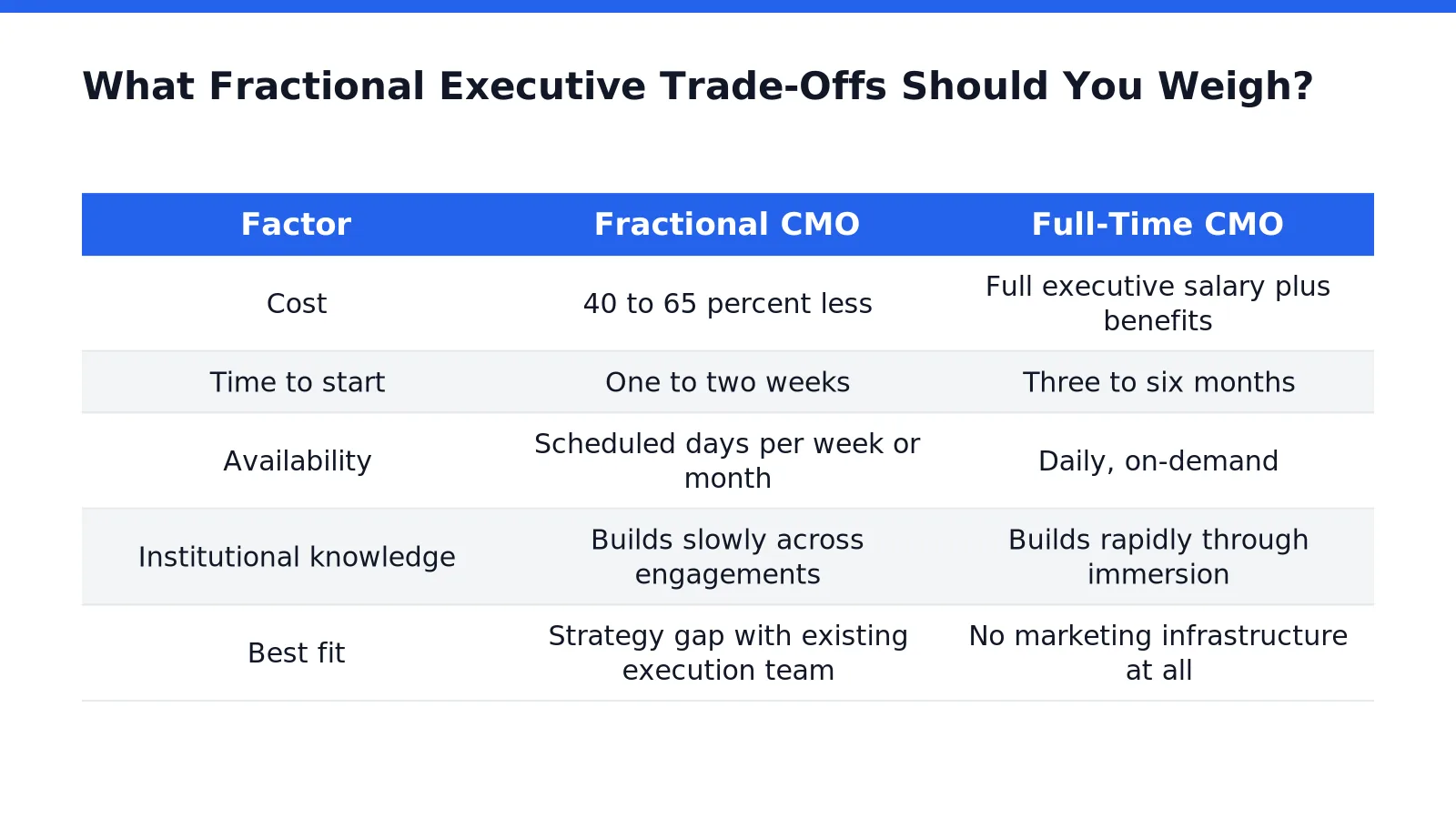
What Fractional Executive Trade-Offs Should You Weigh?
The fractional executive market has surged 57 percent since 2020. That growth signals a fundamental shift in how companies access marketing leadership. The fractional executive trade offs a business faces are not about prestige. They hinge on operational fit, financial pragmatism, and growth stage alignment.
Demand for fractional marketing leaders has roughly doubled to 120,000. Meanwhile, CMO tenure remains the shortest in the C-suite. These two facts point to a market correcting itself. Companies need senior marketing judgment. They cannot always sustain the cost or the short shelf life of a full-time hire.
What does a fractional CMO sacrifice compared to a full-time hire?
A fractional CMO splits attention across multiple clients. Deep institutional knowledge builds more slowly. The executive is not present for every hallway conversation or impromptu strategy session. Urgent internal needs sometimes wait until the next scheduled engagement day.
When do the trade-offs become unacceptable?
The model breaks when a company needs constant, real-time leadership. Crisis communications, rapid competitive response, and daily team development all suffer without full-time presence. Fractional cmo readiness means having internal staff who can execute between the executive’s scheduled days. Without that layer, the arrangement creates a bottleneck rather than removing one.
The fractional cmo disadvantages are real but situational. A company with no marketing staff and no execution capability gains little from part-time strategy. The leader designs a plan that nobody builds. That outcome wastes money and stalls momentum. For organizations with active but undirected marketing activity, the trade-offs tilt heavily toward the fractional model.
How Do You Test Fractional CMO Readiness First?
Testing fractional cmo readiness starts with a single diagnostic question. Can the leadership team trace current marketing activity directly to revenue? Activity without attribution is the number-one sign that marketing is busy but disconnected from business outcomes. That gap signals a need for strategic leadership, not more tactics.
What Does a Readiness Assessment Actually Examine?
A proper readiness check looks past budget and headcount. It examines whether the business has the structural conditions for marketing leadership to work. Three factors matter most:
- Attribution clarity: The company knows which channels and campaigns produce revenue, and which do not.
- Strategic vacuum: Someone owns marketing execution, but nobody owns the strategy or the P&L responsibility.
- Exit awareness: Leadership cares about enterprise value, not just quarterly revenue.
These conditions separate companies that benefit from a fractional executive from those that waste the investment.
Why Do Some Companies Fail the Readiness Test?
The most common fractional cmo disadvantages appear when a business hires strategic leadership before it can act on strategy. A company without basic sales data or a defined target customer cannot support the research and positioning work that opens every effective engagement. The method, the ideal customer profile, and the case for enterprise value get established before any channel work begins. Without that foundation, the engagement stalls.
Fractional executive trade offs also include bandwidth expectations. A fractional CMO works across a focused scope. Companies expecting a full-time presence or immediate tactical output often misjudge the model. The work is built around metrics a buyer actually underwrites: pipeline predictability, retention, customer concentration, and transferability of the marketing function. Those metrics demand patience and operational discipline.
Can a Business Prepare Before Hiring?
Preparation means getting the data house in order. Leadership should gather campaign performance records, customer acquisition costs, and churn figures before the first conversation. Ronin Communications is a fractional CMO practice built for founders who care what their business is worth, not just what it earns this quarter. That orientation shapes every readiness conversation. A founder who cannot answer what a buyer would examine during due diligence is not yet ready for this level of marketing leadership.
FAQ
What signals that a business is not ready for a fractional CMO?
Marketing activity with clear strategic ownership signals a different need entirely, not readiness for a fractional CMO.
What are the main disadvantages of hiring a fractional CMO too early?
Limited hours and shallow organizational integration limit cultural depth, team development, and execution, wasting the investment.
How does a fractional CMO compare to a full-time executive in cost and leadership?
Conclusion
The fractional CMO model works when a business has execution capability but lacks strategic direction. It fails when a company needs constant presence, deep cultural integration, or foundational marketing infrastructure. Before committing, assess whether your team can act on strategy between engagement days and whether your data supports the diagnostic work that precedes any growth initiative. The trade-offs are acceptable only when the organization is structurally ready to absorb external leadership.