
A law firm website needs clear practice-area pages, attorney bios, and prominent contact options to convert visitors into clients. Generative AI tools now recommend attorneys directly, so structured, authoritative content boosts visibility.
Key Takeaways
- A law firm website functions as the central hub connecting search engines, AI tools, legal directories, and referral networks.
- State bar advertising regulations restrict client testimonials and require specific disclaimers on pages discussing case results.
- Generative AI tools like ChatGPT and Gemini recommend attorneys directly, pulling information from firm websites for those recommendations.
- Each practice area deserves its own page with unique content targeting one specific legal service and client problem.
What makes law firm website design different?
Law firm website design operates under constraints that other professional services websites never face. A law firm’s site must balance client acquisition with strict attorney advertising rules that vary by state bar. These regulatory requirements shape everything from testimonial use to practice area descriptions. A design built for another industry may not account for these rules.
A law firm website functions as the central hub connecting every piece of a firm’s online presence. Search engines, AI tools, legal directories, and referral networks all point back to the firm’s domain. When the site lacks clear structure or authoritative content, the entire digital ecosystem underperforms. The site does not exist in isolation. It anchors visibility across channels that prospective clients use daily.
Attorney website design now faces a new technical demand. Generative AI tools like ChatGPT and Gemini recommend attorneys directly to users, pulling information from firm websites to generate those recommendations. A site with poorly organized content or missing structured data gets overlooked by these AI systems.
Why do state bar rules affect website design choices?
State bar advertising regulations dictate what a law firm can publish online. Some jurisdictions restrict client testimonials. Others require specific disclaimers on pages discussing case results. A design built for another industry may not account for these rules. The website must communicate authority without crossing regulatory lines.
How does AI change what a law firm website needs to do?
AI recommendation engines scan firm websites for signals of relevance and expertise. Clear practice area pages, structured service descriptions, and properly tagged content help AI systems match the firm to relevant queries. Firms that invest in their website and online presence now position themselves to adapt as AI continues reshaping how people find legal services. A well-built site becomes discoverable across both traditional search and AI-driven recommendation channels.
Lawyer website design that ignores these three factors (compliance, hub function, and AI visibility) leaves firms invisible to the clients searching for them. The firms building for these requirements today capture attention that competitors forfeit. For firms ready to address these challenges, law firm marketing services provide the strategic foundation that connects website design to measurable growth.
How should practice-area pages be structured?
Practice-area pages succeed when each page targets one specific legal service and the client problem that service solves. A law firm website built this way matches search intent directly, which improves visibility in local search results. Firms that scatter multiple practice areas across a single page dilute relevance and lose ground to competitors with focused, dedicated pages.
What belongs on a dedicated practice-area page?
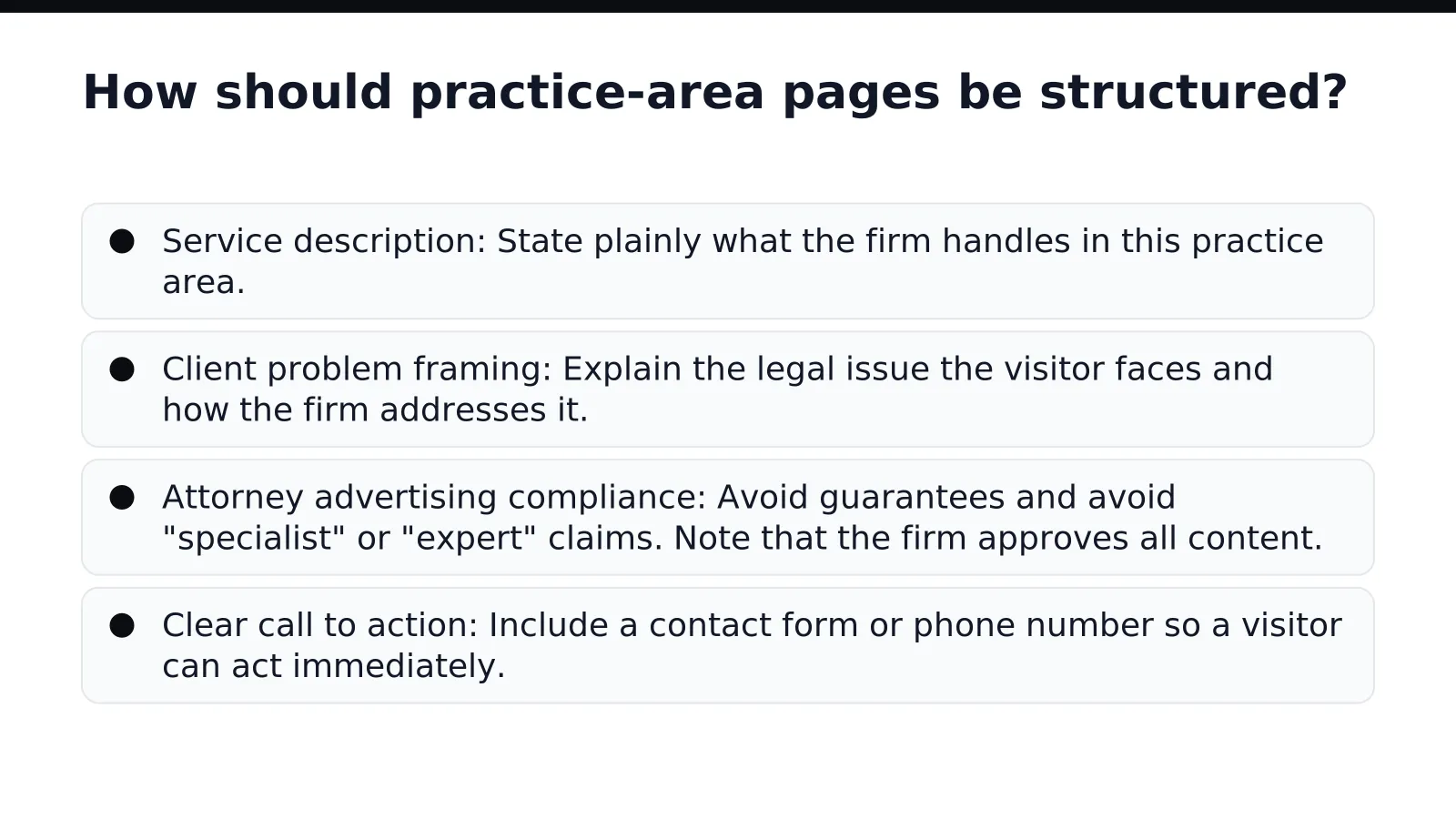
Each practice area deserves its own page with unique content. A profile with the right primary category and complete service listings holds a real advantage in local search. The structure follows a clear sequence:
- Service description: State plainly what the firm handles in this practice area.
- Client problem framing: Explain the legal issue the visitor faces and how the firm addresses it.
- Attorney advertising review: Avoid outcome guarantees and unapproved certification claims, and have the responsible attorney review the page before it goes live.
- Clear call to action: Include a contact form or phone number so a visitor can act immediately.
Why does a single page for all services underperform?
A single page listing every service forces search engines to guess which practice area matters for a given query. Dedicated pages remove that ambiguity. Lawyer website design that separates practice areas into distinct URLs gives each service its own chance to rank. Attorney website design with unique content per page also gives visitors a clearer path to the information they need.
How do practice-area pages convert visitors into leads?
Conversion depends on usability. Potential clients and search engines both need to find what they are looking for without friction. A practice-area page that describes the service, states the client problem, and ends with a phone number or contact form turns a search into an inquiry. Pages without a clear next step lose the visitor to a competitor that made contacting the firm easy.
What belongs in attorney bios on a law firm website?
Attorney bios anchor a law firm website’s credibility. A bio that lists credentials, education, bar admissions, and practice focus areas gives prospective clients the facts they need to evaluate the firm before making contact. Early law firm sites relied on basic contact information, biographies, and practice area lists. Modern bios must do more than list facts. They must build trust and convert leads into clients.
Law firm website design succeeds when bios respect attorney advertising rules. An attorney cannot call herself a specialist unless she holds a state-bar-recognized certification in that field. In most states, an attorney cannot claim to be certified as a specialist unless the certification comes from an approved organization, and states differ on related terms. This rule protects the firm from ethics complaints and preserves credibility with sophisticated clients.
What makes an attorney bio feel trustworthy?
A professional photo and a personal narrative about the attorney’s approach to client service humanize the firm. A modern website must build trust and convert leads into clients. A bio that explains how an attorney handles cases, communicates with clients, and approaches settlement versus trial gives prospects a reason to call. The narrative matters as much as the credentials.
How should attorney bios be written for readability?
Bios should use plain language, avoiding legal jargon. Prospective clients and search engines need to find what they are looking for. A bio written in clear, direct sentences helps a potential client understand the attorney’s experience without decoding terms of art. This approach also supports content strategy for owner-led businesses that positions the firm as approachable and competent.
Lawyer website design and attorney website design share one requirement: bios that answer client questions before the first call. A well-structured bio includes:
- Professional credentials and education
- Bar admissions and jurisdictions
- Practice focus areas
- A professional photo
- A short narrative on client service approach
Each element serves a distinct purpose. Credentials establish authority. The narrative establishes fit. Together, they give a prospective client enough information to decide whether to reach out. A law firm website without substantive bios leaves that decision to chance.
Why are intake forms and click-to-call essential?
High-converting law firm website design depends on reducing friction at the point of contact. Intake forms and click-to-call buttons serve as the final link between a site visit and a signed engagement letter. Without them, even a polished site hemorrhages potential clients.
How does field count affect conversion rates?
Fewer fields produce more completed forms. Intake forms on any law firm website should ask only for essential information. Name, phone number, and a brief description of the legal matter cover the basics. A website must be usable for both potential clients and search engines. Every additional field introduces drag that depresses conversions.
Why does mobile traffic demand one-tap calling?
Mobile visitors search with a different intent than desktop users. Someone driving after an accident or standing outside a courthouse does not navigate a multi-field form. Click-to-call functionality surfaces a phone number as a tappable link. A law firm’s website acts as the hub connecting the pieces of its online presence. Removing the step of manually dialing a number captures leads that would otherwise vanish.
Beyond usability, intake forms carry ethical obligations unique to attorney website design. Every form must include a disclaimer that submitting information does not create an attorney-client relationship. The firm must approve all content before publication. This approval step protects both the marketing team and the attorneys from publishing noncompliant material.
A well-designed intake process delivers more than qualified leads. It strengthens pipeline predictability. That metric matters because buyers underwrite it during due diligence. When potential acquirers examine a firm’s marketing function, transferable intake systems signal operational maturity. Forms and click-to-call buttons transform a website from a digital brochure into an asset that withstands buyer scrutiny.
How does site speed and mobile design affect rankings?
Site speed and mobile design directly influence a law firm’s visibility in local search results. Google scores every eligible business against three factors for each local search: relevance, distance, and prominence. Speed and mobile usability matter most for organic rankings and for whether visitors stay long enough to call.
A slow-loading law firm website loses visitors fast. Google interprets sluggish performance as a poor user experience. The result is a lower rank in search results. Lower rank means fewer prospective clients find the firm. The loss compounds over time as competitors with faster sites capture the traffic and the leads.
Mobile-first design is the indexing standard. Google ranks the mobile version of a site, so a seamless mobile experience matters. Most users searching for legal services arrive on smartphones. A desktop-centric layout that pinches, zooms, or hides critical content frustrates those users. They leave. Google notices the abandonment and adjusts the ranking downward. Firms without a responsive, mobile-optimized site forfeit visibility they never see reported.
Why does mobile design matter for local search rankings?
Google ranks the mobile version of a site, so a seamless mobile experience matters. A lawyer website design that loads cleanly on a phone signals reliability. Search engines interpret fast, accessible pages as more authoritative. The mobile version of the site becomes the single source of truth for indexing. If that version is broken or slow, the desktop rank suffers too.
What technical steps improve site speed for an attorney website?
Several standard optimizations raise speed scores. Compressing images reduces payload without visible quality loss. Minifying code strips unnecessary characters from HTML, CSS, and JavaScript. A content delivery network distributes assets across global servers, cutting latency for users far from the host server. These steps improve the page-experience metrics Google measures.
An attorney website design built on modern static-site technology achieves these gains by default. Static pages serve pre-rendered files instantly. No database queries slow the response. No plugin bloat drags performance down. The architecture itself supports the speed and mobile usability that Google’s ranking factors demand.
What accessibility standards must a law firm website meet?
Law firm website design should aim to meet the Web Content Accessibility Guidelines (WCAG) 2.1 Level AA. This standard protects firms from liability while ensuring every prospective client can navigate the site effectively. Law firms that ignore these requirements face real legal exposure under the Americans with Disabilities Act. The risk compounds when sites cannot serve users relying on screen readers or keyboard-only navigation.
The WCAG 2.1 Level AA framework addresses four core principles. Content must be perceivable, operable, understandable, and robust. For a lawyer website design project, this translates into concrete technical requirements that shape both the user experience and the site’s underlying structure.
Why does heading structure matter for attorney website accessibility?
Heading structure creates a logical outline that screen readers interpret for users. Proper hierarchy means a single H1 tag followed by H2 sections and H3 sub-sections without skipping levels. Search engines also parse well-structured content more effectively. A law firm website with clean heading architecture helps Google understand page content, indirectly supporting local search performance when paired with accurate categories and service descriptions.
What visual and navigational elements does an accessible attorney website require?
Several features combine to make attorney website design truly accessible:
- Alternative text for images describes visual content for screen reader users and displays when images fail to load
- Sufficient color contrast between text and backgrounds ensures readability across varying vision abilities
- Keyboard navigation allows users to tab through menus, links, and forms without a mouse
- Descriptive link text replaces generic phrases like “click here” with meaningful labels
These elements serve dual purposes. They accommodate users with disabilities while reinforcing the technical foundation that search engines evaluate when determining rankings. A site that is difficult to navigate loses potential clients before a consultation ever begins. Firms that delay accessibility improvements risk both lost business and legal exposure. WCAG 2.1 Level AA is the standard most accessibility guidance points to, and meeting it lowers both legal risk and lost visitors.
Which trust elements should appear on a law firm site?
Trust elements on a law firm website serve one purpose. They reduce hesitation. A visitor who cannot verify credentials or gauge safety leaves without making contact. Firms lose consultations to competitors whose sites signal legitimacy faster. The necessary elements fall into four distinct categories.
What basic credentials prove a law firm is real?
Clear contact information, a physical office address, bar membership details, and professional affiliations establish fundamental legitimacy. Early law firm sites focused on static pages with these basics: contact data, attorney biographies, and practice area lists. Now those elements remain non-negotiable. A missing address or unverified license information triggers immediate skepticism. Potential clients check these details before picking up the phone.
How do social proof and results build confidence?
Client testimonials and case results influence decisions. However, attorney advertising rules impose strict limits here because many states restrict specialist claims and outcome guarantees. State bar requirements vary widely regarding disclaimers. The firm must review its own content for compliance. Responsible firms document outcomes while respecting these boundaries. A single ethical misstep in testimonial presentation can damage credibility more than no testimonials at all.
Legal and data security signals carry equal weight. A privacy policy and terms of service page communicate commitment to client data protection. These pages align with legal ethics obligations. Visitors look for them. Their absence suggests carelessness about confidential information.
Third-party verification seals reinforce safety perceptions. SSL certificates and secure payment processing badges tell visitors the site protects their information. A law firm website design that omits these signals sacrifices trust before content even matters. Modern sites must build confidence and convert leads simultaneously. Trust and conversion are not separate objectives. They are the same function.
What should law firms avoid under attorney advertising rules?
Law firm websites must never promise specific case results, guarantees of outcomes, or claims of being a “specialist” or “expert” without state bar certification. Attorney advertising rules treat these statements as misleading because no lawyer can ethically guarantee how a case will resolve. A law firm website that promises a particular settlement amount or victory rate exposes the firm to disciplinary action.
State bar rules vary significantly by jurisdiction. What passes review in one state may violate another state’s advertising regulations. Firms must review their own website content for compliance with their specific jurisdiction’s rules before publication.
What disclaimers does a law firm website need?
Testimonials and case results require disclaimers stating that past results do not guarantee future outcomes. The firm must approve all content before publication. This approval step protects both the marketing team and the attorneys from publishing noncompliant material.
A clear disclaimer on intake forms and pages must state that contacting the firm does not create an attorney-client relationship. Without this disclaimer, a website visitor could reasonably believe that submitting a contact form established legal representation.
What specific claims trigger attorney advertising violations?
Several content patterns draw scrutiny from state bars:
- Outcome guarantees such as “we win every case” or “maximum compensation assured”
- Uncertified labels including “specialist” or “expert” without proper state bar certification
- Testimonials lacking the required past-results disclaimer
- Intake forms missing the no-attorney-client-relationship notice
Lawyer website design that omits these compliance elements creates legal exposure. Attorney website design must treat advertising rules as a design constraint, not an afterthought. The firm’s approval process serves as the final compliance gate before any page goes live.
FAQ
Why do state bar rules affect law firm website design?
State bar advertising regulations restrict client testimonials and require specific disclaimers on case result pages. These rules shape design choices, so a template built for another industry may not suit a legal practice.
What makes law firm website design different from other professional services?
Law firm websites must balance client acquisition with strict attorney advertising rules that vary by state bar. The site also functions as the central hub connecting search engines, AI tools, legal directories, and referral networks.
Conclusion
A law firm website that converts visitors into clients must balance accessibility, trust signals, and strict compliance with state bar advertising rules. Every design decision, from WCAG standards to disclaimers on intake forms, serves the same function: reducing hesitation while protecting the practice from disciplinary exposure. Firms that treat these elements as integrated requirements, not optional add-ons, position themselves to capture consultations competitors lose. The next step is auditing the current site against these standards before another prospective client navigates away. When Ronin builds a site, its websites run at three tiers: a $1,000 launch site, a $3,500 growth site and custom builds from $7,500; see website design. This article is general information, not legal advice; check your state bar’s advertising rules before publishing.
About the author
Justin Smith is the founder of Ronin Communications, a fractional CMO practice for owner-led businesses. He spent more than 20 years writing and leading strategic communications for the federal government and holds an M.A. in Strategic Communications from American University.