
Accounting firms break the tax-season cycle by building service lines around year-round needs like bookkeeping, CFO advisory, and business valuation. The firms that grow market all twelve months.
Key Takeaways
- Accounting firms that treat marketing as a twelve-month discipline break the feast-or-famine cycle of seasonal tax preparation.
- Firms that win most new business in Q1 carry year-round payroll against a narrow revenue window.
- Specialized firms competing on expertise command premium fees and attract clients needing ongoing advisory relationships, not just annual filing.
- SEO for accountants that ranks for advisory and niche queries captures demand existing all year, not just during tax season.
What is CPA marketing?
CPA marketing is the strategic process of attracting and retaining clients for accounting firms through targeted communications and systems. Accounting firm marketing moves beyond seasonal tax preparation to build a steady pipeline of clients who need ongoing financial guidance.
Most accounting firms market hard for ten weeks a year and disappear for forty-two. That pattern creates a feast-or-famine cycle. Revenue spikes during tax season, then collapses. The firms that break this cycle build marketing systems designed for advisory services, not just tax prep. Marketing for accountants succeeds when it generates demand across all twelve months.
Why do accounting firms struggle with seasonal revenue?
The tax season trap catches firms that treat marketing as a short-term event. When most new business arrives in the first quarter, the remaining nine months produce dead air. Staff costs and overhead continue year-round. Revenue does not. Firms that grow are the ones building visibility year-round, not because they want more tax clients, but because they want more advisory clients and niche practice clients.
What separates year-round firms from seasonal ones?
Sustainable growth depends on developing a steady pipeline of clients who need ongoing financial guidance. CPA firm marketing shifts the focus from compliance work to advisory relationships. These firms attract small business owners, high-net-worth individuals, and organizations seeking quarterly planning, not just annual filing. The marketing infrastructure supports that shift. Content, SEO for accountants, and referral systems run continuously. The phone rings in July and October, not just February.
Why do accounting firms struggle with year-round clients?
Accounting firms struggle with year-round clients because their marketing operates on a seasonal cycle rather than a continuous system. When most new business arrives in Q1, the firm is riding a wave, not running a cpa marketing engine. The busy season masks a structural weakness that surfaces every May.
The core problem is not the January-to-April rush. The problem is the other nine months. Firms pay staff year-round and carry overhead year-round, yet generate significant new business for only three to four months. That imbalance erodes profitability and stalls growth.
What does the seasonal revenue gap actually cost a firm?
The gap costs more than lost billings. Fixed expenses continue while new client acquisition drops sharply. A firm that wins most new business in Q1 absorbs eleven months of payroll against a narrow revenue window. The firms that break this cycle treat accounting firm marketing as a twelve-month discipline, not a tax-season push.
Why do most CPA websites fail to attract off-season clients?
Most CPA firm websites are template-driven. They list services, partner bios, and a contact form. Nothing signals deeper industry knowledge or year-round value. A prospective client comparing two firms sees no reason to choose one over the other. That absence of differentiation suppresses marketing for accountants outside the filing deadline.
Accounting firms share a specific set of growth challenges:
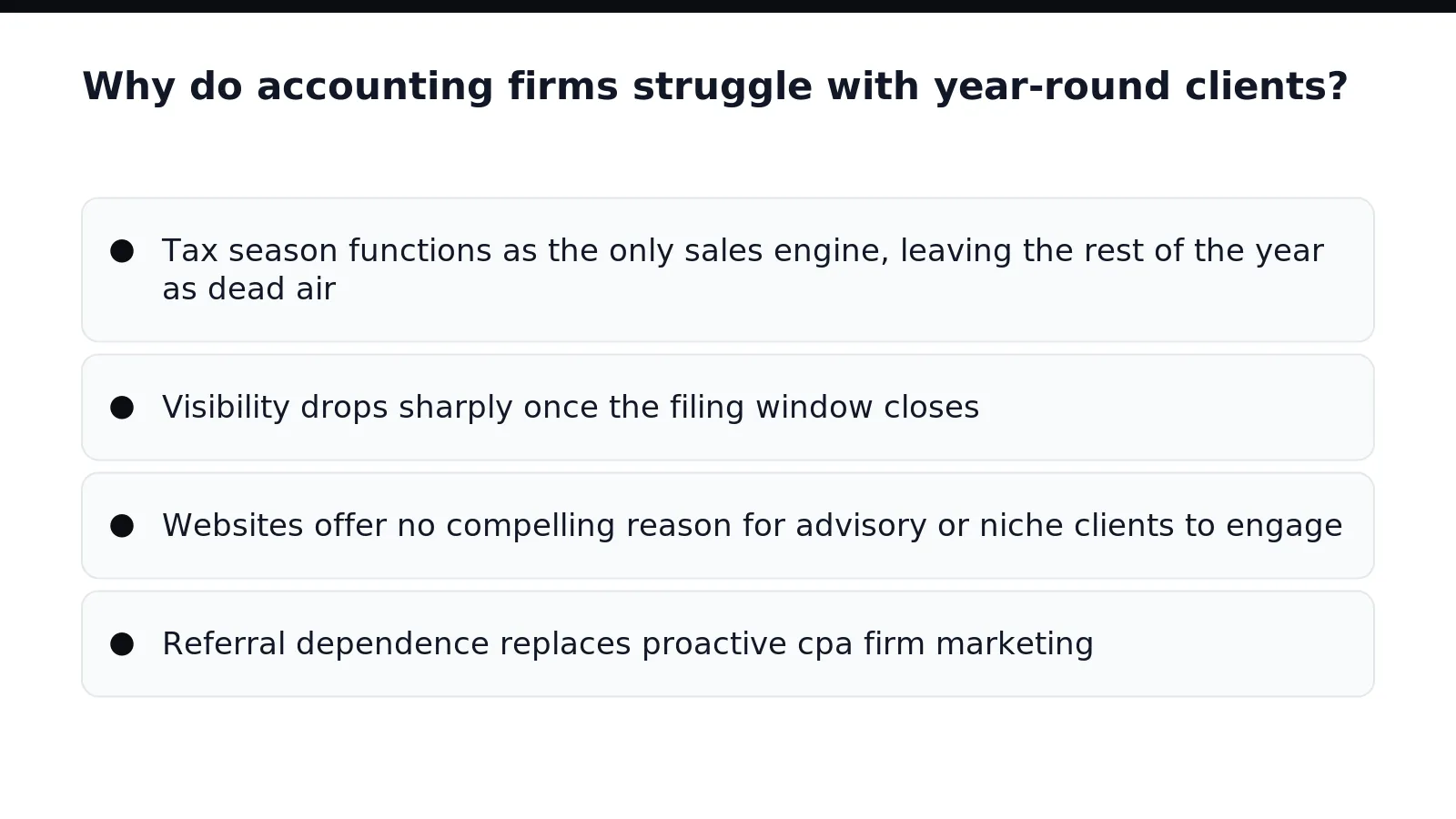
- Tax season functions as the only sales engine, leaving the rest of the year as dead air
- Visibility drops sharply once the filing window closes
- Websites offer no compelling reason for advisory or niche clients to engage
- Referral dependence replaces proactive cpa firm marketing
The fix begins with seo for accountants that builds visibility before the off-season starts. Firms that rank for advisory, bookkeeping, and niche queries capture demand that exists all year. Those that wait until January compete for the same crowded window and lose the other nine months.
How does niche specialization improve CPA firm marketing?
Niche specialization transforms CPA firm marketing from a seasonal scramble into a year-round growth engine. Generalist accounting firms compete on price and availability. Specialized firms compete on expertise that commands premium fees and attracts clients who need ongoing advisory relationships, not just annual tax filing.
Many accounting firms are rethinking their business models. Firms that narrow their focus expand client services into tax strategy and business consulting. These services are in high demand and command premium prices.
What types of niche specialization work best for accounting firms?
Industry verticals produce the strongest results. A firm specializing in dental practices, construction contractors, or e-commerce sellers builds deep domain knowledge that generalists cannot replicate. Service-line specialization works equally well. Firms focusing exclusively on R&D tax credits, estate planning, or M&A advisory attract clients nationwide rather than competing locally.
Real growth for accounting firms comes from advisory work, niche specialization, and consistent visibility outside the tax window. The tax season surge masks a structural weakness. When most new business arrives in the first quarter, the remaining nine months drain resources without generating proportional revenue.
How does specialization affect marketing accountability?
A named marketing framework with a defined sequence and clear checkpoints gives leadership something to hold the marketing function accountable to. Specialized firms target narrower audiences with precise messaging.
SEO for accountants benefits directly from specialization. A generalist firm competing for “CPA near me” faces hundreds of local competitors. A specialized firm targeting “construction contractor CPA” or “dental practice accountant” competes in a far smaller pool. Content marketing, paid search, and referral partnerships all perform better when the value proposition is unmistakably specific. Accounting firm marketing that tries to appeal to everyone appeals to no one with enough force to justify premium billing rates.
What role does local SEO play for accounting firms?
Local SEO determines whether an accounting firm appears in the map pack when a small business owner searches for tax help nearby. Firms that optimize for local search capture demand year-round, not just during the January-to-April rush. That is the core of local SEO.
How does Google decide which accounting firm ranks highest in local results?
Google scores every eligible business against three factors for each local search: relevance, distance, and prominence. The interaction between these factors explains why a firm further from the searcher can outrank one that is closer. A strong SEO for accountants strategy strengthens what the firm controls and mitigates what it does not.
What makes an accounting firm’s profile relevant to a local search?
Relevance comes from the firm’s categories, business description, listed services, and how closely the Google Business Profile content maps to the actual search term. A profile with the right primary category and complete service listings holds a real advantage. Many accounting firms list only tax preparation while neglecting advisory services, which leaves visibility on the table for bookkeeping, payroll, and fractional CFO queries.
Why do some firms show up even when they are farther from the searcher?
Distance is the factor businesses have the least control over, though a well-defined service area helps firms that do not operate from a fixed location. When a firm is stronger on relevance and prominence, Google often favors it over a closer competitor with a thin profile. The three ranking factors work as a system, not a checklist.
Accounting firm marketing efforts that focus solely on proximity miss the larger opportunity. A complete profile signals competence to both Google and prospective clients. Small and mid-sized CPA firms lose high-value local traffic when their profiles sit half-finished with generic categories and missing service descriptions. CPA marketing built around local visibility turns a static listing into a client acquisition engine that operates every month of the year.
How can accounting firms build referral systems with attorneys?
Accounting firms build attorney referral systems through sustained visibility and structured relationship development. The firms that grow are the ones building visibility year-round, not because they want more tax clients, but because they want advisory clients, niche practice clients, and referrals from the professionals who serve the same businesses they do.
Attorneys encounter financial questions constantly. Estate planning attorneys need valuation expertise. Business attorneys need tax structuring guidance. Divorce attorneys need forensic accounting support. Each interaction represents a referral opportunity, but only for accounting firms those attorneys remember outside of tax season.
What makes attorneys refer clients to accountants?
Attorneys refer clients to accountants they trust beyond tax season. From small business owners to individual filers seeking long-term planning, people want accountants they can trust beyond tax season. That trust transfers through professional networks when attorneys see consistent expertise demonstrated throughout the year.
A referral system with attorneys requires three elements:
- Consistent visibility through educational content and professional events
- Documented expertise in niche areas attorneys encounter regularly
- Reciprocal referral patterns that benefit both practices
How does year-round marketing support attorney referrals?
Year-round marketing keeps an accounting firm top-of-mind when attorneys encounter client needs. When done right, local marketing helps firms build lasting relationships that generate consistent referrals. A firm that disappears after April 15 loses the attorney’s attention precisely when estate planning and business structuring questions surface.
For local accountants, transforming a seasonal business model into one with consistent revenue requires a calculated and continuous approach. Attorneys practicing estate planning need accounting partners who understand trust administration, basis step-up, and post-mortem tax filings. Those needs arise in every month, not just during filing season.
What referral structures work best with law firms?
Structured referral relationships outperform casual networking. Accounting firms that document referral protocols, share client outcomes, and schedule quarterly check-ins with attorney partners build predictable pipelines. The attorneys reciprocate because the accounting firm demonstrates reliability through consistent communication and specialized knowledge.
What email strategies work for marketing for accountants?
Email strategies grounded in lifecycle triggers and structured sequences produce consistent client engagement for accounting firms. These approaches convert seasonal filers into year-round advisory clients. The most effective marketing for accountants relies on automated workflows that activate at specific points in the client journey.
Why do seasonal accounting firms struggle with email consistency?
Many firms send mass emails during tax season and disappear for the remaining nine months. This sporadic approach leaves revenue on the table. Marketing spend that cannot be traced to pipeline becomes harder to justify at every firm size. A named framework provides leadership with clear checkpoints for accountability. Without a structured email system, firms miss the chance to build value outside Q1.
What sequences drive results across the client lifecycle?
Four distinct sequences anchor a measurable email program:
- Your mid-year tax check-in (15 minutes)
- Three deductions to plan for before December
- Is your bookkeeping ready for year-end?
- Quick favor: how did we do this season?
These email lifecycle sequences operate on triggers rather than calendars.
Does topical strategy affect email content performance?
Publishing content without a topical strategy behind it produces pages that compete poorly in AI-driven search environments. Emails that link to shallow, competing pages fail to build authority. CPA firm marketing succeeds when email content reinforces a focused topical map. A defined framework gives leadership something to hold the marketing function accountable to, instead of a running list of campaigns and hoping the trends break favorably. SEO for accountants and email work together when both draw from the same strategic core.
How should a CPA firm website explain services and pricing?
A CPA firm website should explain each service in plain language, who it is for, and how engagements are priced. Firms moving toward advisory work should describe recurring engagements and tiers rather than leaving visitors to guess.
Firms that build their service descriptions around these metrics create a marketing infrastructure that compounds in value. The language on the site should signal that the firm is not optimizing for next quarter’s revenue alone. Instead, the firm is building something with lasting brand equity and optionality.
What service descriptions signal enterprise value to a buyer?
Service pages that emphasize recurring advisory relationships demonstrate retention strength. Descriptions that highlight diversified client industries show low customer concentration risk. A clear explanation of how the firm generates predictable engagements, not just seasonal tax work, speaks directly to pipeline stability. These elements transform a service list into a narrative of business durability.
How should pricing be presented to support a future exit?
Pricing should be framed around the value of ongoing partnership, not hourly transactions. The website can outline engagement tiers that imply recurring revenue streams.
What is the first step to start CPA firm marketing?
The first step is strategy before tactics. Every engagement opens with research and positioning before anyone touches a channel. Firms that skip this step build campaigns on weak foundations.
CPA firm marketing without a defined strategy wastes budget and confuses prospects. A firm owner who jumps straight to ads or social posts spends money without knowing which message resonates. The research phase identifies the firm’s ideal client, the services that differentiate the practice, and the channels where those clients actually look for help.
A structured mapping stage defines positioning, ideal client profile and channel priorities first.
What does marketing as enterprise value mean for accounting firms?
Marketing for accountants shifts from impressions and form fills to metrics a buyer actually underwrites. Founders thinking about exit need documented systems, not scattered campaigns.
Accounting firm marketing that starts with strategy produces predictable pipelines. Firms that skip the Map stage carry the cost as unrecovered staff time and wasted ad spend.
FAQ
What is CPA marketing?
CPA marketing is the strategic process of attracting and retaining clients for accounting firms through targeted communications and systems that build a steady pipeline of clients needing ongoing financial guidance.
Conclusion
The decision to build year-round client acquisition starts with strategy, not a new channel. Accounting firms that map their positioning, ideal client profile, and channel priorities before launching campaigns create a marketing infrastructure that produces predictable pipelines. This approach transforms the firm from a seasonal tax practice into a durable business asset that holds value across every quarter. For how Ronin approaches marketing for CPA and accounting firms, see accounting firm marketing.
About the author
Justin Smith is the founder of Ronin Communications, a fractional CMO practice for owner-led businesses. He spent more than 20 years writing and leading strategic communications for the federal government and holds an M.A. in Strategic Communications from American University.