
Strategic Brand Development via Fractional CMOs in Woodbridge
By Justin Smith, Ronin Communications
In Woodbridge, Virginia’s competitive B2B market, disciplined brand development is a requirement for service founders targeting growth from $1 million to $5 million in annual revenue. This article analyses strategic branding and the role of fractional Chief Marketing Officer services in reshaping marketing leadership. It evaluates brand identity, market presence and client engagement practices that help firms differentiate locally. The discussion covers brand positioning, the specific challenges B2B service founders face, and practical approaches for engaging fractional CMO expertise within the Woodbridge context. It also reviews the Ronin Method framework and its application to modern marketing leadership demands.
<!– Structured Data: JSON-LD Schema Markup –>
Impact of Fractional CMO Expertise on Branding Success:

Fractional CMOs deliver senior marketing leadership without the overhead of a full-time executive. They construct tailored strategies with measurable objectives that support sustainable growth. Their market analysis and customer insight inform prioritised actions that improve brand performance.
At the strategic level, fractional CMOs bring extensive experience navigating complex branding landscapes — defining and articulating a company’s vision and mission with precision. That strategic leadership is reinforced by a data-driven approach that gives businesses the ability to track branding performance and make informed adjustments over time. Financially, the model provides meaningful flexibility: firms gain access to CMO-level capability without the fixed costs associated with a permanent executive appointment.
Together, these capabilities enhance brand reputation and market position, elements that are essential to maintaining a competitive advantage.
What is Brand Development and Why Does Woodbridge B2B Marketing Need It?
Brand development is the systematic process of creating and strengthening a brand’s identity and market perception. In Woodbridge’s B2B sector, it establishes presence and builds client trust. Brand positioning assigns distinct value propositions to differentiate offerings, a necessity for local firms competing with larger organisations.
Defining Brand Positioning Services in Woodbridge Virginia
Positioning services in Woodbridge rely on disciplined market research to identify local buyer preferences and competitor behaviour. The output is focused branding messages and positioning that speak to target segments. Adapting positioning to local market characteristics increases the effectiveness of marketing investments.
Key Challenges Facing B2B Service Founders in Virginia’s Growth Markets
B2B service founders in Virginia confront several challenges, including:
A lack of brand clarity is among the most common: many businesses struggle to communicate their unique selling propositions clearly, which creates confusion in the marketplace and weakens competitive positioning. Compounding this is the difficulty of accurately identifying and engaging target audiences in a diversified regional market. Even firms that develop strong positioning often undermine it through inconsistent execution — failing to maintain a coherent brand message across platforms erodes trust and diminishes recognition among prospective clients.
Resolving these issues is a prerequisite for effective brand development in Virginia’s competitive growth markets.
How Does Fractional CMO Leadership Elevate Brand Strategy Consulting in Woodbridge?
Fractional CMO leadership strengthens brand strategy consulting by applying senior-level judgment and operational oversight. Through integrated marketing programs, they ensure marketing activities correspond with corporate objectives and resource constraints.
Role and Responsibilities of a Fractional CMO for B2B Services
Fractional CMOs assume key responsibilities in formulating brand strategy. They lead the strategic planning process for brand development, bringing structure and senior-level judgment to decisions that would otherwise fall on the founder. They also build and guide marketing teams, cultivating a working culture grounded in collaboration and disciplined creativity. Equally important is their role in keeping strategy grounded in market realities — continuously testing assumptions against actual customer behaviour and competitive conditions.
This comprehensive involvement gives businesses the capacity to adjust rapidly to market developments while maintaining relevance and sustained growth.
Comparing Fractional CMO and Full-Time CMO Models for Virginia Businesses
Comparing fractional and full-time CMO models highlights important differences that affect branding effectiveness and resource allocation. On cost, fractional engagements are typically more affordable — businesses gain CMO-level expertise without the salary, benefits, and overhead of a full-time appointment. The model also offers greater flexibility: engagement terms can be shaped around a company’s current stage and specific requirements rather than fixed to a standard job description. Beyond cost and flexibility, fractional CMOs often bring a broader cross-industry perspective, having worked across multiple sectors and business contexts in ways that a single full-time hire rarely accumulates.
These attributes position fractional CMOs as a sound option for Virginia B2B companies seeking senior marketing capability without permanent executive commitments.
What Proprietary Frameworks Drive Effective Brand Growth in Woodbridge’s B2B Market?
Proprietary frameworks can increase the precision of brand growth strategies. The Ronin Method, for example, integrates multiple marketing techniques adapted to B2B requirements.
Mapping Brand Value with The Ronin Method Framework
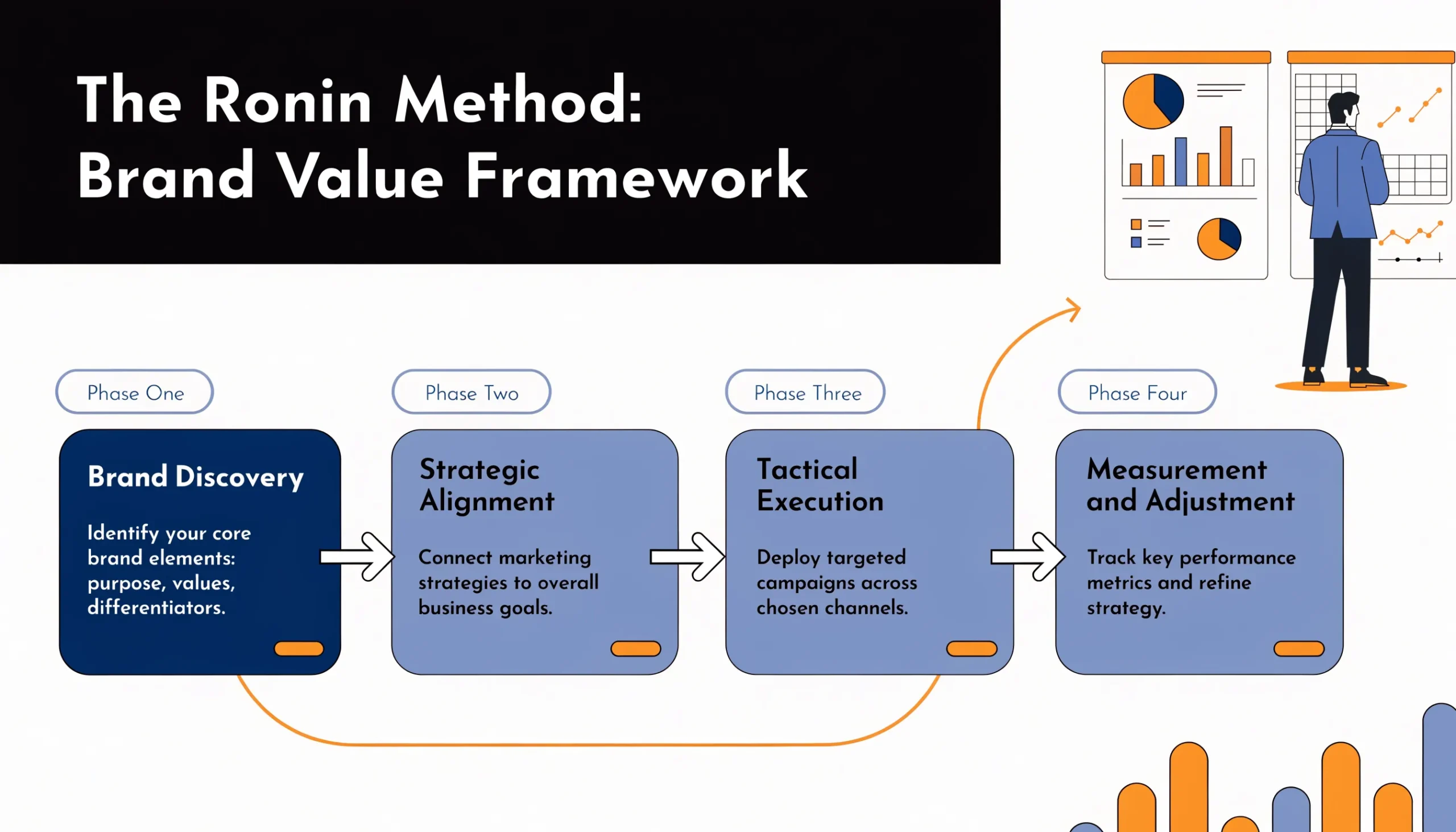
The Ronin Method maps brand value through a structured sequence that includes:
The process opens with Brand Discovery — identifying the core elements that define the brand, including its purpose, differentiators, and the specific value it delivers to its target market. That foundation feeds into Strategic Alignment, where marketing strategies are connected directly to overall business goals rather than pursued in isolation. The third phase, Tactical Execution, translates those strategies into targeted campaigns deployed across the right channels at the right time. The cycle closes with Measurement and Adjustment: performance metrics are tracked continuously against defined brand goals, and each round of findings sharpens the next.
Adhering to these phases gives Woodbridge firms a repeatable mechanism for measuring and refining brand performance against defined metrics.
Leveraging The Compounding Founder Persona to Align Marketing Leadership
The Compounding Founder persona prioritises detailed customer profiling to improve targeting precision. That begins with a thorough understanding of ideal customer demographics, motivations, and decision-making patterns — the depth of insight that separates a generic marketing strategy from one that consistently converts. With that foundation in place, the focus turns to message consistency: a coherent brand voice delivered uniformly across all platforms builds recognition and reinforces credibility over time. The longer-term payoff is the development of genuine emotional connections with the audience — the kind that produce loyalty and word-of-mouth advocacy rather than transactional, one-off engagements.
Collectively, these practices establish a structured foundation for ongoing brand development.
When and How Should B2B Founders Hire a Fractional CMO for Strategic Brand Development?
Founders should audit internal marketing capabilities and set definitive objectives before engaging a fractional CMO. The starting point is an honest assessment of existing marketing functions — identifying what is working, what is absent, and where outside expertise would have the most impact. From that audit, the next step is defining clear, measurable goals for the engagement so that both parties are working toward the same outcomes from day one. Equally important is the groundwork for effective collaboration: open communication channels and well-defined expectations at the outset reduce friction and increase the speed at which the partnership produces results.
This preparatory work increases the value derived from fractional CMO engagement.
Key Considerations and Typical Costs of Fractional CMO Engagement in Woodbridge
A clear understanding of fractional CMO costs is necessary for disciplined budget planning.
- Cost Control: Fractional CMO hires often represent a more affordable route to senior marketing expertise compared to full-time hires.
- Flexibility in Engagement: Businesses have the freedom to choose tailored engagement terms based on financial capabilities.
- Expectation Management: Establishing realistic timelines and outcomes for branding initiatives is important for satisfaction.
Considering these factors helps B2B firms navigate the financial implications of sourcing senior marketing leadership.
Vetting Procedures and Metrics to Evaluate Fractional Marketing Leadership
B2B firms should apply rigorous vetting procedures when selecting fractional CMOs. Key considerations include:
- Assessing Candidate Experience and Fit: Look for candidates with proven success in similar industries.
- Trial Engagements: Utilizing short-term engagements can serve as an effective evaluation tool.
- Performance Metrics: Establish indicators to measure ongoing performance and contributions.
This methodical selection process increases the probability of securing the most appropriate marketing leadership for the business.
How Does Strategic Brand Development Impact Revenue and Enterprise Value for Woodbridge B2B Firms?
Strategic brand development has a demonstrable effect on financial performance. Effective branding initiatives can improve revenue streams and enterprise value through:
- Long-term Brand Value: Invested resources in branding yield substantial returns over time.
- Revenue vs. Enterprise Value: Strong branding contributes to increased revenue streams and improved valuation in the marketplace.
- Attracting Investment: A solid brand presence can draw potential investors, combining reputation and financial performance.
Strategic brand development positions Woodbridge B2B firms for measurable growth and enhanced valuation.
Conclusion
Strategic brand development is a core factor for sustaining growth and differentiation in Woodbridge’s competitive market. Integrating fractional CMO expertise allows B2B service founders to strengthen market position and deepen client relationships. Tailored brand strategies increase revenue potential and reinforce enterprise value over time. Learn how our expert services can support your organisation’s branding objectives.