How IT & Professional Services Buyers Are Using AI to Shortlist Vendors in 2026

IT and professional services buyers are shortlisting vendors with real help from AI tools before a salesperson ever enters the picture. For firms in these categories, understanding exactly how that shortlisting happens — and how to earn a place in it — is quickly becoming as important as traditional search rankings.

How AI Tools Are Shaping Vendor Shortlisting in 2026

Buyers in these categories are using AI tools for early category orientation, generating an initial list of vendors to investigate further, and validating or challenging claims a vendor has already made in a sales conversation. Forrester’s 2026 Buyers’ Journey Survey found 94% of B2B buyers report using AI tools somewhere in this process, and research focused specifically on shortlisting found roughly 73% of buyers using AI tools for that narrower task — a strong signal this is now a standard part of vendor evaluation in these categories, not a niche behavior.

What This Looks Like in Practice for IT Services

An IT decision-maker facing a specific need — a compliance requirement, a security gap, a provider transition — increasingly starts by asking an AI tool to explain the requirement, outline what to look for in a provider, or generate an initial list of vendors who specialize in that area. The vendors who show up in that initial AI-generated list get a real head start in the buyer’s actual research; vendors who don’t show up may never make it onto the human-reviewed shortlist that follows. See SEO for Managed Service Providers (MSPs): A Practical Guide for how MSPs specifically should structure content around this behavior.

What This Looks Like in Practice for Professional Services

For professional services specifically, AI-assisted research tends to concentrate more heavily in the early orientation stage — understanding a category, generating an initial list of options — with final decisions still relying more on direct trust verification, given the higher-stakes nature of many professional services engagements. Even so, not appearing in that early AI-assisted research means missing the initial consideration set entirely, regardless of how strong the eventual in-person trust-building would be. See How Professional Services Firms Should Approach AI Search Visibility for the fuller treatment of that dynamic.

Why Specificity Matters More Than Ever in This Shortlisting Context

An AI tool generating a shortlist is working from whatever specific, checkable claims exist in the content it can access. Vague positioning — “comprehensive IT solutions,” “trusted advisor” — gives an AI tool nothing concrete to include a vendor for. Specific claims about exact services, exact compliance frameworks supported, exact methodologies used give the AI tool something genuine to match against a buyer’s specific query, meaningfully increasing the odds of being included in that generated shortlist.

The Validation Use Case Specifically

Beyond initial shortlisting, research shows buyers using AI tools to validate claims a vendor has already made directly — roughly 47% of buyers report using AI this way, per available research. This means content consistency matters in a new way: if your website and your sales conversations make different or inconsistent claims, an AI tool cross-referencing your public content against what a salesperson said in a meeting can surface that inconsistency directly to the buyer, in a way that’s more visible and more immediate than it would have been in a pre-AI research process.

What Firms in These Categories Should Prioritize

Given this pattern, IT and professional services firms should prioritize specific, checkable, consistent content across their site that directly supports the exact shortlisting queries a buyer in their category is likely to run — not broad positioning statements, but concrete, verifiable claims about services, methodology, and compliance that an AI tool can confidently include in a generated answer. Consistency between website content and actual sales conversations also matters more than it used to, given the validation use case described above.

A Worked Example

Consider an IT services firm and a boutique consulting firm, both targeting the same general buyer type. The IT firm that names specific compliance frameworks, specific response-time commitments, and specific service tiers gives an AI tool concrete material to include it in a shortlist response to a buyer’s specific query. A generic competitor offering “comprehensive managed IT services” gives the AI tool nothing specific enough to confidently recommend. The same logic applies to the consulting firm — specific methodology and case-type experience beats generic expertise claims for the same reason.

Quick Answers

Are AI tools actually shortlisting vendors, or just answering general questions? Available research indicates both — roughly 73% of buyers report using AI tools specifically for vendor shortlisting, not just general category research.

Does content need to be different for IT versus professional services buyers? The underlying principle (specificity over vague positioning) is the same; professional services content also needs a stronger trust-verification layer given the higher-stakes nature of those decisions.

Why does consistency between website and sales conversations matter more now? Buyers are increasingly using AI tools to cross-check and validate claims made directly by a vendor, surfacing inconsistencies more visibly than before.

Sources: Forrester (2026 Buyers’ Journey Survey), Averi, G2 (via PR Newswire). This piece is part of the SEO & AEO hub.

How Professional Services Firms Should Approach AI Search Visibility

Professional services firms — law, accounting, consulting, and adjacent categories — face a particular version of the AI search shift: their buyers are often making high-stakes, high-trust decisions, which changes both how those buyers use AI tools in research and what kind of content actually earns confidence once found.

How Should Professional Services Firms Approach AI Search Visibility?

Professional services buyers use AI tools for early orientation and comparison — understanding a category, narrowing a field of options — but tend to rely more heavily on direct verification (references, credentials, direct conversation) before making a final decision, given the trust and stakes involved. The practical implication: AI visibility matters most for getting into the initial consideration set, while traditional trust-building content and direct engagement still carry the final decision. See How IT & Professional Services Buyers Are Using AI to Shortlist Vendors in 2026 for the data behind this pattern.

Why Trust Signals Matter More Here Than in Most B2B Categories

Professional services buyers are often making decisions with significant financial, legal, or reputational consequences, which raises the bar for what earns confidence beyond simply appearing in search results or an AI answer. Credentials, specific case outcomes (where they can be shared), clear methodology, and direct evidence of expertise carry more weight here than in lower-stakes B2B categories, and content strategy should reflect that higher bar rather than treating professional services like a generic service business.

What This Means for Content Structure

Answer-first structure and genuine topical completeness still apply — the same underlying practices that earn AI citation generally — but professional services content benefits from an additional layer of specific, verifiable trust signals: named expertise, specific methodology, and where appropriate and permissible, concrete examples of outcomes achieved. Vague claims about expertise are weaker here than in most categories, because the buyer’s bar for trusting an unfamiliar source is genuinely higher.

Navigating Compliance and Disclosure Constraints

Many professional services categories operate under real regulatory or ethical constraints on what can be claimed or promised in marketing content — particularly law and financial services. This is a genuine constraint on how specific and outcome-focused content can be, and it’s worth working within your industry’s actual compliance requirements rather than either ignoring them or using them as a reason to default to vague, unpersuasive content. Specific, compliant content that stays within the lines is still more effective than generic content that avoids the issue by saying nothing concrete at all.

Where AI Tools Fit in the Professional Services Buyer Journey

Based on the broader B2B research patterns covered elsewhere in this hub, a reasonable expectation for professional services specifically is that AI tools are used more for initial orientation and category understanding, and less for the final trust-and-verification stage that these higher-stakes decisions typically require. Content strategy should account for both: strong AEO-optimized content to earn a place in the AI-assisted initial research, paired with strong direct trust-building content (bios, case studies, direct testimonials where permitted) for the verification stage that follows.

Putting AEO into Practice: A Professional Services Case Study

Consider a boutique legal practice specializing in a specific area of business law. Their AEO-optimized content might answer common, general questions in that legal area clearly and directly, earning visibility in early-stage AI-assisted research. But the actual decision to engage that firm still likely runs through direct conversation, specific case experience discussion, and personal trust — the AI-visible content gets them into consideration; it doesn’t replace the verification stage.

Balancing AEO Investment With Trust-Building Content

For most professional services firms, this means AEO-optimized content shouldn’t crowd out the trust-building content (detailed bios, case studies, credentials, direct testimonials) that still does the heavy lifting in the final decision. Both are worth investing in, but they serve different stages of a buyer journey that, in this category, still leans more heavily on direct trust verification than most other B2B categories covered in this hub.

Quick Answers

Do professional services buyers rely on AI tools as heavily as other B2B categories? For early orientation, likely yes, based on broader patterns — but final decisions in this category still tend to rely more on direct trust verification.

Should compliance constraints stop us from writing specific content? No — specific, compliant content still outperforms vague content; work within your industry’s actual requirements rather than defaulting to generic language.

What matters most for AI visibility in this category? Getting into the initial consideration set through clear, answer-first content on common category questions.

This piece is part of the SEO & AEO hub, covering search strategy for high-trust, high-stakes B2B service categories.

SEO & AEO for Engineering and Technical Consulting Firms

Engineering and technical consulting firms have a genuine SEO advantage that most of them don’t use: real, defensible technical depth that’s hard for a generic content mill to replicate. The failure mode isn’t lack of expertise — it’s writing that expertise in a way too generic or too jargon-heavy to actually rank or get cited.

The Two Failure Modes in Technical Consulting Content

Most engineering and technical firms fall into one of two traps. The first is generic marketing language that could describe any consultancy — “innovative solutions,” “trusted partner,” “deep expertise” — that says nothing a search engine or an AI tool can meaningfully differentiate from a hundred competitors using the same phrases. The second is content so dense with internal jargon and assumed context that it reads as impenetrable to anyone outside the firm’s own specialists, including buyers who are technically sophisticated but not specialists in this exact sub-discipline. The winning content sits between these: genuinely technical, specific, and precise, but written for an informed buyer rather than a peer reviewer.

Write for the Technically Sophisticated Buyer, Not the Peer

Most buyers evaluating engineering or technical consulting services are themselves technically literate — often engineers or technical leaders themselves — but they’re not necessarily specialists in your specific sub-discipline, and they’re evaluating you alongside several other options in a limited amount of time. Content that assumes too much prior context loses this reader as much as content that’s too generic. The target is precise, substantive, specific content that respects the reader’s general technical literacy without assuming they already share your specific specialized vocabulary.

Lead With Specificity, Not Credentials

Generic credentialing language (“20 years of experience,” “industry-leading expertise”) is easy to claim and hard to verify, and it doesn’t differentiate meaningfully in either search rankings or AI citation. Specific, checkable claims — the actual methodology used, the actual standards or frameworks applied, a genuinely worked example of how a specific problem was approached — do differentiate, because they’re the kind of concrete, checkable content that both search engines and AI tools favor over vague assertions. This is the same underlying logic covered in SEO for Managed Service Providers (MSPs): A Practical Guide, applied to a more technically dense category.

Build Around Real Technical Questions

The strongest content opportunities for engineering and technical consulting firms are the specific, technical questions their buyers are actually searching — not the broad category term, but the precise technical or compliance question that signals a real, active need. A structural engineering firm’s strongest content isn’t a page about “structural engineering services” broadly; it’s specific, technical guidance on the exact problems their real clients bring to them.

Where AEO Fits Naturally

Answer-first structure works especially well for technical content, because technical questions often have genuinely direct, factual answers that can be stated clearly before the supporting detail and nuance. A well-written technical answer, structured this way, is exactly the kind of content an AI tool can lift cleanly — specific, checkable, and complete enough to stand on its own.

Avoid Over-Indexing on a Single Broad Term

As with other B2B categories, the broadest terms in engineering and technical consulting tend to be dominated by large, established firms with significant domain authority. The stronger path for most independent firms is the same tiered approach covered elsewhere in this hub: specific, realistic, high-intent terms first, building toward broader terms as authority grows.

Applying Technical Precision: A Strategic Content Example

Consider a technical consulting firm specializing in a specific compliance area within a broader engineering discipline. Rather than competing for the broad discipline term, its strongest content targets the specific compliance question, written precisely enough that a technically literate buyer can trust the depth, but clearly enough that they don’t need to already be a specialist in that exact compliance area to follow it. That specificity is both the realistic path to ranking and the genuine differentiator that generic competitor content lacks.

Quick Answers

Should technical content be simplified for a general audience? No — the target reader is technically sophisticated, just not necessarily a specialist in your exact sub-discipline. Precision matters more than simplification.

Is credentialing language (“years of experience”) effective content? Not on its own — specific, checkable claims and worked examples differentiate more effectively than generic credentials.

Should we target the broad discipline term or narrower technical questions? Narrower, specific technical questions first — more realistic to rank for, and more directly matched to real buyer search intent.

This piece is part of the SEO & AEO hub, covering search strategy for technically sophisticated B2B service categories.

SEO for Founder-Led B2B Service Businesses ($1M–$10M Revenue)

A B2B service business doing $1M–$10M in revenue occupies an awkward spot for SEO advice. Too small for enterprise strategies built around large content teams and six-figure budgets, too established to treat SEO as a someday project. Here’s what actually applies at this specific stage.

How Should a $1M–$10M Founder-Led Business Approach SEO?

At this revenue range, the right approach is disciplined and narrow rather than broad: a small number of well-chosen, realistically winnable keyword targets, organized into a genuine hub-and-spoke structure, built and maintained with whatever fraction of founder or team time can be consistently committed — not a sprawling content calendar that looks impressive on paper but can’t actually be sustained. The same principle applies regardless of industry — see SEO for Managed Service Providers (MSPs): A Practical Guide for a worked example in one specific vertical.

Why Generic SEO Advice Doesn’t Fit This Stage

Most published SEO strategy content is written from the perspective of a company with a dedicated content team, a real budget, and an established domain. Applying that advice directly at the $1M–$10M stage usually means either attempting far more than is sustainable (a content calendar that collapses after two months) or being intimidated out of starting at all, because the scale of what’s described feels unreachable. Neither outcome serves a business at this stage well.

Start With Domain Reality, Not Ambition

Before setting any targets, know your actual domain authority and current rankings. Many businesses in this revenue range have a newer or lower-authority domain, even if the business itself has been operating for years — marketing simply wasn’t a priority in earlier stages of growth. That starting point should directly shape keyword selection: realistic, lower-difficulty, high-intent terms first, with broader terms as a longer-term goal once early wins build authority.

Pick One Core Topic, Not Five

A common mistake at this stage is trying to build authority across too many topics simultaneously, spreading limited time and content production too thin to build real depth in any of them. A tighter, more effective approach picks one core topic where the business has genuine, demonstrable expertise, builds a real hub-and-spoke cluster around it, and only expands to a second topic once the first is genuinely established.

Match Content Cadence to Actual Capacity

A founder-led business without a dedicated content resource should set a publishing cadence it can actually sustain — even if that’s one well-built piece a month — rather than an ambitious calendar that gets abandoned after the first few weeks. A slower, consistent cadence that actually gets maintained outperforms an ambitious one that stalls, because search and AI visibility both reward sustained, structured effort over sporadic bursts.

Prioritize AEO From the Start, Not as an Afterthought

Businesses at this revenue stage often have the advantage of building fresh — without years of legacy content structured the old way that needs retrofitting. Building new content answer-first from day one, rather than writing traditionally and retrofitting for AEO later, is meaningfully easier than the alternative, and worth the small additional discipline it requires from the outset.

Think About Transferability Early

Even without an immediate exit plan, a $1M–$10M founder-led business benefits from building documented, structured, diversified visibility from the start rather than accumulating years of founder-dependent content that later needs to be unwound. It’s meaningfully easier to build transferable visibility as you go than to retrofit years of personal-brand-dependent content after the fact — see SEO for B2B Companies Preparing for an Exit for the fuller version of this argument.

A Realistic 12-Month Shape

A reasonable trajectory at this stage: months 1–3 spent on domain audit, keyword tiering, and building the first hub page; months 3–6 on the first 4–6 spokes; months 6–9 on early results review and adjustment against real Search Console data; months 9–12 on either deepening the first hub further or carefully starting a second, depending on capacity and results. This isn’t a rigid template, but it’s a realistic shape for what’s achievable without a dedicated content team.

Strategic SEO FAQs for Founder-Led B2B Businesses

Is SEO worth investing in at this revenue stage? Yes, but with a narrower, more disciplined scope than enterprise-oriented advice typically describes.

How many topics should we target at once? One core topic, built into a real hub-and-spoke cluster, before expanding to a second.

Should we prioritize traditional SEO or AEO first? Build both together from the start — answer-first content structure supports both simultaneously.

This piece is part of the SEO & AEO hub, covering practical strategy for founder-led B2B service businesses at this specific stage.

SEO for Managed Service Providers (MSPs): A Practical Guide

Managed service providers face a search problem most generic SEO advice doesn’t address: buyers rarely search “MSP” when they’re actually ready to switch providers. They search for the specific pain that’s driving the decision — a compliance deadline, a ransomware scare, a contract renewal gone wrong. Here’s a practical guide to ranking for the searches that actually precede an MSP buying decision.

How MSP Buyers Actually Search

Most MSP buyers don’t wake up searching “managed service provider.” They search because something specific triggered the decision: a compliance requirement they can’t meet internally, a security incident that exposed a gap, a current provider missing SLAs, or a budget review that surfaced how much they’re spending on an internal IT hire that isn’t scaling. Ranking content that speaks to the generic category misses all of that context. Ranking content built around the specific trigger meets the buyer exactly where they are.

Build Compliance and Industry-Specific Pages

If your MSP serves specific regulated industries — healthcare, finance, legal, defense contracting — compliance-driven searches are some of the highest-intent traffic available to you. Someone searching “HIPAA compliant IT support” or “CMMC managed services” already knows they have a requirement and is actively looking for a provider who understands it. Generic MSPs that don’t build pages speaking directly to these requirements lose this traffic to competitors who do, even if the generic MSP is equally capable of delivering the service.

Each compliance-specific page should name the actual requirement, explain in plain language what it means for the buyer’s IT environment, and describe specifically how your service addresses it — not just that you’re “compliant-ready” in the abstract.

Write Incident-Driven Content

A meaningful share of MSP searches are triggered by something going wrong: a phishing incident, a ransomware scare, an outage that exposed how thin the internal IT bench really is. Content that speaks directly to these moments — what to do immediately after a ransomware attack, how to evaluate whether your current IT setup can handle a security incident — captures buyers at their highest point of urgency. This isn’t about exploiting fear; it’s about being genuinely useful and visible at the exact moment someone is searching with real urgency, which is also the moment they’re most likely to switch providers.

Cross-Link With Local SEO

Many MSP buying decisions still have a local or regional component — a buyer wants a provider who can be on-site if needed, or who understands regional compliance nuances. If your MSP also targets local search, make sure your local SEO pages and your broader service pages link to each other and reinforce the same core messaging. A buyer researching “managed IT services [city]” and a buyer researching “managed service provider for healthcare compliance” might be the same person at different points in their research — your site should connect those paths rather than treating them as separate silos.

The AEO Angle for MSPs

IT decision-makers are increasingly using AI tools to do early-stage vendor research — asking an AI to explain a compliance requirement, compare service models, or shortlist providers for a specific need. The same answer-first structure that earns AI citations generally applies here, with an MSP-specific twist: be specific about what your service actually includes at each tier, what response times you commit to, and what compliance frameworks you support by name. Vague claims about “24/7 support” or “enterprise-grade security” are exactly the kind of content an AI tool has no reason to cite over a competitor’s more specific claim. See How IT & Professional Services Buyers Are Using AI to Shortlist Vendors in 2026 for the data behind this shift.

Why Generic MSP Keywords Fail to Convert

Don’t build your primary content strategy around the generic term “MSP” or “managed service provider” alone. It’s a broad, heavily contested term dominated by large national players and directories with far more domain authority than most independent MSPs will build in the short term. Chasing it directly, especially early on, means competing head-on with sites that have a decade of head start. The stronger path is the specific, trigger-driven, compliance-driven, and locally-relevant searches described above — they’re realistic to win, and they’re the searches your actual buyers are running.

A Worked Example

Consider an MSP serving healthcare practices in a mid-sized metro area. Rather than a single generic “IT services” page, its strongest content targets “HIPAA compliant IT support for medical practices,” “what to do after a healthcare data breach,” and “managed IT services [metro area]” — each page speaking to a different real trigger, all cross-linked, all reinforcing that this MSP specifically understands healthcare compliance. That’s a realistically winnable, high-intent footprint, built from real search behavior rather than the broadest possible category term.

Quick Answers

Should MSPs target “managed service provider” as a keyword? Not as a primary target, especially for newer or smaller domains — it’s dominated by large national players. Specific, trigger-driven terms are more realistic and higher-intent.

How important is compliance content for MSPs? Very, if you serve regulated industries — it’s some of the highest-intent traffic available, and most competitors don’t build it well.

Does local SEO still matter for MSPs? Yes, alongside broader service content — many buyers still want a provider with a regional or on-site presence, so the two strategies should reinforce each other, not compete.

This piece is part of the SEO & AEO hub. See also our Local SEO service for how regional visibility fits alongside broader search strategy.

Build Tech Industry Authority with Strategic Communications | RoninComms Expertise

Build Tech Industry Authority with Strategic Communications: Fractional CMO Services and RoninComms Expertise

By Justin Smith, Ronin Communications

In the tech sector, establishing a credible authority can be a substantial advantage for B2B companies. This article explores how strategic communications, particularly through the lens of fractional Chief Marketing Officer (CMO) services, can help tech firms gain recognition and leadership in their niche. Readers will uncover vital insights into the roles, responsibilities, and timing involved in engaging a fractional CMO, especially within the context of leveraging existing marketing resources efficiently.

Tech companies, especially those within the $1M–$10M revenue bracket, often face challenges in accessing seasoned marketing leadership without committing to the expense of full-time hires. This piece will delve into when and why tech companies should consider fractional CMOs, the indicators signaling their need, and how engaging these professionals can redefine marketing success. By examining the Ronin Method and its strategic practices, businesses can gain valuable tools to achieve sustainable growth and authority in the tech environment.

Building Authority in Tech Through Strategic Marketing Leadership

Fractional CMO services are tailored solutions for tech companies seeking strategic marketing guidance without the need for a full-time executive. This model functions by providing experienced marketers who serve on a part-time basis, orchestrating marketing strategies that are aligned with business objectives. A fractional CMO is instrumental in developing a comprehensive marketing plan that bridges the gap between resources and expertise, ultimately driving both engagement and operational efficiency for B2B firms.

This approach is particularly beneficial for companies operating in the tech sector, where the landscape is constantly changing and often requires swift adaptability to new trends. With a deep understanding of technology marketing leadership, fractional CMOs craft personalized strategies that enhance brand visibility and establish market authority.

What Are the Roles and Responsibilities of a Fractional CMO?

Fractional CMOs play multiple roles within a tech organization, primarily focused on aligning marketing strategies with overarching business goals. They engage in:

  1. Strategic Planning: Developing and refining the marketing framework to meet defined objectives.
  2. Team Leadership: Guiding internal marketing teams to maximize resources and performance.
  3. Performance Analysis: Evaluating marketing efforts through data-driven metrics to drive optimization and growth.

By taking on these responsibilities, fractional CMOs enable tech companies to maintain a strong market presence while navigating complex marketing challenges without the burden of a full-time commitment. Their expertise ensures that every marketing dollar spent aligns closely with the business’s strategic objectives.

How Do Fractional CMOs Enhance B2B Tech Marketing Strategy?

Business leader presenting B2B tech marketing strategies to a team in a vibrant office, showcasing innovation and teamwork

The contribution of a fractional CMO to a B2B tech marketing strategy is multifaceted and essential. They play a key role in:

  • Strategic Marketing Planning: Creating long-term plans that integrate market observations with organizational goals to build a coherent strategy.
  • Lead Generation Tactics: Implementing targeted campaigns that effectively convert leads into loyal customers through personalized communication.
  • Performance Analytics Emphasis: Utilizing metrics to measure campaign success, enabling continuous improvement and informed decision-making.

Incorporating a fractional CMO into the marketing strategy empowers tech companies to capitalize on competitive advantages, enrich their brand narrative, and enhance customer engagement.

When and Why Should Tech Companies Engage a Fractional CMO?

Engaging a fractional CMO can be a strategic maneuver for a tech company at pivotal moments. Companies should consider this approach when they require:

  1. Cost-Effectiveness: Access to high-level expertise without the financial burden of a full-time employee.
  2. Flexibility in Engagement: The ability to scale marketing leadership resources as organizational needs change.
  3. Access to Specific Expertise: Knowledge that aligns with unique product offerings or market demands.

These factors often combine to signal the right time for engagement, propelling the company toward enhanced market authority and strategic alignment.

What Indicators Signal the Need for Fractional Marketing Leadership?

Several key indicators suggest a tech company might benefit from fractional marketing leadership:

  1. Limited Marketing Expertise: A lack of skilled personnel to meet evolving marketing demands or implement strategic initiatives effectively.
  2. Indicators of Stagnant Growth: Observable declines in market reach or customer engagement metrics, necessitating fresh perspectives.
  3. Resource Constraints: Operational challenges that hinder the capacity to execute marketing activities efficiently.

Recognizing these signals allows tech companies to address deficiencies and streamline their marketing processes with the guidance of seasoned fractional CMOs.

How Does Fractional CMO Hiring Compare to Full-Time Leadership?

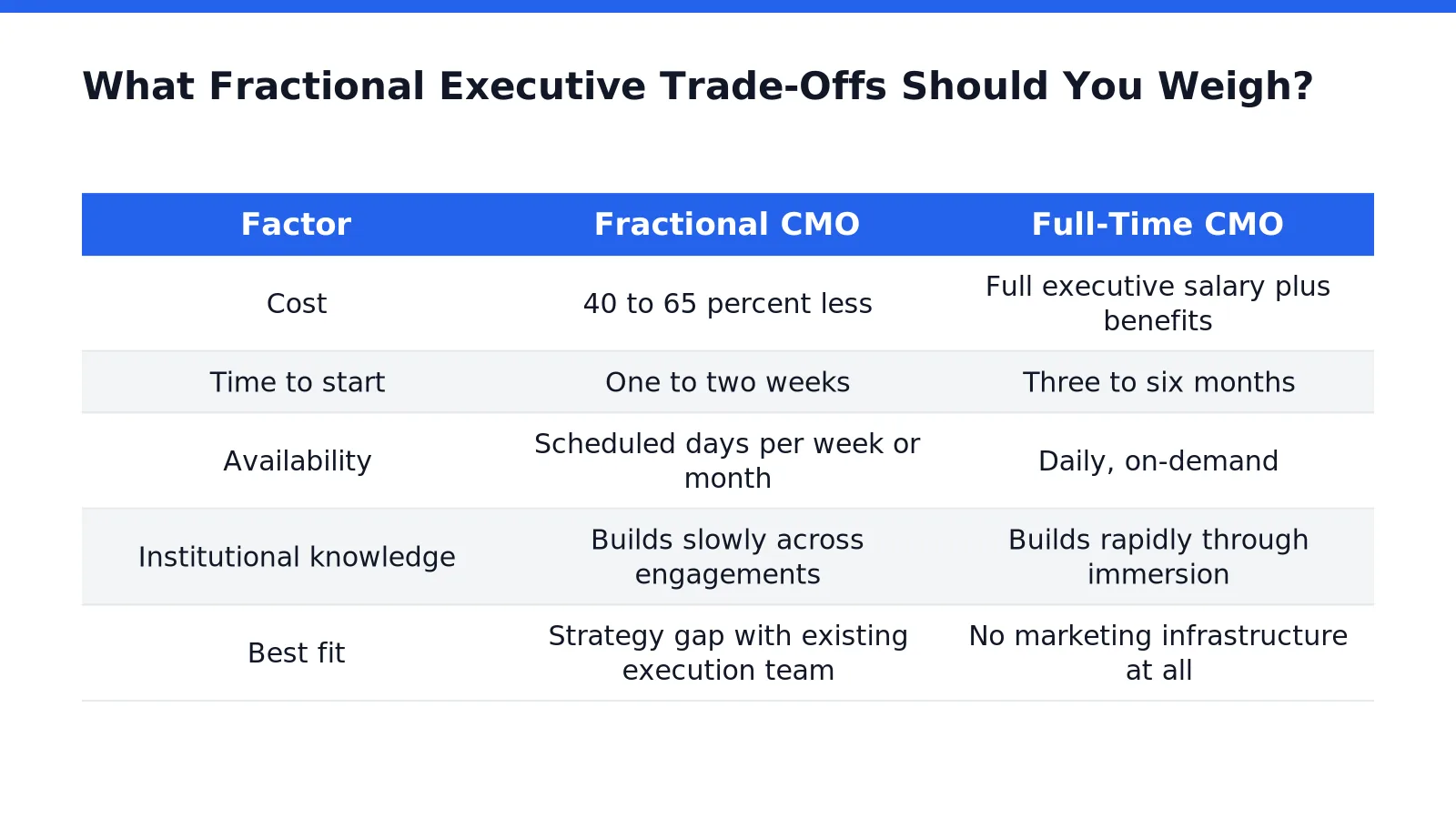
Comparing fractional CMO vs full-time CMO hiring reveals markedly different considerations for tech companies. Key comparisons include:

  • Cost Comparison: Fractional CMO services allow for flexible budgeting, reducing overhead costs associated with full-time hires.
  • Operational Flexibility: They provide strategic oversight without the commitment to permanent contracts, adapting to the company’s growth phase.
  • Focus on Strategic vs. Day-to-Day Management: Fractional CMOs concentrate on delivering high-level strategy rather than day-to-day marketing tactics.

This comparative analysis highlights the functional advantages of fractional CMO arrangements, making them an attractive option for tech companies.

How to Vet and Hire a Fractional CMO for Technology Sector Success?

Professional reviewing resumes and conducting interviews to hire a fractional CMO in a well-lit office setting

Vetting and hiring a fractional CMO involves a systematic approach that ensures the selection of a candidate well-suited for the organization’s needs. Important steps include:

  1. Qualifications to Look For: Seeking candidates with specific industry experience and a proven track record in B2B marketing.
  2. Interviewing Strategies: Employing targeted questions that uncover strategic thinking and adaptability.
  3. Evaluation Criteria for Selection: Establishing clear performance metrics to assess candidates’ potential impact on business objectives.

A thorough hiring process facilitates the integration of a fractional CMO who can positively influence marketing initiatives.

What Criteria Determine an Effective Fractional CMO?

Determining an effective fractional CMO revolves around several criteria pivotal to their success, such as:

  • Experience and Industry Knowledge: In-depth familiarity with marketing trends specific to the tech industry.
  • Ability to Drive Growth: Proven capacity for developing strategies that lead to measurable outcomes.
  • Flexibility in Strategy Adjustments: Agility in adapting to market shifts and the organizational landscape.

These metrics serve as guiding principles for evaluating candidates and ensuring the right fit for B2B tech firms.

What Are Best Practices for Evaluating Fractional CMO Candidates?

Evaluating fractional CMO candidates should adhere to best practices that streamline the selection process. Considerations include:

  1. Assessment of Domain Experience: Reviewing past projects and references relevant to the tech industry.
  2. Effective Interviewing Techniques: Utilizing case studies or simulations to gauge candidates’ strategic intellect.
  3. Selection Criteria to Consider: Focusing on alignment with company culture and marketing philosophy.

By applying these best practices, organizations can enhance their likelihood of hiring competent fractional CMOs who resonate with their mission.

How Does The Ronin Method Support Sustainable Growth in Tech Marketing?

The Ronin Method underscores a structured framework that champions sustainable growth for tech companies. This approach emphasizes four pivotal phases:

  1. Map: Defining clear marketing strategies aligned with business objectives.
  2. Build: Establishing scalable systems that support ongoing marketing efforts.
  3. Grow: Identifying and leveraging opportunities for market expansion.
  4. Multiply: Optimizing processes to increase impact across diverse channels.

The Ronin Method encapsulates an iterative growth strategy, providing tech companies with essential tools for nurturing long-term authority in the marketplace.

What Are the Phases of The Ronin Method: Map, Build, Grow, Multiply?

The phases of The Ronin Method offer a clear pathway for tech marketing success:

  • Mapping Strategy: Involves analyzing market needs and aligning them with organizational goals.
  • Building Scalable Systems: Creates frameworks that allow for efficient resource use while maximizing output.
  • Growing Through Optimization: Ensures that marketing practices adapt and thrive within changing markets.
  • Multiplying Results Across Markets: Focuses on replicating successful strategies to gain traction in new segments.

This systematic approach positions tech companies to thrive in a competitive landscape.

How Does The Ronin Method Differentiate Ronin Communications in the Market?

The Ronin Method distinguishes Ronin Communications through its unique methodologies that prioritize clarity and results-driven marketing. By focusing on measurable outcomes and integrating comprehensive market insights, the method empowers tech companies to build enduring brands and cultivate audience trust. The emphasis on adaptable frameworks enables Ronin Communications to stay relevant in a market environment that is constantly shifting.

What Are the Strategic Benefits of Technology PR Best Practices?

Strategic technology public relations (PR) practices are essential for establishing credibility and authority. Key benefits include:

  • Enhancing Brand Visibility: Effective communication strategies elevate brand recognition among target audiences.
  • Establishing Thought Leadership: By positioning companies as industry experts, PR fosters trust and loyalty.
  • Fostering Trust with Audiences: Consistent messaging nurtures relationships with customers, enhancing overall brand reputation.

These PR strategies form the backbone of a successful approach to marketing in the tech sector.

How Do Tech PR Strategies Integrate with B2B Marketing Objectives?

Tech PR strategies should be harmoniously integrated with overarching B2B marketing objectives. This integration involves:

  • Personalized Narratives: Crafting messages that resonate with distinct audience segments.
  • Structured Storytelling: Developing compelling brand stories that engage and motivate potential customers.
  • Authority Building Methods: Employing tactics that underscore the company’s position as a market leader.

Thus, effective tech PR not only amplifies brand voice but also supports larger marketing goals, ultimately leading to greater marketplace success.

What Impact Does Effective Tech PR Have on Industry Authority?

Effective tech PR carries considerable weight in shaping industry authority through various mechanisms:

  • Building Trust and Credibility: Strategic PR fosters a trustworthy image across diverse audiences, which is essential for sustainability.
  • Positioning as Thought Leaders: Regular contributions to industry discussions and publications establish expertise and reliability.
  • Creating Measurable Engagement Metrics: Implementing and measuring campaigns reveals insights into audience preferences and behaviors, guiding future initiatives.

Through these strategies, tech companies can bolster their industry authority via effective PR.

What Pricing Frameworks and ROI Metrics Support Fractional CMO Engagements?

Understanding pricing frameworks and ROI metrics is vital for assessing fractional CMO engagements. Key frameworks might encompass:

  1. Range of Pricing for Services: Prices typically vary based on market expectations and the CMO’s level of expertise.
  2. Key ROI Metrics to Track: Measuring KPIs such as conversion rates and customer acquisition costs provides insights into the effectiveness of marketing strategies.
  3. Insights on Value Measurement: Long-term analysis of brand growth and market authority helps justify the investment in fractional marketing leadership.

Pricing and ROI are fundamental components that influence decision-making when engaging fractional CMOs.

How Do Fractional CMO Costs Compare to Full-Time Marketing Executives?

The cost implications of hiring fractional CMOs versus full-time marketing executives showcase substantial differences. Particularly, fractional CMOs can provide expertise on a flexible basis, typically at a lower cost than hiring full-time personnel. This arrangement allows tech companies to access high-level strategic oversight while maintaining flexibility in resourcing. The operational benefits align well with the predicaments faced by companies aiming to grow without incurring the full financial risk associated with permanent hires.

What Performance Outcomes Validate Investment in Fractional CMOs?

Several key performance outcomes substantiate the value of investing in fractional CMOs:

  1. Factors Indicating Successful Outcomes: Businesses observing improved lead generation and customer retention can attribute success to effective strategies led by fractional CMOs.
  2. Tracking Revenue Growth: Notable increases in revenue and market share serve as primary indicators of strategic effectiveness.
  3. Assessing Customer Acquisition Efficiency: Detailed analysis of acquisition costs and sales funnel efficiencies helps illustrate ROI for marketing investments.

These outcomes collectively validate the benefits of fractional CMO integration within tech organizations, establishing their role in driving sustainable growth.

Case Study: From Scattered Marketing to Compounding Growth

Founders looking for a fractional CMO case study usually want one thing: proof the framework works before they hand over budget and trust. This marketing case study for a founder-led business won’t give you a client name, a logo, or a slide of hockey-stick numbers — because that’s not what this is. It’s a composite, assembled from the patterns that show up again and again when a founder-led B2B service business finally replaces a rotating cast of marketing tactics with an actual system. Here’s what that pattern looks like, stage by stage.

Quick answer: This is an illustrative, composite scenario, not a documented case study of one named client. It’s built from patterns typical of engagements with founder-led B2B service businesses doing roughly $1.5M–$3M in revenue: reactive, tactic-chasing marketing that depended entirely on the founder, run through the four stages of the Ronin Method — Map, Build, Grow, Multiply — resulting in a more predictable pipeline, a business that runs without the founder’s daily involvement in marketing, and a company that’s more attractive to an eventual buyer. We use directional language throughout instead of invented precise figures, because no real client authorized specific numbers for this piece.

The Before State: What Scattered Marketing Actually Looks Like

Picture a 15-person B2B professional services firm doing roughly $2.5M in revenue, 12 years in business, no outside investors, no marketing hire. The founder built the company on referrals and reputation, and for a decade that was enough. Then growth stalled somewhere in the low seven figures, and the usual response kicked in: try more stuff.

A new website. A LinkedIn push that lasted six weeks. An SEO agency retainer that produced blog posts nobody read because there was no strategy behind the keywords. A trade show booth booked because a competitor had one. None of it was connected to anything else, and none of it was measured against a plan, because there wasn’t one.

If this sounds uncomfortably familiar — the sticky-note content calendar, the agency that went quiet after the kickoff call, the ad spend nobody can explain in hindsight — you’re not alone. That’s the norm for a founder-led business at this stage, not the exception. The founder was the head of sales, the head of marketing, and the final approver on every piece of content, which meant marketing only happened when the founder had time, and the founder never had time.

The result was a business that was good at delivering for existing clients and unpredictable at generating new ones. Pipeline depended almost entirely on the founder’s personal network and whoever happened to refer business that quarter. There was no real positioning — ask five people inside the company what made the firm different, and you’d get five different answers, none of them sharp. That’s the starting point the Ronin Method is built to solve, and it’s the reason the founder-led marketing ceiling shows up so consistently in businesses this size.

Stage 1: Map — Getting Honest About the Terrain

The first move wasn’t a campaign. It was a diagnostic: who’s actually the best-fit customer, what do they really buy, who’s the real competition, and what does the business believe about itself that isn’t true anymore. This is the Map stage of the Ronin Method, and in a composite engagement like this one, it typically surfaces uncomfortable facts — that the firm’s “ideal client” language described almost nobody they’d actually closed in the past two years, and that the value proposition on the homepage described three services when the real growth was coming from one.

Map work replaces assumptions with evidence: customer interviews, a look at where closed-won deals actually originated, a clear-eyed competitive scan. It’s not glamorous, and founders often want to skip straight to tactics. But skipping it is exactly how a business ends up with a trade show booth and no pipeline to show for it.

Stage 2: Build — Turning Clarity Into Infrastructure

With positioning sharpened, the next stage is building the foundation that makes everything downstream actually work: a website that says something specific, a content engine with a real editorial plan instead of ad hoc posts, and messaging that a salesperson — or the founder, at a networking event — could repeat without sounding like a brochure.

This is the Build stage of the Ronin Method, and it’s where a lot of scattered-marketing businesses have actually spent money before, just in the wrong order. They built a website before they knew what to say on it. They hired a content freelancer before they had a strategy for the content to serve. Build, done in sequence after Map, means the brand foundation and content infrastructure finally reflect a real strategic position instead of a guess.

Stage 3: Grow — Building a Pipeline That Isn’t the Founder

Once the foundation is in place, the Grow stage of the Ronin Method is where lead generation, nurture, and conversion get systematized. In a composite engagement, this typically means a mix of inbound content tied to the refined positioning, a nurture sequence for prospects who aren’t ready to buy yet, and a referral process that’s actually a process instead of a hope.

The directional shift here is the important part: pipeline starts becoming less dependent on whether the founder happened to have coffee with the right person that week. It starts showing up on a predictable cadence, sourced from channels the business can see, measure, and repeat — rather than “we’re not sure where that lead came from.”

Stage 4: Multiply — Making It Compound Without the Founder in the Room

The final stage, Multiply, is where systems get optimized and automated so results compound instead of resetting every quarter, and where marketing starts being evaluated through the lens of what a future buyer would see, not just what drives this month’s leads. For a founder thinking about eventual exit — even an exit that’s five or ten years out — this is the stage that starts building what we call being a Compounding Founder: a business whose growth engine doesn’t live entirely inside one person’s head and calendar.

In a composite scenario like this one, Multiply typically shows up as: reporting rhythms the leadership team actually uses, marketing operations that don’t collapse when the founder takes a two-week vacation, and a documented system a buyer’s diligence team could look at and understand — rather than a black box of “the owner just kind of does it.”

The After State: Before and After, Side by Side

Across composite engagements like this one, the same dimensions tend to shift in the same direction. Here’s the general pattern, illustrated — not a specific client’s measured results.

Dimension Before After
Pipeline predictability Referral-dependent, feast-or-famine, no visibility into source Multiple sourced channels, tracked and repeatable, less reliant on any one relationship
Founder time on marketing Constant, reactive, first thing cut when sales gets busy Strategic oversight only; day-to-day execution runs without the founder
Brand clarity Different answer from every person you ask; generic positioning A specific, defensible position the whole team can repeat consistently
Valuation readiness Growth engine lives entirely in the founder’s head and network Documented, transferable system a buyer’s diligence team can evaluate

Most fractional CMOs grow your revenue. I grow your multiple — and this table is the reason: the “after” column isn’t just about more leads, it’s about a business that’s worth more because it doesn’t depend on one person to keep working.

What This Composite Scenario Doesn’t Claim

It doesn’t claim a specific revenue lift, a specific percentage increase in leads, or a specific multiple expansion, because attaching invented numbers to an unnamed situation would make this less credible, not more. What it claims is simpler: this sequence — Map, then Build, then Grow, then Multiply — is the order that actually works for a founder-led business trying to get off the tactic treadmill, and the shifts described above (in pipeline sourcing, founder time, positioning clarity, and buyer-readiness) are the consistent, directional pattern across engagements shaped this way.

Frequently Asked Questions

Is this a real client?
No. This is an explicitly illustrative, composite scenario built from patterns typical of engagements with founder-led B2B service businesses, not a documented account of one specific named client, and no real financial figures or direct quotes are attributed to it.

Why publish a composite case study instead of waiting for a real one?
Because founders evaluating a fractional CMO deserve an honest picture of what the process looks like before a real, attributable case study exists — and inventing a fake client with fabricated numbers would be worse than being transparent about using a composite.

How long does a sequence like Map, Build, Grow, Multiply typically take?
It varies by business, but Map and the early part of Build typically unfold over the first 90 days, with Grow and Multiply developing over the following quarters as an ongoing part of the engagement rather than a fixed project timeline.

Does every engagement go through all four stages in strict order?
Mostly yes, though the stages overlap in practice — Grow work often starts before Build is fully finished, and Multiply is less a finish line than an ongoing discipline layered on top of the other three.

What does “valuation readiness” actually mean for a business this size?
It means the marketing engine — positioning, pipeline, content, and reporting — is documented and repeatable enough that a buyer’s diligence team can evaluate it independently of the founder, rather than taking the founder’s word for how growth happens.

What This Means for Your Business

If the before-state described here sounds like your business — reactive marketing, a founder who’s also the head of sales and the head of marketing, pipeline that depends on who you happened to run into this month — the pattern above is the roadmap, not a guarantee. Every engagement starts with the Ronin Method applied to your specific terrain, not a copy-paste of someone else’s sequence.

The engagement continues as an ongoing fractional CMO partnership for as long as it keeps delivering value — it’s not a project that wraps with a deck and a goodbye. If you want to talk through what Map would actually surface for your business, that’s a conversation worth having before you spend on another tactic.

When and How to Transition From a Fractional CMO Engagement

At some point, most founders who work with a fractional CMO start wondering how and when that relationship should change. A transition from a fractional CMO engagement isn’t a failure state — it’s a normal, sometimes healthy, part of a company’s growth curve, and knowing what a good version of it looks like matters more than knowing when to pull the trigger.

Quick answer: A fractional CMO engagement should change when the business has grown enough to justify a full-time in-house marketing leader, when the strategic groundwork has matured to the point that a different kind of leader fits the next stage, or when the working relationship genuinely no longer fits. A healthy transition is planned, documented, and leaves systems that outlive any one person’s day-to-day involvement. An unhealthy one looks like scrambling, undocumented decisions, and marketing infrastructure that only the departing CMO ever understood.

This is a nuanced topic for us to write about, so let’s be direct about where we stand. Ronin is built as an ongoing fractional CMO partnership, not a project with a fixed end date — the engagement continues for as long as it’s still earning its keep. But “ongoing” and “permanent, no matter what” are not the same thing. A business’s needs change. Sometimes the right next move for a founder is to bring marketing leadership in-house. This article is about that broader question — the legitimate reasons a founder might transition away from any fractional CMO arrangement, and what separates a well-run transition from a messy one.

Why Fractional CMO Engagements Eventually Change Shape

Every fractional engagement is designed around a moment in a company’s growth — not a fixed term, but a fit between what the business needs and what a part-time leader can realistically provide. That fit shifts as the company changes. Three reasons come up most often.

The business has grown enough to need — and afford — a full-time CMO

A fractional CMO makes economic and strategic sense when a company needs senior marketing leadership but doesn’t yet have the scale, budget, or complexity to justify a full-time executive seat. Somewhere between $5M and $15M in revenue, depending on the industry and how marketing-dependent the growth engine is, that math often flips. The company can afford a full-time hire, and the volume of decisions, campaigns, and team management has grown to the point where having that person in the building five days a week creates real value a fractional arrangement can’t match.

The strategic work has matured

Fractional CMOs tend to be strongest in ambiguous, high-leverage terrain: positioning, go-to-market strategy, building the marketing engine from scratch, fixing a broken funnel. Once that terrain is mapped and the systems are running, some businesses need a different profile of leader — someone focused on scaling execution, managing a larger internal team, or owning a specific channel at depth. That’s not a knock on the fractional model. It’s a sign the model did its job and the business’s needs evolved past what it was built to solve.

The fit has genuinely changed

Sometimes it’s simpler than either of those. Leadership changes, the company’s strategic direction shifts, or the working relationship just isn’t producing the value it once did. A good fractional CMO relationship, like any leadership relationship, should be evaluated honestly against what it’s actually delivering — not kept in place out of inertia or because ending it feels awkward.

What a Healthy Transition Looks Like

The difference between a good transition and a bad one usually isn’t the decision to transition at all — it’s whether the groundwork for it existed the whole time. A well-run fractional CMO engagement should be transition-ready on any given day, whether or not a transition is actually planned.

  • Documentation exists as a matter of course. Strategy documents, brand guidelines, campaign playbooks, and reporting frameworks live in shared systems the company owns — not in one person’s head or personal files.
  • Marketing systems are built to run without constant hands-on involvement. Automation, content calendars, agency relationships, and reporting cadences are structured so a new leader (fractional or full-time) can pick them up and understand what’s happening within days, not months.
  • There’s a real plan, discussed openly. If a transition is on the table, it’s a conversation — not a surprise. Timeline, scope of a wind-down period, and what “done” looks like get put in writing.
  • Institutional knowledge gets transferred deliberately. Why decisions were made, not just what was decided, gets captured somewhere a successor can find it.

Here’s what that actually looks like in practice: a client of ours once needed to bring a VP of Marketing in-house as they scaled past a size where fractional leadership made sense. Because the campaign calendars, brand system, and reporting dashboards had been built as company assets from day one, the new hire was running independently inside three weeks. No panic, no forensic reconstruction of “how did we get here.” That’s the whole point of building it that way from the start.

Warning Signs of an Unhealthy Transition

An unhealthy transition usually isn’t caused by the transition itself — it’s caused by an engagement that was never structured to survive one. If the fractional CMO was the only person who understood how the marketing engine worked, ending that arrangement means the company loses more than a person. It loses functioning infrastructure.

Healthy Transition Signs Unhealthy Transition Signs
Strategy docs, brand assets, and playbooks live in shared, company-owned systems Key decisions and reasoning exist only in the CMO’s head or personal notes
Reporting cadence and KPIs are already documented and understood by the founder No one besides the departing CMO can explain what’s working and why
Agency and freelancer relationships have clear scopes and points of contact Vendor relationships depend entirely on the CMO’s personal rapport
A transition timeline and scope are discussed and agreed on in advance The founder learns about the change with little to no runway
Marketing systems keep running the week after the CMO steps back Campaigns stall, reporting goes dark, or nobody knows how to update the website

If your business is looking at that right-hand column and recognizing itself, that’s worth taking seriously — not necessarily as a reason to end the engagement, but as a signal the engagement needs to change how it’s being run before any transition, planned or otherwise, happens.

How Ronin Is Built for This from Day One

Most fractional CMOs grow your revenue. Ronin’s model is built to grow your multiple — which means the marketing systems, brand assets, and reporting infrastructure are built as durable, diligence-ready company assets from the start, not as a byproduct of one person’s working style. That’s not an incidental benefit. It’s the design intent, because a marketing function that can’t survive a change in who’s running it isn’t actually an asset — it’s a liability wearing an asset’s clothes.

To be clear about what that does and doesn’t mean: it doesn’t mean the relationship is designed to end. The engagement continues as an ongoing fractional CMO partnership for as long as it’s delivering value — that’s the default, not the exception. What it means is that the systems underneath the relationship don’t depend on the relationship continuing forever to keep functioning. Those are two different things, and conflating them is where a lot of founders get confused about what “built to last” actually requires.

If you’re evaluating whether a fractional CMO relationship — Ronin’s or anyone else’s — is even the right starting point for your business, that’s a related but separate question worth thinking through on its own; see When a Fractional CMO Is Not the Right Choice. This article assumes you already have an engagement in place and are thinking about how it should evolve, not whether to start one.

What Comes Next: The Options

A transition doesn’t have to mean the company goes it alone. Most founders land in one of three places.

  • Bringing in a full-time, in-house CMO. This is the natural next step once scale and complexity justify a dedicated executive. See Marketing Director vs. Fractional CMO for how that role differs from a marketing director hire, which is a more common — and often premature — substitute.
  • Restructuring the fractional engagement itself. Sometimes the right move isn’t ending the relationship but changing its scope, cadence, or pricing model as the business’s needs shift. Retainer vs. Project vs. Equity: Fractional CMO Engagement Models Explained covers how those structures differ.
  • Promoting from within. Some companies have a marketing coordinator or generalist who’s grown alongside the fractional CMO and is ready to take on more. This works best when the fractional CMO has been deliberately mentoring toward that outcome, not withholding strategic visibility to stay indispensable — worth revisiting The 4 Jobs of a Fractional CMO (and What They Don’t Do) to understand which of those jobs a promoted internal hire is and isn’t ready to carry.

Frequently Asked Questions

How do I know if it’s time to transition away from a fractional CMO?
The clearest signal is that the business has outgrown what a part-time leader can deliver — usually shown by revenue scale, the volume of marketing decisions being made weekly, or the need for someone managing a larger internal team full-time. If the strategic groundwork feels solid and the gap is now about execution depth and headcount, that’s often the moment.

What should I ask for before ending a fractional CMO engagement?
Ask for full documentation of active strategy, campaigns, reporting frameworks, and vendor relationships, plus a defined transition window rather than an abrupt stop. A fractional CMO who resists providing this, or whose systems can’t be handed to someone else without extensive reconstruction, was likely never building durable infrastructure in the first place.

Is it normal for a fractional CMO relationship to end?
Yes. Businesses change, and a model designed for one stage of growth won’t always fit the next one. What matters is whether the ending is planned and orderly or reactive and disruptive — the model itself isn’t the issue either way.

Does transitioning away from a fractional CMO mean the engagement failed?
No. A fractional CMO who builds transferable systems and prepares the business for its next stage of leadership has done the job correctly, even if that means the business eventually needs a different kind of leader. The measure of success is the state the marketing function is in when the relationship changes, not how long the relationship lasted.

Can a fractional CMO engagement change shape without fully ending?
Often, yes. Many engagements evolve — scope narrows, cadence shifts, or the fractional CMO moves from a build-heavy role into a lighter oversight role as an internal team takes on more. That’s a restructuring, not necessarily a transition out entirely, and it’s worth discussing explicitly rather than assuming an all-or-nothing outcome.

The Bottom Line

A fractional CMO engagement, done well, should never leave a business worse off for having relied on it — whether that relationship continues for years or eventually changes shape. The test isn’t whether the relationship lasts forever. It’s whether the marketing function it built could survive a change in who’s running it, on any given day, without the wheels coming off.

If you’re a founder evaluating whether your current marketing leadership is set up that way — or wondering what the next stage of leadership should look like for your business — that’s exactly the conversation worth having early, not after a transition is already underway. Learn more about how Ronin structures fractional CMO engagements built for durability from day one.

How a Fractional CMO Integrates With Your Existing Team

Fractional CMO team integration fails for one reason more than any other: nobody defined who reports to whom before day one. You already have people — maybe a marketing coordinator, a salesperson who “also does marketing,” an ops lead who owns the website. A fractional CMO doesn’t walk in and replace that structure. The CMO sits at the top of it, and how that gets defined determines whether the engagement works.

This article is about the internal org chart — reporting lines, authority, and working relationships between the fractional CMO, the founder, an existing marketing hire, sales, and ops. It is not about managing outside agencies or freelance vendors. If you’re trying to figure out how a fractional CMO coordinates external agencies and contractors, that’s a different question with a different answer — see How a Fractional CMO Orchestrates Agencies, Freelancers, and In-House Teams. This piece is about the people already on your payroll.

Quick answer: A fractional CMO typically reports directly to the founder/CEO and sits above existing marketing staff in the org chart, without becoming their day-to-day taskmaster. The CMO owns strategic direction, priority-setting, and marketing decision rights; an internal marketing coordinator or manager keeps executing content, campaigns, and channel work, now with a clearer brief and a boss who actually knows marketing. Sales and ops stay peers who receive marketing’s output and feed it intel, not direct reports. Friction gets avoided by writing the reporting structure down in week one — not assuming everyone will figure it out.

Why This Is a Different Problem Than Vendor Management

Orchestrating an agency is a scheduling and accountability problem — you’re managing deliverables from people who don’t work for you and never will. Internal integration is a relationship problem. You’re managing people who do work for your company, who have careers, egos, and reasonable questions about what happens to their job when someone new shows up with “Chief Marketing Officer” in their title.

Get this wrong and you get one of two failure modes. Either the fractional CMO steps around the existing marketing hire out of politeness, and nothing changes — or the fractional CMO steps on the existing marketing hire, who quietly disengages or quits within ninety days. Neither serves the business. The fix isn’t chemistry; it’s structure, defined early and in writing.

The Org Chart Question: Who Reports to Whom

In nearly every Ronin engagement, the fractional CMO reports to the founder or CEO — not to an internal marketing manager, and not to a sales VP. That’s non-negotiable, and it’s not about ego. Marketing leadership has to have a direct line to the person setting company strategy, or every recommendation gets filtered through someone without the authority to act on it.

Below the CMO, the existing internal marketing hire — coordinator, specialist, generalist, whatever the title — reports to the CMO for marketing direction and priorities, while often remaining an employee of the company (payroll, HR, benefits) with the founder still involved in that administrative relationship. Sales and operations are not direct reports to the CMO. They’re cross-functional partners: sales feeds the CMO pipeline intel and lead quality feedback, ops keeps the CMO honest about what the business can actually deliver, and the CMO keeps both in the loop on what’s coming down the pipe.

Where the Fractional CMO Sits

Founder / CEO
Fractional CMO
Internal Marketing
Coordinator / Manager

Direct report — marketing direction and priorities

Cross-functional partners — not direct reports

Sales
Operations

This structure isn’t complicated on paper. What makes it work in practice is saying it out loud, to every person it affects, before the fractional CMO starts touching anyone’s day-to-day work.

Defining Authority and Decision Rights

What the fractional CMO owns

Strategic marketing direction, budget allocation across channels, messaging and positioning, campaign priorities, agency and vendor selection, and the marketing roadmap tied to revenue and growth goals. The CMO makes the calls on where marketing dollars and hours go, and is accountable for the results of those calls.

What stays with the founder or CEO

Overall company strategy, major budget approval above an agreed threshold, hiring and firing decisions for marketing staff (the CMO advises; the founder decides), and any pivot that touches the business model, not just the marketing plan. A good fractional CMO doesn’t want this authority — a fractional CMO who’s angling for it is a red flag, not a feature.

Where sales and ops fit in

Sales isn’t marketing’s customer, and marketing isn’t sales’ vendor — they’re supposed to be one growth function operating from two seats. The CMO needs standing access to sales pipeline data and closed-lost reasons; sales needs a real voice in what marketing produces, because they’re the ones fielding it in live conversations. Ops needs to flag capacity constraints before marketing promises something the business can’t deliver. None of this requires a reporting line. It requires a recurring conversation, which is usually where The Reporting Cadence comes in — the rhythm of meetings and updates that keeps these functions synced without anyone owning anyone else.

The Existing Marketing Hire: Avoiding the Threat Response

Here’s what actually happens in a lot of these companies: there’s already a marketing coordinator or junior marketing manager, usually someone smart and underused, who’s been quietly running social media, updating the website, and building email campaigns without much strategic direction. Then the founder brings in a fractional CMO, and that person’s first assumption is I’m about to be managed out.

That fear is reasonable, and pretending it doesn’t exist is how engagements go sideways in the first month. The fix is a direct conversation, early, that covers three things:

  • Role clarity: the CMO sets direction and strategy; the internal hire executes and builds the operational muscle the CMO doesn’t have time for. Neither role disappears — they specialize.
  • Growth path: a good internal marketing hire, properly directed, becomes significantly more valuable over the engagement — not less. Working under real marketing leadership is often the best professional development that person has had.
  • Decision boundaries: what the internal hire can decide alone, what needs a check-in, and what goes to the CMO. Ambiguity here, not the org chart itself, is what generates resentment.

The Compounding Founders Ronin works with almost always have someone in this position, and the businesses that integrate best are the ones where the founder makes the reporting line explicit on day one instead of letting it get discovered informally over a few uncomfortable weeks.

How the Relationship Actually Works Day to Day

In practice, integration isn’t a single kickoff meeting — it’s a cadence. A weekly or biweekly working session between the CMO and the internal marketing hire to review priorities and remove blockers. A recurring touchpoint with sales to review pipeline and lead quality. A regular update to the founder that isn’t a status report so much as a decision-forcing conversation: here’s what’s working, here’s what needs a call from you, here’s what I’m handling without you.

That structure — who meets with whom, how often, and what gets reported at each level — is worth designing deliberately rather than letting it default to whatever’s easiest. For a full breakdown of how that communication rhythm should be built, see The Reporting Cadence: How a Fractional CMO Should Communicate Progress.

Common Friction Points (and How to Defuse Them)

A few patterns show up often enough to name directly:

  • The internal hire was the de facto marketing lead before the CMO arrived. Acknowledge that shift explicitly instead of letting it go unspoken — it’s the single biggest source of quiet resentment.
  • Sales thinks marketing now reports to them because leads matter to their number. It doesn’t. Sales gets influence over marketing priorities, not authority over marketing decisions.
  • Ops gets looped in only after commitments are made. Build ops into the planning conversation, not just the execution handoff, or you’ll keep promising things the business can’t deliver on time.
  • The founder keeps making marketing decisions directly with the internal hire, bypassing the CMO. This undermines the entire structure. If the founder isn’t willing to route marketing decisions through the CMO, the reporting line was never real to begin with — that’s worth surfacing before the engagement starts, not three months in.

None of this is really about org chart mechanics. It’s about whether the business is willing to treat marketing as a function with a real leader — the same way it already treats finance or operations. A fractional CMO can’t manufacture that willingness; the founder has to bring it, and the CMO’s job is to make it easy to sustain once it’s there. This is also, functionally, the difference between hiring someone to fill a title and hiring someone to run marketing like the growth lever it actually is — which is a big part of why The Marketing Manager Trap is worth reading if any of this friction sounds familiar from a past hire.

Frequently Asked Questions

Does a fractional CMO replace our existing marketing coordinator or manager?
No. A fractional CMO almost never replaces an existing internal marketing hire — the CMO provides strategic direction the internal hire typically hasn’t had, while the internal hire keeps executing day-to-day marketing work, now with clearer priorities and a leader who understands the discipline.

Who does the fractional CMO report to?
The founder or CEO, directly. Routing the fractional CMO through a sales leader, an operations lead, or an internal marketing manager weakens the authority marketing leadership needs to actually change how the business goes to market.

What happens if our internal marketing hire feels threatened?
That reaction is common and needs to be addressed directly and early, not left to resolve itself. A clear conversation about role boundaries, decision rights, and the internal hire’s growth path under the new structure defuses most of the tension before it becomes disengagement.

Does sales report to the fractional CMO?
No. Sales remains a peer function that shares pipeline data and lead-quality feedback with the CMO, and receives marketing’s output in return — it’s a working partnership, not a reporting relationship.

How is this different from how a fractional CMO manages agencies or freelancers?
Vendor management is about coordinating deliverables from people outside the company; internal team integration is about defining authority and reporting lines for people already on payroll. The two require different structures, which is why they’re covered separately — see How a Fractional CMO Orchestrates Agencies, Freelancers, and In-House Teams for the vendor side of the equation.

Getting the Structure Right From Day One

The businesses where fractional CMO team integration goes smoothly are the ones that treat the org chart as a decision to be made deliberately, not a detail to be sorted out informally. Define who reports to the CMO, what the CMO decides alone, what stays with the founder, and how sales and ops plug in — before the CMO’s first full week, not after the first friction point.

Most fractional CMOs grow your revenue. I grow your multiple — and that starts with a marketing function that’s structured to actually run, not just occupy a line on the org chart. If you’re evaluating how a fractional CMO would fit alongside the team you already have, get in touch with Ronin to talk through what that structure would look like for your business.

What to Expect in Your First 90 Days With a Fractional CMO

If you’re about to bring on a fractional CMO, the first 90 days fractional CMO onboarding involves is the part most founders worry about most — not because it’s complicated, but because it’s unfamiliar. You don’t know what you’ll be asked for, when you’ll see anything real, or how to tell if it’s working. This is a typical shape for those 90 days, not the only shape, but it’s the pattern that shows up often enough to be useful.

Quick answer: In a typical fractional CMO onboarding, the first 30 days are almost entirely diagnostic — interviews, data review, competitive and customer research, ending in a written strategy. Days 31-60 shift into early build: messaging, positioning, and the first pieces of marketing infrastructure. Days 61-90 produce the first real deliverables and the first proof that the plan is working, along with a settled reporting rhythm. If 90 days pass with no written strategy and no visible output, that’s a red flag, not a normal lull.

Why the First 90 Days Look Different From What You’d Expect

Most founders’ mental model of “hiring marketing help” comes from hiring a marketing coordinator or an agency: you hand over a task, they execute it, you see a deliverable within a week or two. A fractional CMO engagement runs on a different clock. The early weeks are front-loaded with thinking, not doing — because executing a plan that hasn’t been diagnosed yet is exactly the mistake a fractional CMO exists to prevent.

That’s genuinely uncomfortable for some founders. You’re paying for a senior marketing leader, and week two doesn’t produce a single social post or landing page. Here’s what actually happens instead: the first month is spent understanding your business well enough that everything built afterward has a reason to exist. It’s slower up front and faster everywhere after.

This article maps that arc loosely to the first two stages of the Ronin MethodMap (roughly days 1-30) and the early part of Build (days 31-90). It’s a big-picture view. For a deeper walkthrough of what happens inside the first month specifically, see The Strategy Sprint: What Happens in the First 30 Days. For how ongoing communication settles into rhythm, see The Reporting Cadence.

Days 1-30: The Map Stage

The first 30 days are about getting oriented — fast, but thoroughly. You should expect to be asked for things you didn’t necessarily think of as “marketing,” including:

  • Access to your CRM, website analytics, and any existing marketing accounts
  • A list of your best customers, and honestly, your worst-fit ones too
  • Sales call recordings or notes, if you have them
  • An unfiltered read on what’s worked, what’s flopped, and what you’re embarrassed you haven’t gotten to yet
  • Time — usually a handful of structured working sessions, not a single kickoff call

Underneath that, the fractional CMO is doing the work most businesses skip entirely: defining who the ideal customer actually is (not who you’ll take money from), sizing up the competitive terrain, and pressure-testing your current positioning against what customers actually say when you’re not in the room. This is why positioning is the first job — you can’t build a content engine, a campaign, or a website rewrite on top of a positioning statement nobody’s validated.

By day 30, you should have a written strategic document in hand — not a slide deck of platitudes, but a specific point of view on your ICP, your positioning, your competitive gaps, and a prioritized plan for what gets built first. That document is the deliverable of the Map stage, and it’s the thing every later decision gets checked against.

Days 31-60: Early Build Begins

With a strategy in hand, the second month shifts from diagnosis to construction. This is where the Build stage of the Ronin Method starts in earnest, though it doesn’t finish here — Build continues well past day 90. What typically shows up in this window:

  • Messaging and positioning get codified into something usable — website copy direction, sales talking points, a one-page positioning brief
  • The first pieces of marketing infrastructure get stood up or repaired: tracking, a content calendar, a CRM cleanup, whatever the strategy flagged as broken
  • Early content or campaign assets start moving through production
  • You’ll likely be asked to weigh in on brand and voice decisions — this is the stage where “does this sound like us” questions come up most

Here’s what actually happens with most founders around week six: the pace of asks picks up right as the novelty of the engagement wears off, and it can feel like more work than the sales conversation implied. That’s normal. Building marketing infrastructure that didn’t exist before takes founder input — the goal is to need less of it by month four, not zero of it by month two.

Days 61-90: Momentum and First Proof Points

The third month is where the engagement starts producing things you can point to. Expect the first live assets — a rebuilt page, a launched campaign, a content series actually publishing on schedule — along with the first real performance data to react to. It won’t be dramatic yet. Ninety days is enough time to prove the engine runs, not enough time to prove it compounds.

By day 90, a fractional CMO should be able to show you: what’s shipped, what it’s already telling you, and what’s queued next. Reporting should have found its rhythm by now, not still be improvised.

A Typical 90-Day Timeline

The table below is a typical shape, not a guarantee — timelines shift with business complexity, how fast access and information move, and what condition your existing marketing was in to begin with.

Phase Ronin Method Stage What Shows Up
Days 1-30 Map Discovery interviews, data and CRM review, ICP definition, competitive research, a written strategy document
Days 31-60 Early Build Messaging codified, infrastructure repaired or stood up, first content/campaign assets in production
Days 61-90 Build (continuing) First live assets shipped, early performance data, reporting rhythm established, prioritized plan for month four and beyond

How Communication Cadence Starts

Early on, communication tends to be heavier and less structured — more calls, more back-and-forth, because there’s more to figure out. By month two or three, it should settle into a predictable rhythm: a regular standing check-in, a recurring report you can actually read in five minutes, and clear escalation if something needs a faster decision. If communication still feels ad hoc at day 90, that’s worth naming directly. The full breakdown of what a healthy cadence looks like — and what a report should and shouldn’t contain — is in The Reporting Cadence.

On Track vs. Stalled: What to Watch For

Ninety days isn’t long enough to judge ROI, but it is long enough to judge whether the engagement is functioning the way it should.

Signs it’s on track:

  • You had a written strategy document by day 30, not a verbal summary
  • You can name at least one thing that shipped by day 60
  • The fractional CMO is asking you sharper questions over time, not the same orientation questions repeatedly
  • Reporting exists and has gotten more useful, not vaguer, as the weeks go on
  • You understand what’s being prioritized next and why

Red flags of a stalled engagement:

  • Ninety days in and there’s still no written strategy — just conversations
  • Everything is “in progress” with nothing shipped or shippable
  • You’re the one chasing updates instead of receiving them
  • The plan hasn’t changed since week one, regardless of what’s been learned
  • Every conversation is tactical (a post here, an ad there) with no visible thread back to a strategy

If you’re seeing more red flags than green ones by day 90, that’s worth a direct conversation before day 120.

FAQ: First 90 Days With a Fractional CMO

Will I see marketing results in the first 90 days?
Not results in the revenue-moving sense — 90 days is enough time to build and launch the first pieces, not enough time to prove they compound. Expect shipped assets and early signal, not a transformed pipeline.

What’s the single most important deliverable from the first 30 days?
A written strategy document. It should define your ICP, your positioning, and a prioritized plan — everything built afterward should trace back to it.

How much of my time will the first 90 days actually require?
More than later months, less than most founders fear. Expect a handful of structured sessions in month one, tapering to periodic input and decisions by month three.

Does every fractional CMO follow this exact 90-day structure?
No — this is a typical shape, not a fixed formula. Business complexity, how fast information and access move, and the condition of your existing marketing all shift the timeline.

What happens after day 90?
The Build stage continues, and Grow-stage work — lead generation, nurture, conversion — starts layering in as the foundation holds. The engagement continues as an ongoing fractional CMO partnership, for as long as it keeps serving the business.

The Bottom Line

The first 90 days with a fractional CMO should feel like watching a foundation get poured before the framing goes up — slower at first, then faster than you expected. If you want the deep version of month one, read The Strategy Sprint. If you’re wondering how ongoing reporting is supposed to work, read The Reporting Cadence.

Most fractional CMOs grow your revenue. I grow your multiple — and that starts with getting the first 90 days right, not rushed.