Rankings for small and mid-sized law firms hinge on three Google factors: relevance, distance, and prominence. A technically sound website, content answering client questions, and a strong local presence form a connected system.
Key Takeaways
- Google scores every eligible business on relevance, distance, and prominence for each local search.
- AI Overviews now appear above traditional results, answering questions directly on the search page.
- Prominence separates top local results through reviews, backlinks, citations, and overall web presence.
- Firms optimize relevance and prominence to overcome a distance disadvantage in local rankings.
What is law firm SEO?
Law firm SEO is the practice of optimizing a firm’s website and local presence so prospective clients can find the firm when searching for legal help. The discipline coordinates technical soundness, content that answers client questions, and a strong local footprint into one connected system.
A law firm can publish more content, fix a few technical issues, and chase a few backlinks without seeing meaningful growth. SEO for law firms works best when the pieces support each other. Strategy, content, development, local search, authority, conversion, and reporting all move toward the same goals: helping the right people find the firm and turning that visibility into qualified opportunities.
What does law firm SEO actually include?
The practice spans several connected components:
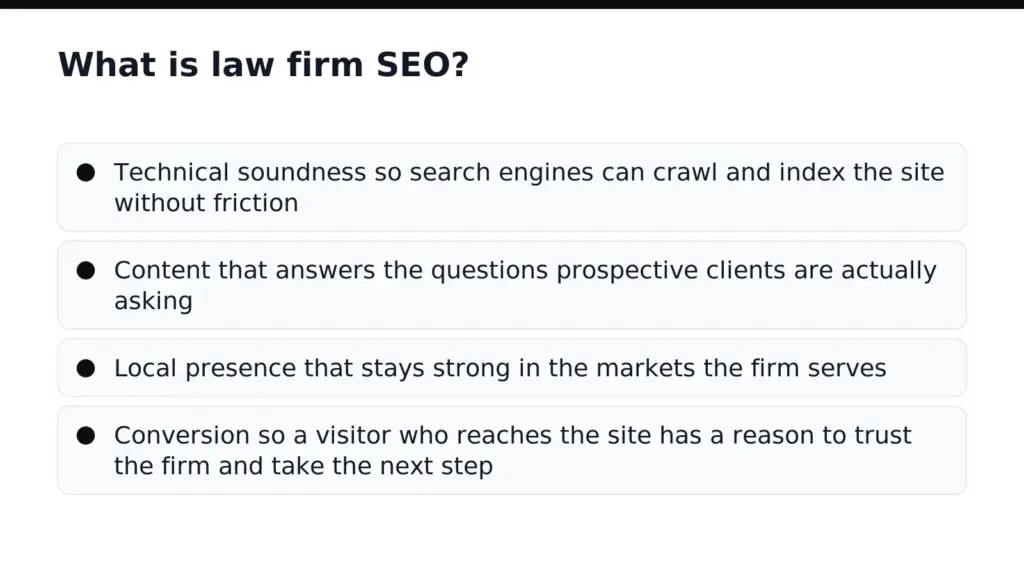
- Technical soundness so search engines can crawl and index the site without friction
- Content that answers the questions prospective clients are actually asking
- Local presence that stays strong in the markets the firm serves
- Conversion so a visitor who reaches the site has a reason to trust the firm and take the next step
How is law firm SEO different from generic SEO?
Generic SEO chases rankings. Lawyer SEO and attorney SEO chase qualified opportunities. A firm’s website has to be technically sound, its content has to match real client questions, and its local presence has to hold up in the specific markets the firm serves. Once someone reaches the site, the page has to give that person a reason to trust the firm and act.
Local SEO for lawyers adds another layer. A firm competing for cases in a defined geographic area needs its local signals aligned with the searches prospective clients run in that area. Without that alignment, visibility does not convert into consultations.

Why do rankings matter for small firms?
Search rankings determine whether a law firm gets found or gets ignored. For two decades, the law firm marketing playbook was built around a single benchmark: landing on page one of Google. Law firm SEO was a numbers game. The goal was visibility in the traditional list of ten clickable results. That benchmark is being replaced.
The shift carries real consequences for small firms. A practice that relied on organic rankings now competes against AI-generated answers that never send a click to a website. The traffic source that once fed consistent consultations is shrinking. Firms without an adaptive strategy lose the pipeline they spent years building.
How is AI changing search for law firms?
Google’s AI Overviews now answer many questions directly at the top of the results page.
What does this mean for attorney SEO strategies?
SEO for law firms must now optimize for AI-driven search surfaces. Traditional ranking signals still matter. But they are no longer sufficient. Small firms need content structured for AI extraction. They need entity recognition that connects the firm’s name, practice areas, and location to the queries AI models process. The old playbook of chasing page-one rankings alone leaves firms invisible to the massive audience engaging with AI Overviews. Local SEO for lawyers and lawyer SEO now require a dual focus: traditional rankings plus AI answer engine optimization. Firms that ignore this shift cede ground to competitors who adapt faster.
What actually moves rankings in 2026?
Google scores every eligible business against three factors for each local search: relevance, distance, and prominence. These three signals determine which law firms appear in the local pack and where they rank.
Law firm SEO in 2026 hinges on how well a firm optimizes each factor. Ignoring any one of them leaves rankings on the table. Firms that treat these as separate checkboxes lose ground to competitors who understand how the factors interact.
How does relevance affect law firm rankings?
Relevance measures how closely a Google Business Profile matches the searcher’s intent. The score draws from the firm’s chosen categories, its business description, the services listed, and how precisely the profile content maps to the actual search term. A profile with the right primary category and complete service listings holds a real advantage here. For attorney SEO, this means selecting practice-area categories with precision and listing every service the firm provides.
Why does distance still matter for local search?
Distance reflects how far the listed location sits from the searcher. This is the factor businesses have the least control over. A well-defined service area helps firms that do not operate from a single storefront. Even so, a firm further from the searcher can outrank a closer competitor when relevance and prominence scores are stronger. Local SEO for lawyers rewards firms that accept distance as a constraint and double down on the other two factors.
What role does prominence play in SEO for law firms?
Prominence captures how well-known and trusted a business appears to Google. Reviews, backlinks, directory citations, and overall web presence feed this signal. For SEO for law firms, prominence often separates the top three local results from everyone else. A firm with strong relevance and a tight service radius still underperforms without the authority signals that prominence demands.
The three factors do not operate in isolation. A lawyer SEO strategy that optimizes relevance and prominence can overcome a distance disadvantage. The full breakdown of these ranking mechanics appears in the guide on Google Business Profile ranking factors.
How do practice-area pages drive results?
Practice-area pages convert visitors into clients by answering specific legal questions with precision. A well-built page matches search intent, establishes trust, and prompts action.
What makes a practice-area page technically effective?
Technical soundness determines whether content performs at all. A page that loads slowly or displays errors loses visitors before they read a single word. The site infrastructure must support fast rendering, clean navigation, and mobile responsiveness. Without that foundation, even the most carefully written content fails to reach its audience.
How does content alignment with client questions improve rankings?
Content succeeds when it addresses the exact questions prospective clients ask. A family law page describing child custody procedures in plain language serves searchers better than generic firm overviews. Law firm SEO depends on this alignment between page content and real search queries. Attorney SEO strategies that map each practice area to specific client concerns create relevance signals search engines reward.
Local SEO for lawyers adds another layer. A personal injury page optimized for a specific city, with location references and service-area details, competes effectively in geographic searches. The combination of topical depth and local signals strengthens visibility across both organic and map results.
What role does trust play in conversion?
Once a visitor lands on the page, the content must build credibility immediately. Clear explanations of legal processes, attorney bios and straightforward next steps give readers confidence. Many state bars restrict or require disclaimers on case results and client testimonials, so check your state’s advertising rules before publishing them. SEO for law firms extends beyond rankings to include conversion architecture. The page must present a clear next step, whether that means a contact form, phone number, or consultation scheduler.
Lawyer SEO that neglects trust elements generates traffic without cases. A technically sound page with relevant content still underperforms if visitors leave uncertain about the firm’s qualifications. The three elements, technical performance, content relevance, and trust signals, work as a connected system. Remove any one component and the page’s ability to drive results collapses.
Each practice area needs its own approach. See how marketing differs for personal injury firms, estate planning attorneys and family law practices.
What role do reviews play in local SEO for lawyers?
Reviews directly shape a law firm’s prominence, one of three factors Google uses to score local search results. Google scores every eligible business against relevance, distance, and prominence for each local search. A firm with stronger review signals can outrank a competitor physically closer to the searcher.
Local SEO for lawyers depends on this mechanism. Prominence reflects how well-known and trusted a business appears to Google. Review volume, recency, and average rating feed that calculation. Review count, recency and rating together shape prominence, influencing local rankings. Each state bar sets its own rules on reviews, testimonials and how firms respond to them, so the firm should review its approach against its own state’s rules.
How do reviews interact with Google’s three local ranking factors?
Google’s three factors do not operate in isolation. A firm with weak prominence needs perfect relevance and zero distance to compete. Strong reviews offset distance disadvantages. Review count, recency and rating together shape prominence, influencing which firms appear at the top of local results. The interaction explains why review generation is not optional. It is foundational.
Why are reviews considered part of SEO rather than reputation management?
Reviews and Google Business Profile work are part of lawyer SEO. The distinction matters because reviews feed the same algorithm that ranks the local pack. A firm treating reviews as brand protection misses the ranking signal entirely. Every new review strengthens the entity Google associates with a practice area and location.
Attorney SEO strategies that separate reviews from technical optimization create a blind spot. The Google Business Profile converts review signals into local pack visibility. Firms neglecting review cadence lose prominence to competitors who systematize it. Review responses must follow ethical standards. A thoughtful reply demonstrates engagement without crossing ethical lines.
How does AI search change attorney SEO?
AI search rewrites the distribution model for attorney SEO. Traditional search engine optimization placed a firm inside a list of 10 blue links. AI-generated answers now sit above those links and answer the query directly. A growing share of people who need a lawyer never scroll past that summary.
The shift carries real consequences. Firms invisible to AI overviews lose visibility even when traditional rankings hold steady.
What replaces the traditional ranking benchmark?
The old benchmark asked one question: did the firm land on page one? The new benchmark measures recognition, consistency, and trust across the web. AI models pull answers from multiple sources and synthesize them. A firm must appear in enough trusted locations that the model selects its information as authoritative.
Lawyer SEO now requires structured, factual content that AI systems can extract and cite. Vague practice area pages fail this test. Detailed, well-organized information succeeds.
How does local visibility shift under AI search?
Local SEO for lawyers changes because AI overviews often pull from Google Business Profiles, legal directories, and review sites simultaneously. Consistency across those platforms matters more than any single ranking signal. A firm with mismatched addresses or outdated practice area listings confuses the AI and drops from consideration.
SEO for law firms that once relied on proximity and a handful of citations now demands broader digital consistency. The AI cross-references information. Discrepancies reduce trust in the model’s output and eliminate the firm from the answer set. Firms competing for AI search visibility must treat every public mention as a potential citation source.
What should you ask an SEO provider?
Most lists of SEO agencies are written by the agencies ranking themselves number one. The legal SEO industry is going through a genuine shift right now. Google’s AI Overviews have swallowed a significant portion of informational search traffic. A provider that cannot explain this shift is working from an outdated playbook.
The first question a law firm owner should ask is how the provider’s approach has changed in response to AI-driven search. A credible answer references specific adjustments to content strategy, technical infrastructure, and conversion tracking. Vague promises about rankings signal a provider still operating from a 2019 playbook.
How does the agency measure success beyond rankings?
Rankings alone no longer capture the full picture. AI-generated summaries now answer many queries before a user ever clicks a result. Providers should track visibility inside AI Overviews, click-through rates from local packs, and qualified consultation requests. A narrow focus on keyword positions misses the channels where prospective clients actually find legal help.
What does the provider’s own content strategy look like?
Examine the agency’s published work. A provider that publishes thin, repetitive content cannot credibly build authority for a law firm. The depth of their own articles, the structure of their content hubs, and their approach to answering user questions directly reveal whether they practice what they sell. An SEO strategy framework built for owner-led service businesses prioritizes achievable targets and comprehensive topic coverage over scattered blog posts.
Firms investing in law firm SEO need a partner who treats search as a connected system. Technical soundness, content that matches real client questions, and strong local signals all contribute to sustainable visibility. A provider who cannot articulate how these pieces interact is unlikely to build lasting visibility.
How do you build a sustainable SEO system?
A sustainable SEO for law firms system measures outcomes, not spreadsheet metrics. SEO should not be judged by how many keywords show up in a spreadsheet. The real test is whether the system produces cases consistently, month after month, without requiring constant founder intervention.
Firms that chase rankings alone build fragile engines. Those engines collapse when algorithm updates hit or when a key vendor departs. A durable system connects every component toward the same objectives. Strategy, content, development, local search, authority, conversion, and reporting all work toward the same goals. No single piece carries the entire load.
What makes a law firm’s SEO system transferable?
Transferability matters most when a firm prepares for sale. A firm’s marketing function must be transferable when due diligence shows up. Buyers underwrite metrics like pipeline predictability, retention, and customer concentration. They also examine whether the marketing engine runs without the founder. A system dependent on one person’s relationships or institutional knowledge loses value immediately.
How does local search fit into a sustainable system?
Local SEO for lawyers anchors the system in geography. A firm with strong local signals captures high-intent searches from prospects ready to hire. The local presence feeds authority, which strengthens content performance, which improves conversion rates. Each element reinforces the others.
What role does conversion play in long-term SEO success?
Conversion closes the loop. Attorney SEO efforts that drive traffic without converting visitors waste budget and time. A sustainable system tracks what happens after the click. It measures consultation bookings, not just impressions. It optimizes pages for trust signals that turn researchers into retained clients. Without conversion data, the system operates blind to its own effectiveness.
FAQ
What are the three factors Google uses to rank law firms?
Google scores every eligible business on relevance, distance, and prominence for each local search.
How does law firm SEO differ from generic SEO?
Generic SEO chases rankings. Lawyer SEO and attorney SEO chase qualified opportunities.
How is AI changing search results for law firms?
Google’s AI Overviews now appear above traditional search results, answering questions directly on the search page.
Conclusion
The decision is straightforward: law firm SEO now demands a system built for AI-driven search, not a checklist of rankings. Firms that align content, local signals, and conversion tracking into one transferable engine build visibility that lasts and a marketing function that holds up if the firm is ever sold. For how SEO fits into a firm’s wider marketing, see Ronin’s approach to law firm marketing. This article is general information, not legal advice.
About the author
Justin Smith is the founder of Ronin Communications, a fractional CMO practice for owner-led businesses. He spent more than 20 years writing and leading strategic communications for the federal government and holds an M.A. in Strategic Communications from American University.