
B2B public relations builds credibility, visibility, and trust with business buyers, analysts, and partners through strategic relationship-building, not press release distribution. DPR Group confirms PR functions as a lead generation and awareness tool across trade publications, social media, and review sites. Ronin Communications is a fractional CMO practice serving founder-led B2B service businesses.
Key Takeaways
- B2B PR builds credibility, visibility, and trust through strategic relationship-building, not press release distribution.
- Effective B2B PR strategies match stories to specific journalists and analysts, measuring results against business objectives.
- B2B buyers research across trade publications, social media, review sites, and third-party forums before purchasing.
- Media coverage replaces cold outreach by building long-term connections, with journalist features carrying independent weight.
Why Does B2B PR Fail Without a Strategy?
Most B2B companies treat public relations as a press release factory. They announce a product, send it to a media list, and hope something sticks. That approach rarely works, and it is not what PR actually is. A Public Relations Strategy for B2B Growth requires deliberate planning, not distribution volume.
B2B public relations is the strategic practice of building credibility, visibility, and trust with business buyers, industry stakeholders, journalists, analysts, and partners. It is relationship-building with evidence attached. Without that strategic foundation, results vary widely because. Many variables are in play: how the audience is defined, what business objective the effort actually solves for, the quality of the story, whether the spokesperson can deliver it, timing. Follow-through across owned and earned channels.
What Happens When B2B PR Lacks Direction?
A brilliant pitch to the wrong journalist accomplishes nothing. The failure is not in the writing. The failure is in the targeting. B2B PR strategies that skip audience definition and objective-setting produce activity without outcomes.
Consider the contrast:
Why Do Results Vary So Widely?
Results vary because the variables are not controlled. Audience definition, story quality, spokesperson capability, timing, and follow-through each determine whether media relations for B2B produce credibility or noise. Effective media outreach strategies address these variables before a single pitch goes out.
What Are the Core Components of B2B PR?
A Public Relations Strategy for B2B Growth rests on four pillars: credibility, visibility, lead generation, and multi-channel reach. Walker Sands identifies PR as a critical piece of a complete marketing program, one that delivers measurable business outcomes when planned and executed with discipline.
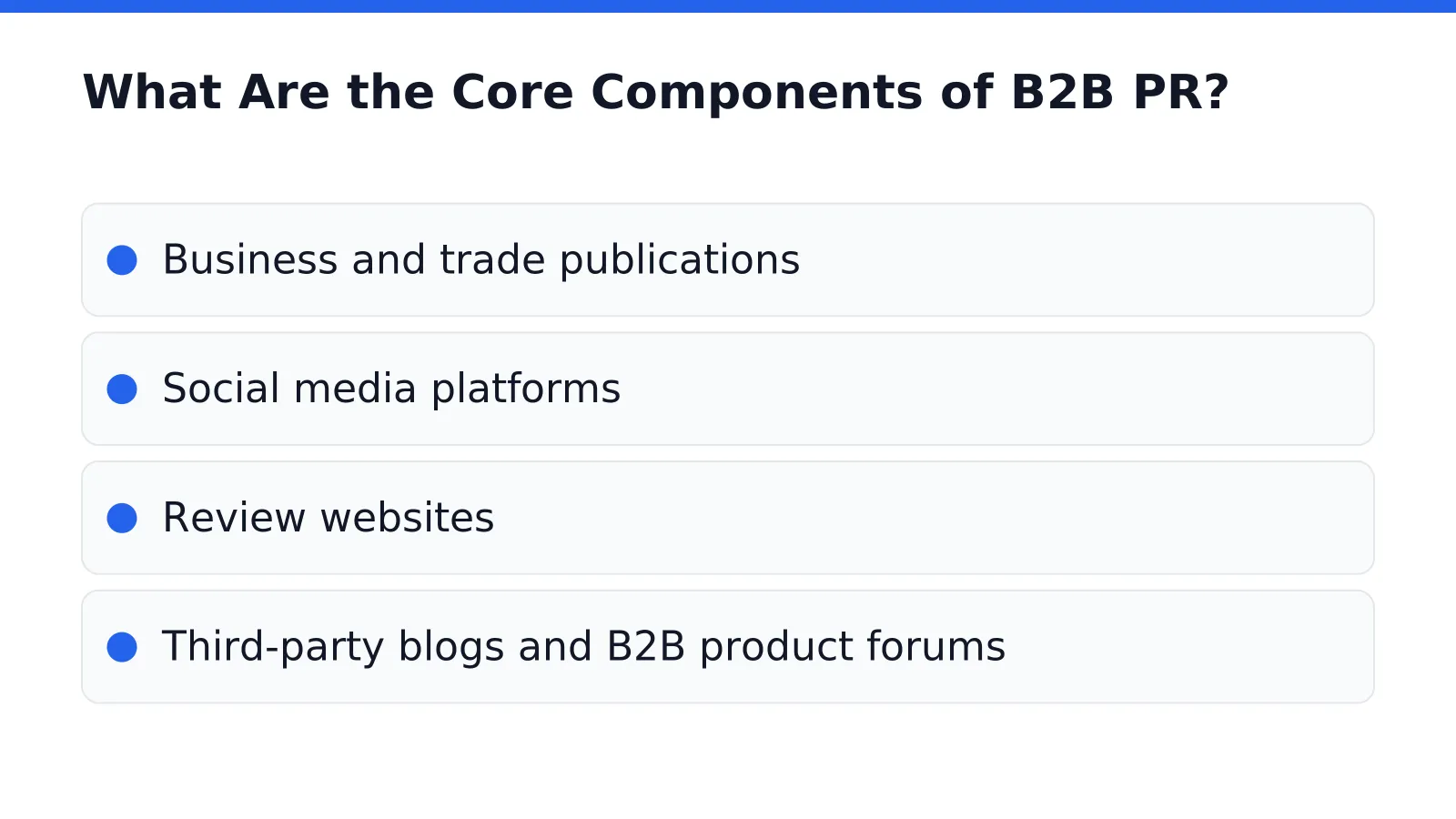
B2B buyers are information-savvy and research-oriented. They evaluate purchasing decisions through multiple sources before engaging a vendor. That behavior forces B2B organizations to appear across business and trade publications, social media, review websites, and third-party sources like blogs or B2B product forums.
What Channels Should a B2B PR Strategy Cover?
Effective B2B PR strategies distribute stories across every channel that influences purchasing decisions:
- Business and trade publications
- Social media platforms
- Review websites
- Third-party blogs and B2B product forums
A single-channel approach misses buyers who research elsewhere. Walker Sands notes that reaching prospects requires a strategic, multi-pronged approach to public relations.
Why Does Media Outreach Need a Plan?
Blindly pitching reporters and commenting on breaking news without a solid plan is risky. It limits results and wastes credibility. Media relations for B2B demands a defined strategy before any outreach begins.
The core components work together. Credibility comes from consistent, evidence-backed storytelling. Visibility comes from multi-channel distribution. Lead generation follows when both operate under one disciplined framework.

How Does Media Relations for B2B Build Trust?
Media relations for B2B builds trust by placing a company’s expertise in front of business buyers through channels those buyers already respect. Trade publications, industry analysts, and specialized journalists carry independent credibility that paid advertising cannot match. A business that appears consistently in these outlets gains third-party validation. That validation matters because B2B purchasing decisions involve research, scrutiny, and multiple stakeholders.
B2B marketing focuses on building long-term relationships and addressing specific business needs, according to Salesforce. Media relations serves that goal directly. When a journalist covers a company’s insight or solution, the coverage functions as an endorsement from a neutral party. Buyers weigh that endorsement differently than a vendor’s own claims.
Why Does Third-Party Coverage Matter More Than Advertising?
Third-party coverage matters more because B2B buyers are information-savvy and research-oriented. They evaluate purchasing decisions through business publications, trade media, and industry forums. A mention in a respected outlet signals that editors found the company’s perspective worth publishing. That signal reduces perceived risk for a buyer evaluating an unfamiliar vendor.
Traditional prospecting tactics are losing effectiveness, per ValueSelling Associates. Cold outreach and mass email no longer produce the same response. Media coverage replaces chasing leads with building meaningful, long-term connections. A buyer who reads about a company before the first sales call enters that conversation with existing familiarity.
What Does Media Relations Deliver That Direct Outreach Cannot?
Media relations delivers credibility that direct outreach cannot manufacture. A sales representative can claim expertise. A journalist’s decision to feature that expertise carries independent weight. B2B is the commercial space where one business sells to another business, not to individual consumers. That structure means purchase decisions involve longer cycles and more scrutiny.
The approach treats media relations as a sustained practice, not a one-time press release. Consistent coverage compounds. Each published piece adds to a company’s visible track record. Buyers researching a vendor encounter that record across multiple channels. The accumulated evidence shapes their perception before any direct conversation begins.

Why Are Relationships More Effective Than Volume?
B2B marketing centered on high-volume lead generation for years. Cold calls, mass emails, and large-scale trade shows were the gold standard for filling the sales funnel. That playbook no longer works. Only 1–3% of potential buyers are actively in the market at any given time, according to Moaaz Nagori, Head of Marketing at ConvergeX Connections. Volume tactics waste resources on buyers who are not ready to purchase.
A Public Relations Strategy for B2B Growth shifts the focus from chasing transactions to building credibility with the silent majority. B2B PR strategies that prioritize relationships keep a company visible and trusted long before a prospect enters a buying cycle. When that prospect finally has a need, the relationship is already in place.
What replaces the old volume playbook?
High-impact networking and sustainable revenue growth share a direct connection. Practical alternatives include:
- Micro-events that bring small, targeted groups together for meaningful conversation rather than mass attendance
- B2B influencer marketing that puts company expertise in front of audiences who already trust the messenger
- Ongoing media relations for B2B that earn coverage in publications buyers actually read
How do relationships convert the 97% who aren’t buying yet?
The 97% of out-of-market buyers still consume information. They read trade publications, follow industry voices, and attend events. A relationship-first approach keeps a company in that information stream. When a need surfaces months later, the business that stayed present wins the call. Volume tactics burn budget on the 1–3% while ignoring the majority who will buy eventually. Relationship-based strategies build the pipeline without wasting resources on cold outreach that gets ignored.
Companies that master this shift stop competing on noise. They compete on trust built over time, which no volume campaign can manufacture.
How Do You Build a PR Strategy That Compounds?
A compounding Public Relations Strategy for B2B Growth starts with foundation work, not outreach. Companies that skip straight to pitching reporters burn credibility and limit results. The DPR Group frames effective PR as relationship-building with evidence attached, not a distribution tactic.
B2B PR strategies fail most often when the groundwork is missing. Blindly pitching journalists without a defined audience, a clear business objective, or a spokesperson ready to deliver creates risk without reward. Variables multiply fast: story quality, channel selection, and follow-through across owned and earned media all determine whether the investment compounds or collapses.
What Foundation Must Exist Before Any Media Outreach?
A strong foundation requires three elements locked in place before the first pitch. The audience definition must be precise. The business objective the PR program serves needs explicit articulation. The spokesperson requires preparation to carry the story credibly. Skipping any of these three elements produces activity without accumulation.
How Do Owned and Earned Channels Work Together?
Owned channels provide the evidence. Earned channels provide the amplification. A company blog, research report, or case study gives journalists something concrete to reference. Media relations for B2B then distributes that evidence through publications buyers actually read. Without owned content backing the pitch, earned media coverage lacks substance. Without earned distribution, owned content sits unseen.
Ronin Communications embeds as the marketing leader inside founder-led B2B service businesses, setting strategy and building the operating system through The Ronin Method. The four-stage framework sequences foundation work before amplification, so every media placement references real proof points rather than empty claims.
FAQ
Why does B2B PR fail without a strategy?
Most B2B companies treat PR as a press release factory, sending announcements to broad media lists without deliberate planning or audience definition.
What are the core components of B2B PR?
The four pillars are credibility, visibility, lead generation, and multi-channel reach across trade publications, social media, and review sites.
How do B2B buyers research before purchasing?
B2B buyers evaluate decisions through trade publications, social media, review sites, and third-party forums before engaging a vendor.
Conclusion
A B2B public relations strategy that compounds requires the same discipline as any other growth investment: define the audience, lock in the objective, prepare the spokesperson, and sequence owned content before earned amplification. Companies that build this foundation stop competing on noise and start competing on trust accumulated over time. The next step is auditing whether the current PR activity builds that foundation or burns budget on activity without accumulation.