
Google Maps rankings move when a business systematically optimizes three factors: relevance, distance, and prominence. Relevance demands precise categories and service descriptions matching search intent. Distance considers the listed location from the searcher. Prominence reflects authority from reviews and citations. Google rewards businesses that prove accuracy across every signal (Name, Address, Phone) without inconsistencies weakening local authority.
Key Takeaways
- Google Maps rankings move when a business systematically optimizes relevance, distance, and prominence.
- Relevance demands precise categories and service descriptions matching search intent.
- Google rewards businesses that prove accuracy across every Name, Address, Phone signal without inconsistencies.
- Measure rankings across the whole service area with a geo-grid, not from one search at the office.
What does local SEO for small business actually involve?
Local SEO for small business is the systematic process of optimizing a company’s digital presence to appear in geographically relevant search results. Google scores every eligible business against three core factors for each local search: relevance, distance, and prominence. These factors interact in ways that explain why a business further from the searcher can still outrank one that is closer.
How does Google determine which businesses to show?
The ranking mechanism rests on a three-part framework. Understanding each factor reveals where effort produces the greatest return.
- Optimize for relevance first. Relevance measures how well a business profile matches the searcher’s intent. This comes from the primary category, the business description, the services listed, and how closely the Google Business Profile content maps to the actual search term. A profile with the right primary category and complete service listings holds a real advantage.
- Acknowledge the role of distance. Distance considers how far the listed location is from the searcher or the area specified in the query. This is the factor businesses have the least control over, though a well-defined service area helps for companies that do not operate from a single storefront.
- Build prominence over time. Prominence reflects how well-known and trusted a business is, both online and offline. Review count, review score, and the strength of a web presence all feed into this signal.
What information does Google trust most?
Google relies on accurate information to trust a listing. Details such as the business name, address, phone number, URL, hours, and categories must remain consistent across the website and other platforms. When these signals stay clear and uniform, visibility becomes stronger and more predictable.
The interplay of these three Google Business Profile ranking factors determines whether a business appears in the local pack or fades into the background. A company that neglects any single factor cedes ground to competitors who address all three.
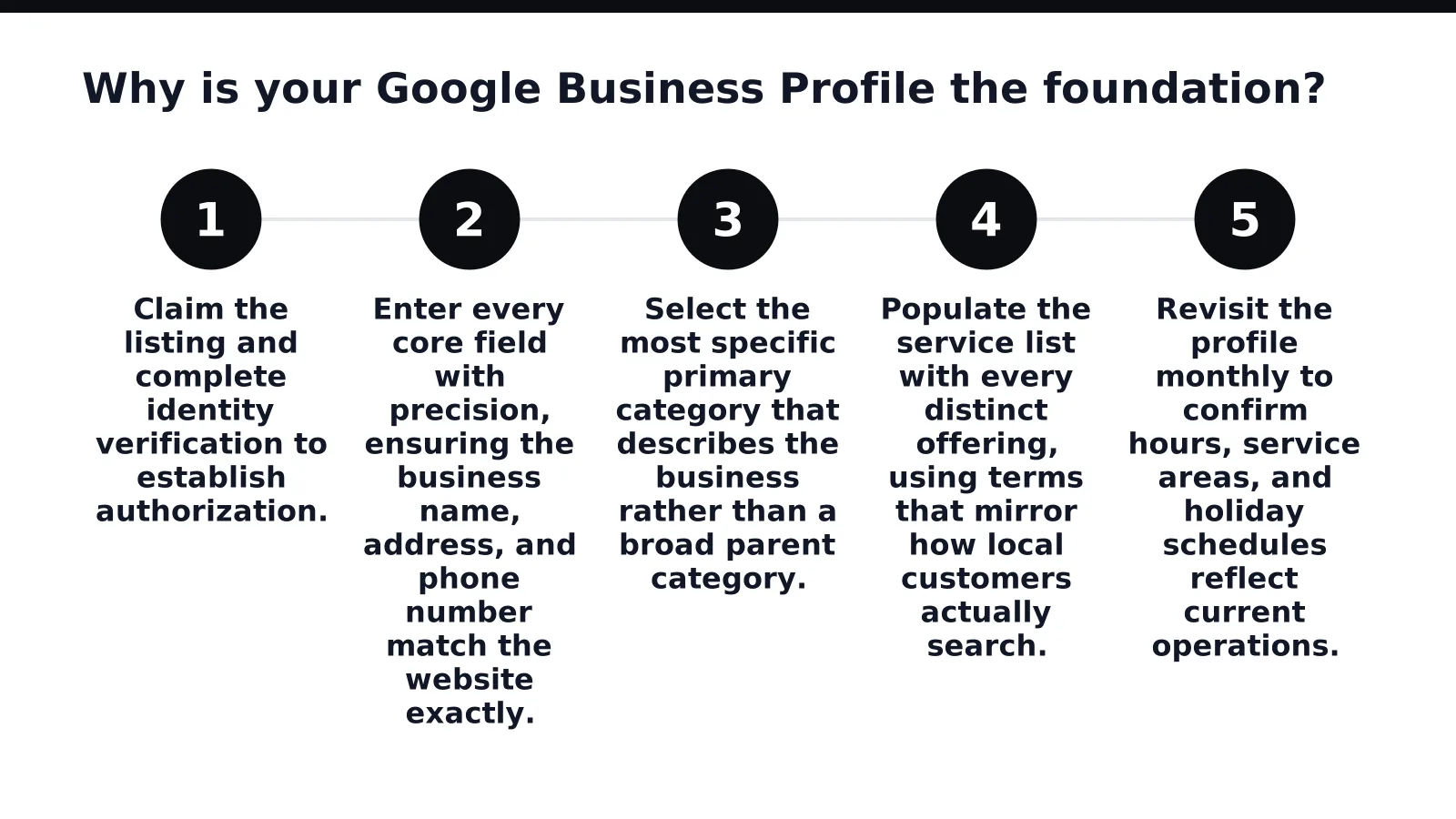
Why is your Google Business Profile the foundation?
A Google Business Profile forms the single most critical element of local SEO for small business. No other local signal carries comparable weight. It is widely treated as the most important local SEO factor and needs complete, ongoing accuracy. Without it, a service business forfeits its claim to the map pack and the visibility that drives phone calls and site visits.
What exactly does a verified profile signal to Google?
Verification does more than unlock editing permissions. Submitting the verification code tells Google that an authorized representative controls the listing. Google prioritizes verified profiles, and unverified businesses rarely surface in map results. The verification step directly influences whether a business appears when nearby customers search for services the company offers.
How does profile completeness affect local search visibility?
Businesses with complete and accurate information earn higher placement in local search results. Google’s own guidance states this plainly. Every field matters: business name, physical address, phone number, operating hours, website URL, and service areas. Incomplete listings erode trust. Gaps or contradictions across the profile create friction that pushes a business lower in the rankings.
What gives a profile the edge in relevance matching?
Relevance hinges on category selection and service definitions. Google scores every profile against the searcher’s intent, and a listing with the correct primary category and fully populated service listings holds a measurable advantage. A plumbing company choosing “Plumber” as its primary category and listing every service from water heater repair to drain cleaning matches more intent signals than a competitor that stops at a generic category. Those signals compound. Each precise match between a search term and a defined service strengthens the profile’s relevance score.
The sequence matters in a specific order:
- Claim the listing and complete identity verification to establish authorization.
- Enter every core field with precision, ensuring the business name, address, and phone number match the website exactly.
- Select the most specific primary category that describes the business rather than a broad parent category.
- Populate the service list with every distinct offering, using terms that mirror how local customers actually search.
- Revisit the profile monthly to confirm hours, service areas, and holiday schedules reflect current operations.
For the full field-by-field list, see the Google Business Profile optimization checklist.
A how to rank on Google Maps strategy without these fundamentals leaves ranking potential on the table. Google Maps ranking rewards the business that treats its profile as a living asset, not a one-time setup. Owners of service companies who neglect profile upkeep lose map impressions to competitors who maintain better data hygiene. That impression gap translates directly into missed bookings and revenue leakage that compounds week over week.

How do you choose categories that match search intent?
Categories communicate to Google exactly what a business is and which search queries it should surface for. The primary category and service listings must map closely to the actual search term a prospective client types. Without that alignment, a listing competes for the wrong clicks or no clicks at all.
What is the difference between what a business is and what it offers?
Specific categories describe what the business is at its core, not merely the services it provides. A plumbing contractor selecting “Plumber” as its primary category signals Google that it belongs in results for “plumber near me.” Services like “drain cleaning” or “water heater repair” supplement that signal without replacing the fundamental identity.
Category selection follows three steps:
- Identify the single highest-volume search term that directly names the business type and assign it as the primary category.
- Select the most specific secondary categories that represent core distinct capabilities without diluting topical authority.
- Align GBP service listings with the same terminology used in category fields so Google’s relevance engine matches profile content to user queries without ambiguity.
Can secondary categories weaken local visibility?
Secondary categories create risk when they blur rather than sharpen what the business is. A general contractor adding “Handyman” as a secondary category competes against different competitors and often lower-value queries. Each additional category instructs Google to evaluate the profile against a broader set of search terms. That breadth comes at the expense of precision.
The category audit evaluates every current field against one question: does this match the exact phrasing a ready-to-buy client uses? Categories that fail the test get cut. The result is a tighter signal that competes more effectively for the terms that drive revenue.
What role do reviews play in Google Maps ranking?
Customer reviews shape Google Maps ranking through their influence on trust and prominence signals. These two factors directly affect where a business appears in local search results. Without a steady flow of fresh feedback, a listing loses the engagement signals that Google rewards.
Business owners pursuing local seo for small business should treat reviews as a core ranking lever, not a cosmetic extra. Google evaluates both the quantity and quality of feedback when determining local pack positions. A profile with recent, positive reviews signals ongoing relevance to the algorithm. Customer reviews, local citations, and community-based links build trust and prominence, which directly impact map rankings.
The mechanics break down into three distinct signals:
- Recency signals that a business remains active and engaged with its customer base
- Response rate demonstrates that ownership values customer feedback and manages the listing actively
- Sentiment provides relevance cues that match a business to search intent
How does review recency compare to total review volume?
Recency matters alongside total volume. A business earning reviews every month can outrank a competitor with a larger but stale review count. This shift reflects Google’s preference for businesses demonstrating current, ongoing engagement rather than historical popularity alone.
The practical implication is clear. Consistent, modest review generation beats accumulating a large count and then stopping. Read more about review recency versus volume.
Should owners respond to every review?
Responding to reviews improves rankings and builds trust with potential customers. Requesting and responding to reviews strengthens both visibility and credibility. The response itself becomes content that Google can parse for relevance signals about the business.
Professional replies to negative reviews demonstrate operational competence. Acknowledging positive ones reinforces the behaviors that generate future reviews. Review management is integrated into local SEO strategy rather than offered as a standalone service. The work touches categories, service listings, and engagement signals simultaneously.
Why does NAP consistency matter across citations?
NAP consistency determines whether Google trusts a business listing enough to show it in local search results. A citation is any mention of a business name, address, and phone number on another site, directory, or platform. When those three data points match exactly across every citation, Google’s confidence in the listing increases. Mismatched details erode that confidence and hurt rankings.
Business owners often underestimate how quickly inconsistencies spread. Foundational data aggregators feed NAP information into dozens of smaller directories automatically. A single error at the aggregator level propagates across the entire citation network within weeks. Fixing the aggregators first prevents errors from multiplying downstream.
How do NAP errors affect local search visibility?
Citation signals carry a smaller share of overall local ranking weight than Google Business Profile or reviews. Yet citations form the foundation those other signals depend on. A business with strong reviews but conflicting addresses across directories sends mixed signals to Google’s algorithm. The search engine responds by lowering the listing’s prominence in local results.
The damage compounds over time. Each inconsistent citation weakens the trust layer that Google builds around a business profile. Competitors with clean, uniform NAP data consistently outrank businesses with scattered errors. The ranking gap widens as Google processes more conflicting information.
What steps fix NAP inconsistencies across directories?
- Audit every existing citation for the business name, address, and phone number.
- Identify mismatches between the current listing and what appears on each directory.
- Correct errors on foundational data aggregators before touching smaller directories.
- Update remaining citations to match the verified NAP exactly.
- Monitor new citations monthly to catch inconsistencies before they spread.
A thorough NAP audit and consistency fix reveals how many directories carry outdated or incorrect information. Citation accuracy is a prerequisite for any local SEO for small business strategy. Without clean NAP data, even the best local SEO tips produce limited results.
Businesses that ignore NAP consistency lose ground to competitors who maintain uniform listings. The cost shows up as fewer map appearances and missed phone calls from nearby customers. For service businesses operating in competitive local markets, that visibility gap translates directly into lost revenue.
How do you build location pages that rank?
Location pages rank when every detail matches what Google expects to find. A business name, address, phone number, URL, hours, and categories must stay identical across the website and all external platforms. Mismatched details erode Google’s confidence and suppress visibility.
The foundation starts with accurate core information. Details such as name, address, phone number, URL, hours, and categories must match across the website and other platforms. When these elements drift out of alignment, Google becomes less confident in the listing’s legitimacy. That hesitation costs rankings.
What directories matter most for location pages?
Two directory types carry distinct weight. Industry-specific directories like Angi and HomeAdvisor for contractors or Avvo for attorneys carry more relevance weight than generic platforms. These trade-specific listings signal deeper authority to Google’s local algorithm.
General directories also matter. Broad business listing sites carry meaningful domain authority and are worth claiming and completing properly. A complete, accurate presence on both directory types builds the citation consistency Google rewards.
How does localized content affect page performance?
Content specificity matters more than it used to. Search engines distinguish genuine, localized content from templated filler with increasing precision. Pages that describe actual service areas, neighborhood landmarks, and location-specific offerings outperform generic duplicates.
The process follows a clear sequence:
- Audit every existing citation for NAP consistency across all platforms.
- Claim and complete profiles on industry-specific directories first.
- Expand to general directories with strong domain authority.
- Write location-specific content that references real service details.
- Verify all hours, categories, and URLs match the website exactly.
Each step compounds the next. Industry directories establish relevance. General directories reinforce prominence. Consistent details across both prevent the drift that triggers ranking declines.
How do you measure visibility across a service area?
Measuring visibility across a service area starts with understanding Google’s distance factor. Distance is how far a listed location sits from the searcher or from the location implied in their search. A well-defined service area helps businesses that do not operate from a single storefront.
How does Google determine distance for service-area businesses?
Google calculates distance from the address on file, not from the searcher’s perception of the business. For companies without a fixed storefront, a properly configured service area becomes the primary signal. This setting tells Google which neighborhoods and zip codes the business actually serves.
What tools track rankings across multiple locations?
A geo-grid audit maps ranking positions across every point in a service area. Ronin offers a free geo-grid audit, and it is built into its local SEO work. The grid reveals precisely where visibility drops off and where competitors overtake the listing.
Business owners who skip this measurement lose visibility in pockets they never see reported. A consistent local SEO for small business strategy leads to more visibility, phone calls, and foot traffic over time. Without systematic tracking, those losses compound silently.
Why do some businesses outrank closer competitors?
Google scores every eligible business against three factors: relevance, distance, and prominence. A business further from the searcher can still beat a closer one when its profile demonstrates stronger relevance and prominence. This explains why Google Maps ranking shifts block by block rather than following a simple radius from the address.
The distance factor remains the one businesses have the least control over. However, a well-defined service area gives service-area businesses a lever that storefront-only competitors lack. Pairing that definition with steady review generation and category optimization strengthens the other two ranking pillars.
What common mistakes should you avoid in local SEO?
Small businesses chasing local SEO for small business gains often sabotage their own visibility through preventable errors. The most damaging mistakes erode Google’s confidence in a listing and waste the compounding power of consistent marketing effort.
Why does inconsistent business information hurt rankings?
Google relies on accurate name, address, and phone number (NAP) data to trust a listing. When NAP elements drift out of alignment, Google becomes less confident in showing the business, which leads to inconsistent rankings. A single mismatched phone number across directories signals unreliability. The algorithm then hesitates before surfacing that profile in local results.
What happens when a strategy has no ongoing owner?
A strategy handed over at the end of a project usually sits in a drawer because nobody has the time to run it. Marketing results compound. Rankings, reviews, referral relationships, email lists, and tracking all get more valuable the longer someone tends them. Without dedicated oversight, the local seo tips that drive google maps ranking gains become shelfware. The business loses the accumulated authority that consistent optimization builds over months and years.
How do duplicate or unmanaged profiles damage visibility?
Multiple unmanaged profiles confuse both customers and Google’s systems. The search engine cannot determine which listing to prioritize. This fragmentation splits review counts and dilutes the relevance signals that determine how to rank on google maps. Businesses with several locations face even greater risk. Managing multi-location profiles demands strict consistency across every listing to avoid these ranking penalties.
FAQ
What are the three factors that move Google Maps rankings?
Google Maps rankings move through relevance, distance, and prominence. Relevance requires precise categories and service descriptions. Distance considers the listed location from the searcher. Prominence reflects authority from reviews and citations.
Why is a Google Business Profile the most important local SEO element?
A Google Business Profile is the single most critical local SEO factor. No other local signal carries comparable weight. Complete optimization and ongoing accuracy of this profile directly determine map pack visibility and phone call generation.
What information does Google trust most for local rankings?
Google trusts consistent Name, Address, and Phone signals across the website and other platforms. Uniform business name, address, phone number, URL, hours, and categories strengthen visibility. Inconsistencies weaken local authority and ranking predictability.
Conclusion
Google Maps rankings reward businesses that control relevance, distance, and prominence through systematic work. Owners who audit citations, define service areas, and refresh localized content own the advantage. Apply these levers consistently and visibility builds over time. To see where you show up across your service area today, start with a free geo-grid audit.
About the author
Justin Smith is the founder of Ronin Communications, a fractional CMO practice for owner-led businesses. He spent more than 20 years writing and leading strategic communications for the federal government and holds an M.A. in Strategic Communications from American University.