Roofing companies rank in Google Maps through relevance, distance, and prominence, optimizing categories, descriptions, and services to match search intent. The map pack shifts at every address, so rankings at the office vanish miles away. That makes visibility across the whole service area, not just at the office, the goal.
Key Takeaways
- The map pack generates a different result at every address a homeowner searches from.
- The map pack sits above the organic results, so the top three spots get a large share of local clicks.
- Relevance, distance, and prominence determine which profiles appear in the map pack and in what order.
- A profile with strong relevance and high prominence beats a closer competitor with a weaker profile.
What is roofing SEO?
Roofing SEO is the process of optimizing a website and Google Business Profile for one or more service locations. A roofing company in Google Maps cannot rely on a single ranking position. The map pack yields a different result at every address a homeowner searches from.
The practice centers on two connected but distinct goals. First, ranking in Google’s Local Map 3-Pack. Second, ranking in traditional organic search for city- and service-specific queries. Both channels feed the same outcome: phone calls from homeowners ready to hire.
Why does the map pack ranking matter for roofers?
Ranking within the top three results matters because the map pack appears above the organic listings, and most homeowners call from it without scrolling further. A roofing company sitting in position four or lower is hidden behind a “more places” click.
The map pack is not a static ranking. It shifts with the searcher’s physical location. A business that appears first at the office often vanishes three miles away. Local SEO for roofers addresses this proximity problem directly by building signals that expand visibility across an entire service area.
What does roofing SEO include beyond the map pack?
The discipline also covers business citations on directories like Yelp and Angi. These citations reinforce the location data Google uses to trust a profile. Organic rankings for service-specific queries provide a second path to capture demand. A complete roofing company SEO strategy treats both the map pack and organic results as interdependent assets.
Effective roofing marketing connects these technical optimizations to revenue. Without systematic local visibility, a roofing business loses calls it never knows existed. The companies holding top positions before storm season are the ones that capture the surge when it arrives.
Why does the map pack change by location?
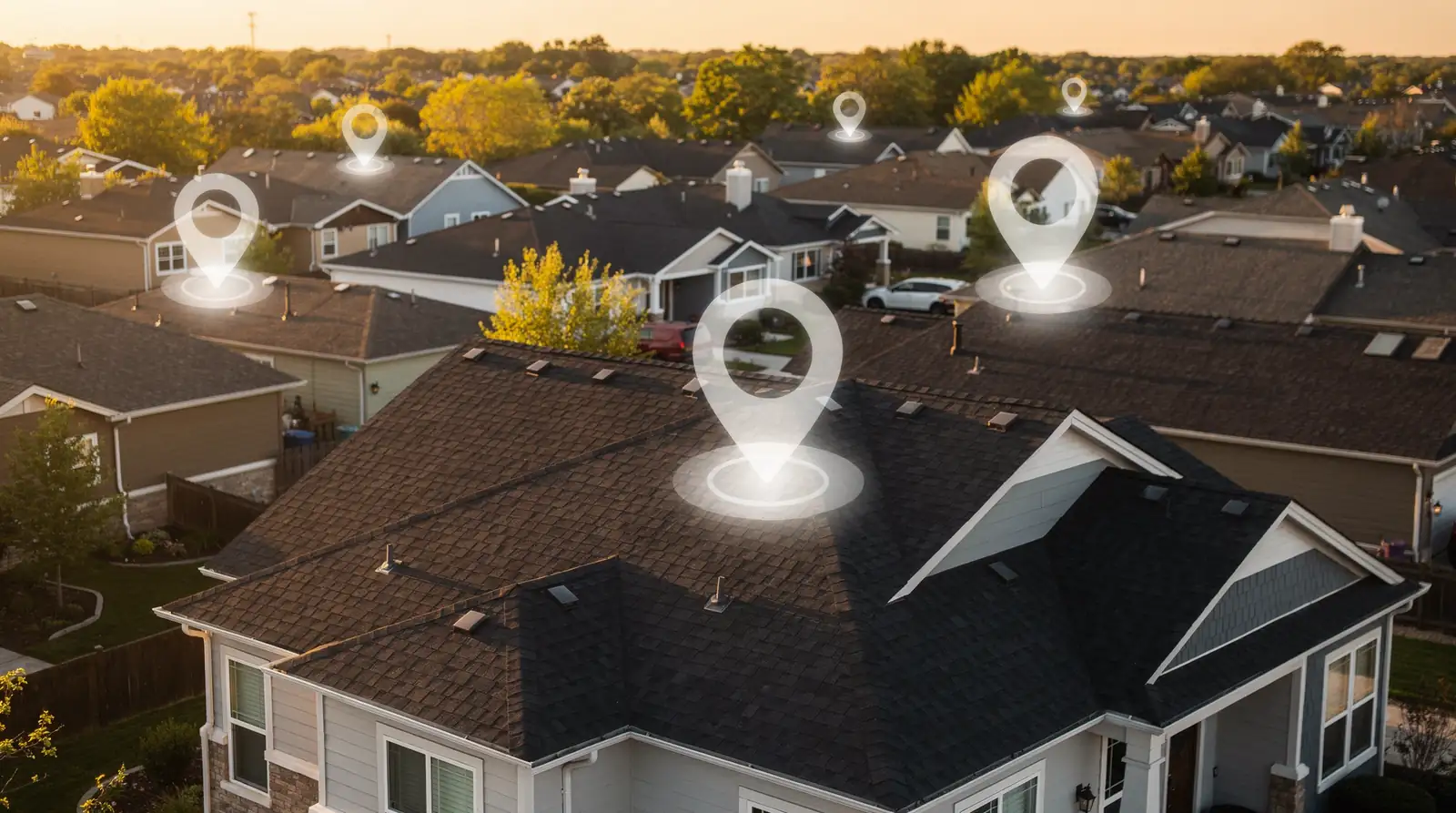
The map pack produces a distinct ranking at every address a homeowner searches from. Google does not assign a single, fixed position to a roofing company. The search engine recalculates the local results based on where the query originates.
A roofing contractor often reports a number-one ranking. That ranking reflects the view from the office. Drive four miles toward a target service neighborhood and the same profile disappears. The business that dominated the screen at headquarters vanishes where the actual customers live. Most local seo for roofers only improves visibility at the contractor’s office address, not across the full service area where work is performed.
What three factors does Google use to rank local businesses?
Google evaluates every eligible business against three factors for each local search: relevance, distance, and prominence. Relevance measures how well a profile matches the search term. Distance reflects how far the listed location sits from the searcher. Prominence captures the business’s overall visibility across the web. A company further from the searcher can still outrank a closer competitor when relevance and prominence outweigh the distance gap.
Why does a roofer rank well at the office but not in nearby neighborhoods?
The office address anchors the distance calculation. When a search originates from that exact spot, the proximity score hits its maximum. Move the search origin three or four miles away and the distance factor shifts. Competitors with stronger relevance signals or higher prominence now enter the map pack. The roofer who appeared dominant at the office drops out because the algorithm recalculates the three-factor score from the new location. Roofing company seo that ignores this dynamic leaves entire neighborhoods uncovered.
Roofing seo strategies must account for how proximity reshapes the competitive field. A local SEO audit reveals exactly where a profile gains and loses visibility across a service area. Without that data, roofing marketing budgets fund rankings that only the business owner ever sees.
How do relevance, distance, and prominence work?
Google evaluates every eligible business against three factors for each local search. Relevance measures how well a profile matches what the searcher is looking for. This comes from categories, the business description, and the services listed on the Google Business Profile. A roofing company with the correct primary category and complete service listings holds a clear advantage over competitors with sparse or mismatched profiles.
Distance reflects how far the listed location is from the searcher. It also accounts for the location implied in the search term itself. A homeowner searching “roofer near me” in Google Maps triggers a distance calculation from their device. A search for “roofing contractor [neighborhood name]” shifts the center point to that area.
Which ranking factor do businesses control the least?
Distance is the factor businesses have the least control over. A physical address cannot move closer to every searcher across a service area. However, a well-defined service area helps businesses that do not operate from a single storefront. Specifying the neighborhoods and cities served signals to Google where the business is willing to travel.
Why does a business farther away sometimes outrank a closer one?
The three factors interact. A profile with strong relevance and high prominence can beat a closer competitor with a weaker profile. Prominence reflects how well-known and trusted a business appears online, based on reviews, backlinks, and directory presence. Understanding how these factors interact explains why a business further from the searcher can still beat one that is closer. A roofing company with a steady stream of reviews, a complete service list and consistent citations can outrank a nearer competitor with a thin profile. The full breakdown of these Google Business Profile ranking factors shows how each element contributes to local visibility.
What should your Google Business Profile include?
A Google Business Profile needs a precise primary category, complete service listings, and verified business information. Profiles missing these elements lose visibility in local search results, especially for service-area businesses where Google’s verification standards have tightened.
Why does the primary category matter so much?
Google matches a profile to a search query by evaluating relevance first. A profile with the right primary category and complete service listings has a real advantage in relevance scoring. Roofing contractors who select a generic category like “Contractor” instead of “Roofing Contractor” signal less relevance to Google’s algorithm. The result is lower placement in the map pack. The fix is straightforward: choose the most specific primary category available and list every service the company provides.
What verification steps does Google now require?
Google has expanded video verification and legitimacy checks, especially for service-area businesses. Roofing companies without a storefront face additional scrutiny. The verification process now often requires a live video showing the business location, equipment, and proof of operations. Profiles that fail verification disappear from search results entirely. Completing this step correctly protects the visibility a company has already built.
Beyond the category and verification, the profile must include accurate operating hours, a local phone number, and high-quality project photos. Google’s local algorithm is increasingly focused on trust, proof, proximity, and real-world signals. Roofing companies that systematize these signals are the ones consistently winning calls across their entire service area. A complete profile also benefits from a thorough Google Business Profile optimization checklist that covers every field worth updating.
How do photos and posts affect local rankings?
Photos and posts signal an active, legitimate business. Profiles with regular photo uploads and weekly posts receive more clicks and direction requests. Google interprets this engagement as a relevance signal. Stale profiles with outdated images or no recent activity lose ground to competitors who maintain fresh content. The algorithm rewards consistency. A roofing company that adds project photos monthly and publishes updates about services or seasonal offers builds the real-world signals Google’s system now prioritizes.
Why do service-area pages matter for roofers?
Service-area pages expand a roofing company’s visibility beyond a single office address. Local SEO for roofers depends on these pages to signal relevance across every neighborhood a contractor serves, not just the street where the business is physically located.
A Google Business Profile alone anchors visibility to one point. The map pack ranking shifts with the searcher’s location. A roofer who ranks first at the office disappears three miles away without additional location signals. Service-area pages solve this problem by creating dedicated, optimized content for each city or neighborhood the company wants to reach.
How do service-area pages connect to Google Business Profile optimization?
Local SEO for roofing companies is the process of optimizing a website and Google Business Profile for one or more service locations. Service-area pages form the website half of that equation. Each page targets a specific geography with localized content, service descriptions, and trust signals that Google associates with that area.
These pages also support business citations on directories like Yelp and Angi. Consistent location data across the website and external directories strengthens the profile’s authority. Inconsistent information weakens it.
What role do service-area pages play in modern search visibility?
Visibility now depends on how well a roofing company shows up across Google Maps, organic search results, and AI-powered local answers, often at the neighborhood level. Service-area pages feed all three channels. A well-built page ranks organically for city-specific queries. It reinforces the Google Business Profile for map pack appearances. It provides structured content that AI overviews extract for local answers.
Roofing companies without these pages leave entire service territories invisible. The competitor who builds them captures the calls.
How does storm season affect roofing SEO?
Storm season transforms roofing SEO from a steady marketing activity into a time-sensitive business asset. Roofing searches jump sharply in the days after a major hail or wind event. The companies already ranking at the top of Google get most of those calls.
Why does search volume surge after a storm?
Homeowners search for a roofer immediately after discovering damage. The urgency is absolute. A damaged roof leaks, causes interior destruction, and demands fast repair. That urgency is what drives the spike in searches.com. The spike is concentrated and brief. Most searches occur within two days of the weather event. Roofing companies either intercept that demand or miss it entirely.
Can a roofing company build rankings after a storm hits?
No. SEO for roofers requires weeks or months to shift map pack positions. Google’s local algorithm weighs relevance, distance, and prominence across hundreds of signals. Those signals accumulate slowly through reviews, citations, and on-page optimization. A company cannot build that visibility after a storm hits. The window closes before any new optimization effort takes effect.
The map pack positions a roofing company holds before storm season are the ones that generate jobs when demand arrives. Local SEO for roofers functions as advance positioning. Companies that invest in roofing company SEO during calm months own the search results when homeowners need them most. Those that delay find themselves invisible during the highest-value weeks of the year. Roofing marketing strategies built around storm season recognize this lead time. The work happens months before the first hailstone falls.
How does roofing SEO fit with paid ads?
Roofing SEO and paid search serve different functions in a marketing system. Paid ads buy immediate visibility. SEO for roofers builds durable visibility that remains after ad spend stops. A roofing company running both channels captures demand at every stage of the buying cycle.
Paid ads deliver calls today. They stop the moment the budget runs out. Roofing company SEO compounds over time, building value that keeps working after the spend stops. The two channels reinforce each other when managed as one system rather than competing line items.
Why do roofing companies need both channels?
Local SEO for roofing contractors is not just about being visible on Google. It is about being in position before the calls start. Paid ads fill the gap while organic rankings mature. A company that relies only on paid ads carries the full cost of every lead indefinitely.
Local SEO for roofers reduces that dependency. As organic rankings strengthen across Google Maps service areas, the cost per acquired customer falls. The paid budget then shifts toward competitive terms and immediate storm-response campaigns.
How does organic visibility affect company valuation?
Organic search traffic transfers to enterprise value when it is structurally durable. That durability comes from documented, repeatable practices rather than a founder’s personal effort. Paid ad performance does not transfer the same way. A buyer cannot underwrite ad spend that stops producing the moment the budget pauses.
Roofing marketing built on organic visibility creates an asset. The rankings, the review profile, and the content systems all remain after a sale. That distinction matters for owners planning an exit within three to five years.
What should roofing owners do first?
Roofing owners must lock down research and positioning before spending a dollar on tactics. The impulse to fix a Google Maps ranking or launch ads is strong, but skipping the foundational work usually wastes budget. Ronin offers a free geo-grid audit that shows where a roofing company appears in the map pack across its service area: get your free geo-grid audit.
Roofing company SEO and roofing marketing campaigns fail when they chase channels without a clear strategic anchor. Every engagement opens with research and positioning before anyone touches a channel. The method, the ideal customer profile, and the case for enterprise value get nailed down first.
Why do roofing companies skip strategy and jump straight to tactics?
Most owners feel the urgency of a thin pipeline. A slow week triggers a reflex to buy ads or overhaul the website. That reflex ignores the root problem. Without a defined customer profile and a documented method, campaigns optimize for the wrong signals. Traffic rises. Qualified leads do not.
What metrics matter when a roofing business is built to sell?
Founders thinking about exit need more than impressions and form fills. The work is built around the metrics a buyer actually underwrites: pipeline predictability, retention, customer concentration, and how transferable the marketing function is when due diligence shows up. A Google Maps ranking that depends on one person’s relationships collapses under scrutiny. A documented system that produces consistent leads across a service area holds its value.
FAQ
Why does the map pack ranking matter for roofers?
The map pack appears above organic results, so a roofing company outside the top three is easy to miss.
What three factors rank local businesses?
Google scores relevance, distance, and prominence.
Why does the map pack change by location?
Google recalculates results by query location.
Conclusion
Roofing SEO rewards owners who treat visibility as advance positioning rather than an emergency response. The rankings, reviews, and documented systems built during quiet months become the asset that captures storm-season demand and survives a buyer9s due diligence. Owners who skip strategy and chase tactics forfeit that value. The next step is clear: lock down research and positioning before spending another dollar on channels.
About the author
Justin Smith is the founder of Ronin Communications, a fractional CMO practice for owner-led businesses. He spent more than 20 years writing and leading strategic communications for the federal government and holds an M.A. in Strategic Communications from American University.