
Ranking an HVAC company in Google Maps and Search requires a fully optimized Google Business Profile. That means filling every field, choosing the right categories and keeping hours current. A steady flow of reviews is critical. Profiles left untouched lose ground to active competitors.
Key Takeaways
- A complete Google Business Profile with every field filled and correct categories prevents ranking erosion.
- Urgent breakdown searches require map pack and Local Services Ads visibility where speed and proximity win.
- Planned searches for heat pump installation or AC replacement cost require dedicated service pages with deep content.
- Geo-grid scans map ranking positions block by block to expose weak zones across a contractor’s service area.
How homeowners search for HVAC
Homeowners search for HVAC services in two distinct patterns. Urgent breakdowns trigger one behavior. Planned upgrades trigger another. Each pattern demands a different visibility strategy.
When an air conditioner fails on a 90-degree afternoon, the homeowner does not research options. The phone comes out immediately. A search for “AC repair near me” follows within seconds. The homeowner calls one of the first businesses Google displays. These urgent searches are won in the map pack and Local Services Ads. Speed and proximity determine who gets the call.
Planned searches unfold differently. A homeowner considering a heat pump installation or researching AC replacement costs takes time. Multiple searches occur across days or weeks. Service pages, reviews, and helpful content win these searches. The homeowner compares options before booking.
What triggers an urgent HVAC search?
A complete system failure triggers immediate action. No cooling in summer heat or no heat during a winter freeze forces the homeowner to search right now. These searches convert fastest.
How do planned HVAC searches differ?
Planned searches involve research and comparison. The homeowner evaluates costs, reads reviews, and studies service pages before deciding. Content depth matters more than proximity for these searches.
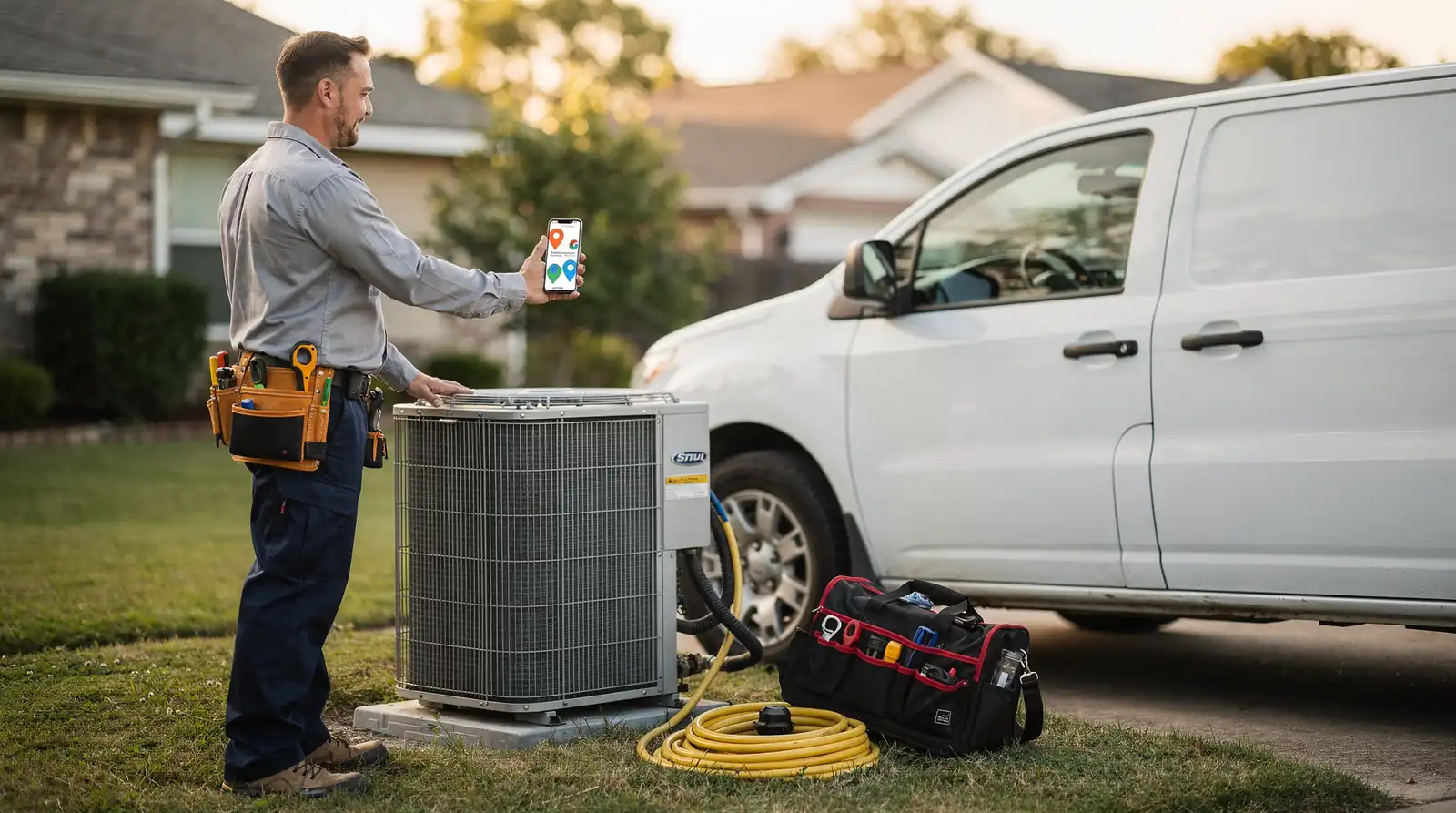
Start with your Google Business Profile
A hvac google business profile serves as the listing that appears in Google Maps and the map pack when homeowners search for heating and cooling services nearby. Without a complete, accurate profile, an HVAC company forfeits visibility to competitors who maintain theirs actively.
What category should an HVAC company select first?
The primary category must be HVAC contractor or Air conditioning contractor. Secondary categories apply only to services the business actually provides. Selecting the wrong primary category misdirects Google’s ranking algorithm and pushes the listing out of relevant local searches.
How should services appear in the profile?
List every service separately rather than grouping them under a single broad label. Furnace repair, AC installation, duct cleaning, and heat pump maintenance each deserve their own entry. This granular approach signals relevance for specific search queries and improves the profile’s ability to match homeowner intent.
A profile set up once and left alone slowly loses ground to competitors who keep theirs active. Service area boundaries, hidden address settings for businesses without a storefront, accurate emergency hours, and real project photos all require regular updates. The Google Business Profile optimization checklist walks through every field that needs attention. Neglecting these elements causes ranking erosion that compounds month after month.

Build a page for every service
A dedicated service page captures high-intent traffic from planned searches. Homeowners researching heat pump installation or AC replacement cost find these pages through Google Maps and Search, not through the homepage. Each page must address a single service with complete, specific information.
Hvac local seo depends on this structure. A service page that covers what the service is, signs it is needed, factors affecting cost, typical timeline, available brands, warranty details, financing options, and dispatcher FAQs answers every question a prospect brings to the search. Google rewards depth.
What should an HVAC service page include?
A complete service page converts visitors into calls. The content must follow a clear sequence:
- Define the service and when a homeowner needs it
- List warning signs that indicate immediate action
- Explain cost variables: equipment size, ductwork condition, efficiency ratings
- State the typical installation or repair timeline
- Name the brands carried and their warranty terms
- Outline financing options and qualification requirements
- Answer the questions dispatchers hear most often
Service pages win planned searches. Reviews and helpful content reinforce them, but the page itself carries the ranking weight. That’s where I start with any HVAC company that wants more planned work.
How many service pages does an HVAC company need?
One page per distinct service. Furnace repair, AC installation, duct cleaning, and heat pump replacement each deserve their own URL. Combining services onto a single page dilutes relevance. Hvac search engine optimization rewards specificity. I recommend that a company offering eight core services needs eight dedicated pages, each optimized for the exact phrase homeowners type into Google Maps and Search.
Cover your whole service area
A single Google Business Profile listing covers one address. HVAC companies serving multiple towns need a deliberate strategy to appear in searches across the entire footprint. Without it, visibility shrinks to a narrow radius while competitors capture calls from surrounding communities.
Geo-grid scans reveal exactly where a business ranks across its service area. These scans map ranking positions block by block, exposing weak zones where the profile fails to appear in the map pack. This diagnostic tool shows ranking distribution across every neighborhood a contractor claims to serve.
How do geo-grid scans improve HVAC local SEO?
Geo-grid technology pinpoints ranking gaps that generic reports miss. A contractor might rank first in one zip code and disappear completely two miles away. The scan quantifies that drop-off, giving hvac local seo efforts a precise target list rather than guesswork.
What content supports multi-town visibility?
Genuinely local town pages, reviews that mention specific communities, and local backlinks all strengthen signals for each target area. Reviews referencing “the furnace repair crew in Springfield” carry more weight than generic testimonials. Local links from chambers of commerce or community organizations reinforce relevance for those specific locations.
The combination of scan data and localized content transforms a single-location hvac google business profile into a multi-town asset. Rankings expand where the data shows opportunity, and content sustains those positions over time.
Reviews do double duty
Reviews fuel both trust and local search visibility. Every rating and written response signals relevance to Google’s algorithm while convincing homeowners to choose one contractor over another. HVAC local SEO depends on this dual function, where reviews strengthen prominence and drive conversion simultaneously.
How do reviews affect Google Maps ranking?
Reviews contribute directly to the relevance and prominence signals Google uses to rank businesses. A steady flow of new reviews keeps the profile active, which correlates with higher placement in the map pack. Stale profiles lose ground to competitors who maintain consistent review velocity.
What is the most effective way to collect HVAC reviews?
A systematic approach outperforms passive collection. The process works in two steps:
- The technician asks for a review at the end of each service call, while the positive experience is fresh.
- The technician texts the review link immediately, removing friction between intent and action.
This method converts satisfied customers into review contributors before they move on to other priorities. A proactive review generation system turns sporadic feedback into a predictable asset.
Replying to every review completes the cycle. Responses demonstrate engagement to both Google and prospective clients. An active reply history signals that the business monitors feedback and values customer input, which reinforces the trust component of the ranking equation.
Pair SEO with Local Services Ads
Local Services Ads capture urgent demand while SEO for HVAC companies builds long-term visibility. The two channels serve different moments in the customer journey. One converts homeowners who need service today. The other compounds authority for searches that repeat month after month.
How do Local Services Ads differ from standard Google Ads?
Local Services Ads operate on a pay-per-lead model, not pay-per-click. A contractor pays only when a prospective customer contacts the business through the ad. This billing structure protects marketing budgets from wasted clicks that never convert.
What sequence works best for an HVAC company?
- Launch Local Services Ads first to capture immediate service calls in Google Maps and Search.
- Run HVAC search engine optimization concurrently to build organic rankings.
- Shift budget toward organic visibility as rankings strengthen and lead costs decline.
I recommend this approach because contractors who skip the paid layer lose emergency repair calls to competitors already visible in the map pack. Those who rely on ads alone pay indefinitely for every lead. Pairing both channels creates a pipeline that converts today while HVAC local SEO reduces acquisition costs over time.
Plan around seasonality
HVAC demand follows predictable seasonal cycles. A Google Maps ranking strategy that ignores these cycles wastes budget during slow months and leaves revenue on the table when demand peaks.
HVAC search engine optimization requires timing content publication to match homeowner search behavior. Spring work pays off in summer. Contractors who publish maintenance agreement content during shoulder seasons capture homeowners planning ahead, not just those facing emergencies.
How should HVAC companies time their content calendar?
A seasonal content calendar aligns publishing with search volume shifts. Follow this sequence:
- Publish maintenance agreement content in early spring before cooling demand spikes.
- Refresh service pages and HVAC Google Business Profile listings with seasonal offers two weeks before each peak season.
- Post project photos and updates weekly during busy months to signal activity to Google’s local algorithm.
- Shift content focus to heating services in early fall, again before emergency calls surge.
Why do shoulder seasons matter for local rankings?
Shoulder seasons provide a window to build ranking authority without competing against emergency-driven search volume. Content published during these slower periods has time to index and gain relevance before homeowners begin searching urgently. A contractor who waits until the first heat wave to update their profile cedes the top three map pack positions to competitors who prepared months earlier. For a deeper look at how service pages and GBP optimization work together, the contractor SEO framework covers the full approach.
Make sure your website converts
A Google Maps ranking drives traffic. A website that fails to convert wastes that traffic. The site must present click-to-call buttons, booking tools, reviews, and licensing credentials in positions visitors see immediately. Mobile speed is non-negotiable. A slow-loading page loses the homeowner who needs service right now.
What elements must be visible for a high-converting HVAC website?
Four elements drive conversion for HVAC contractors. Click-to-call functionality belongs at the top of every page. Online booking reduces friction when a prospect is ready to schedule. Customer reviews displayed prominently build trust before the first phone call. Licensing information confirms legitimacy and removes a common objection. Each element answers a question the visitor is asking before they move to a competitor.
How important is mobile speed for HVAC website conversion?
Mobile speed determines whether a visitor stays or leaves. Homeowners searching for heating and cooling help use phones. A site that loads slowly on mobile devices abandons the lead to a faster competitor. Mobile speed is a requirement, not an option. Every second of delay shrinks the pool of potential customers who complete a call or booking.
How to tell if it’s working
Measuring success in HVAC local SEO demands tracking specific outcomes rather than vanity metrics. The most direct indicators are calls and booked jobs attributed to the Google Maps listing. A Google Business Profile for HVAC companies either generates service calls or it does not.
Calls and booked jobs by source reveal whether the profile converts search visibility into revenue. Geo-grid rankings show precisely where the business appears in the map pack across the service area. Reviews per month indicate reputation momentum, because profiles that accumulate fresh reviews consistently outrank stagnant ones.
What metrics matter most for HVAC Google Maps performance?
Three numbers tell the story. First, track calls and booked jobs by source every week. Second, monitor geo-grid rankings across each ZIP code the company serves. Third, count reviews added per month and the average rating. A profile with declining review velocity loses visibility even if nothing else changes.
How quickly do changes in HVAC search engine optimization show results?
HVAC search engine optimization adjustments to the profile, categories, or review cadence typically begin to show results in weeks; however, ranking across a whole service area usually takes several months of steady work. No one can promise a specific timeline. Calls and booked jobs follow as rankings improve. Profiles left unmanaged experience a slow erosion that accelerates when competitors increase their review velocity.
A simple HVAC SEO checklist
- Primary category set correctly
- Every service listed separately in profile
- Service area boundaries accurately defined
- Accurate emergency hours maintained
- Monthly photos posted to profile
- One dedicated page per service on website
- Top towns covered with genuinely local pages
- Technician asks for a review on every service call
- Respond to every customer review promptly
- Calls and booked jobs are tracked by lead source
FAQ
How long does HVAC SEO take?
HVAC SEO typically takes several months to show meaningful results. The timeline depends on competition, website authority, and the consistency of optimization efforts. A new campaign rarely delivers top rankings in weeks. Owners who commit to a sustained strategy see compounding returns as their HVAC Google Business Profile and website gain authority. From my experience, patience and steady effort are key to success.
Local Services Ads or SEO: which is better?
Local Services Ads and SEO for HVAC companies serve different purposes and work best when used together. Ads generate immediate visibility at a cost per lead. SEO builds organic, long-term visibility that does not require paying for each click. A balanced approach uses ads for quick calls while SEO matures, creating a pipeline that reduces reliance on paid channels over time.
Do I need a page for every town?
No. Start with your most important towns and make each page genuinely local with real jobs, reviews and local detail. A few strong pages do better than many near-copies, and pages that only swap the town name can be treated as doorway pages. This strategy better supports local relevance and avoids search penalties.
For how this fits into a full program, see HVAC marketing. To see where you rank across your service area today, start with the free geo-grid audit.
Conclusion
HVAC SEO is not a set-it-and-forget-it task. It demands consistent attention to the profile, the website, and the content calendar. Owners who commit to this system build a pipeline that generates calls without paying for every click. The next step is auditing the current profile and website against the conversion elements and seasonal timing outlined here.
About the author
Justin Smith is the founder of Ronin Communications, a fractional CMO practice for owner-led businesses. He spent more than 20 years writing and leading strategic communications for the federal government and holds an M.A. in Strategic Communications from American University.