
Local SEO for lawyers requires a complete, active Google Business Profile. Google’s map pack usually shows just three firms, near the top of the results. A profile set up once and abandoned loses ground to competitors who maintain current hours, photos, and a steady flow of reviews.
This article is educational, not legal or ethics advice. Each firm is responsible for its own advertising and should approve anything published in its name.
Key Takeaways
- Google’s map pack usually shows just three law firms.
- A profile set up once and abandoned loses ground to competitors who maintain current hours and photos.
- The primary category selection is the single most consequential field on the Google Business Profile.
- Never offer incentives for reviews, and check your state bar’s rules before asking.
Why local search matters for law firms
Location drives legal search behavior. Bare queries without a city attached are rare. Most prospective clients type terms like “divorce lawyer [city]” or rely on their device to supply location automatically.
That reality makes the attorney map pack the most valuable screen real estate a law firm can occupy. When a search triggers local results, Google displays only three firms at the very top of the page. Not ten. Three. Those positions usually sit above the organic listings, blog posts and directory entries.
Law firms outside those three spots face a hard truth. Many high-intent searchers never scroll past the map pack, so a firm ranking fourth misses many of the calls that come straight from it.
Local seo for attorneys changes that dynamic. A connected approach to law firm SEO combines profile optimization, review velocity, and citation consistency to signal relevance to Google’s local algorithm.
How does the map pack affect lead quality for law firms?
The map pack captures searchers ready to act. Someone checking hours or tapping a call button has already moved past research. These leads arrive with higher intent than those clicking through to a general practice-area page. Missing the map pack means losing the prospects closest to making a hiring decision.
What separates the three firms that show up from everyone else?
Google weighs three signals heavily. Relevance ties directly to how precisely a google business profile for lawyers matches the searcher’s query. Prominence reflects review count, ratings, and overall web authority. Proximity to the searcher’s location rounds out the equation. Firms serious about law firm local seo address all three signals systematically rather than chasing one while ignoring the others.
Local seo for lawyers builds visibility where it counts. When the phone rings less than the firm’s reputation suggests it should, the map pack is frequently the missing piece.
Google Business Profile for law firms
A Google Business Profile for lawyers determines which local searches a firm can appear in. The primary category selection is the single most consequential field on the profile.
What category should a law firm choose?
A general “Law Firm” category casts the widest net but puts the listing against every firm in the market regardless of specialty. Selecting specific categories like personal injury, family law, or criminal defense narrows that competition to searchers actually looking for that kind of representation.
How does the profile affect attorney map pack rankings?
An optimized, active Google Business Profile is a key ranking factor for the attorney map pack. Firms that leave profiles static lose ground to competitors who update categories, services, and photos consistently.
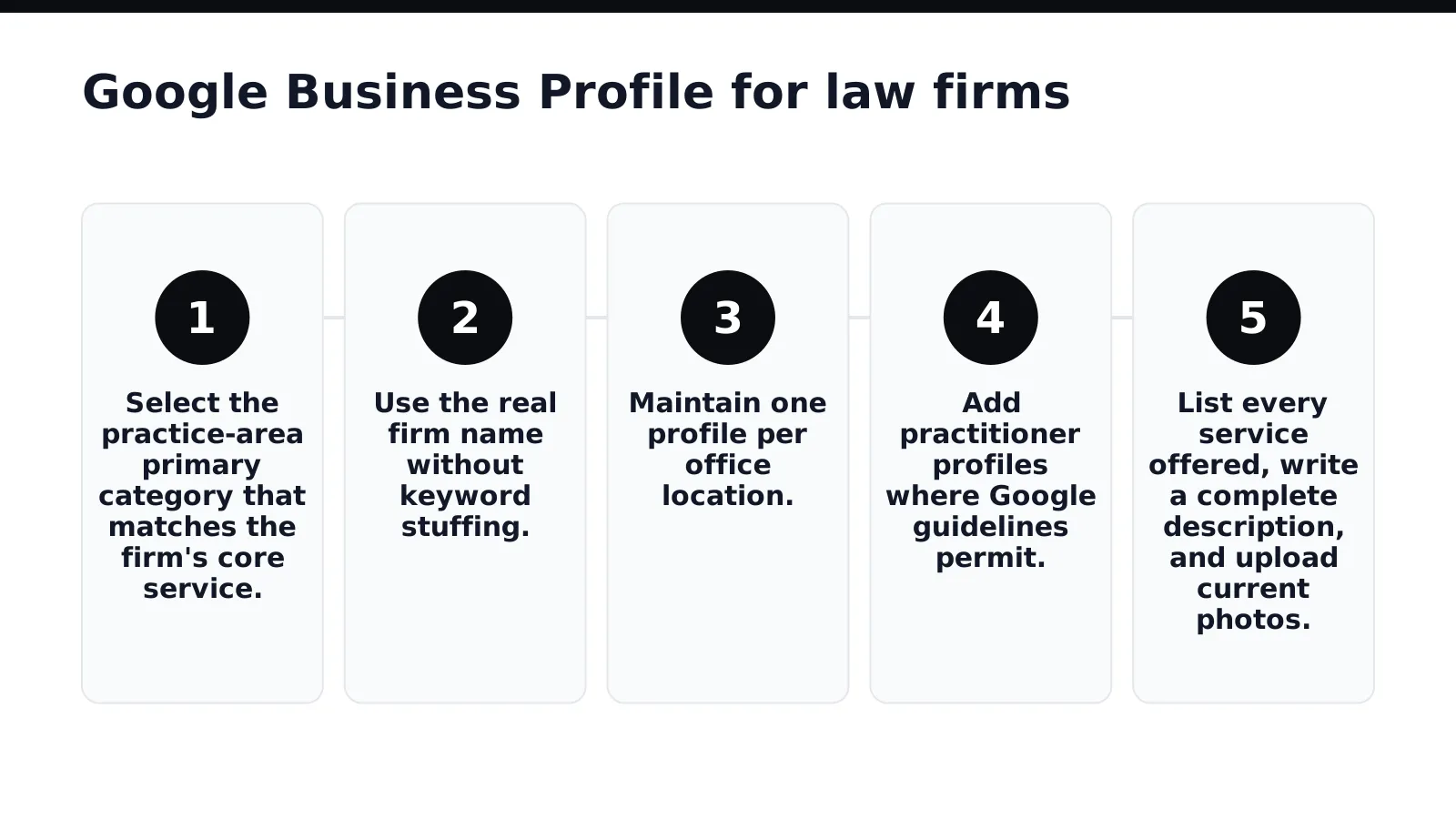
Follow these steps to configure the profile correctly:
- Select the practice-area primary category that matches the firm’s core service.
- Use the real firm name without keyword stuffing.
- Maintain one profile per office location.
- Add practitioner profiles where Google guidelines permit.
- List every service offered, write a complete description, and upload current photos.
Law firm local SEO starts with this foundation. A misconfigured category excludes a firm from searches it should win.

Practice-area and office pages
Dedicated practice-area and office pages form the backbone of local SEO for lawyers. A single homepage cannot rank for every service a firm offers. Separate pages aligned to each practice area and physical location give Google clear signals about what the firm does and where it does it.
Law firm local SEO depends on this structure. Office pages require a specific set of details to improve local relevance. Each page should include courthouse information, driving directions, and attorney profiles tied to that location. These elements tell search engines that the office serves a real geographic community and handles cases in that jurisdiction.
Practice-area pages demand a different approach. These pages must cover the legal process from start to finish. Key information includes first steps a client takes, fee structures, and what to expect during an initial consultation. A family law page that explains filing procedures and retainer costs converts better than one that only describes the firm’s experience.
What details belong on an office page for local SEO for attorneys?
An office page gains local authority when it includes the nearest courthouse by name and address. Clear driving directions from major highways build practical relevance. Individual attorney profiles with bar admissions connect the firm to the specific location for the attorney map pack.
How do practice-area pages strengthen a Google Business Profile for lawyers?
Practice-area pages act as landing destinations that reinforce the services listed on a firm’s GBP. Each page signals relevance for a distinct legal need. Firms expanding into new markets benefit from a location page SEO checklist before publishing multiple office pages.
Done well, these pages also become part of a documented marketing system the firm owns.
Reviews within the rules
Review generation for law firms operates under constraints other businesses never face. State bar rules govern what attorneys may ask, offer, and say. A firm that ignores these rules risks disciplinary action, not just a lost ranking.
Local SEO for attorneys depends on review velocity, but compliance comes first. The basics: check your state bar’s rules, offer no incentives and ask only after the matter has concluded.
What do state bar rules prohibit in review requests?
Rules vary by state, but the safe baseline is the same everywhere: offer nothing of value in exchange for a review. Google’s own policies prohibit incentives too. Some states also have rules about when and how you can ask.
How should a law firm ask for reviews?
- Confirm the matter has closed before any request.
- Send a direct link to the firm’s Google Business Profile for lawyers.
- Keep the request neutral, with no promised benefit.
- Never ask during active representation.
Public replies carry equal risk. A firm must never confirm a client relationship or discuss case details in any response. A simple acknowledgment of feedback stays compliant. The attorney map pack rewards review volume, but a disciplined process protects the license. Firms building a compliant review system benefit from law firm marketing guidance that respects advertising rules.
Directories and citations
Citations are structured mentions of a law firm’s name, address, and phone number on third-party websites. Consistent citations across legal directories and general platforms strengthen local SEO for lawyers by reinforcing the firm’s location data to search engines. Inconsistent or missing citations erode that signal and cost firms map visibility.
Which directories matter most for law firm citations?
Legal-specific directories carry outsized weight for law firm local SEO. The core set includes:
- Avvo
- Justia
- FindLaw
- Martindale-Hubbell
- State bar association listings
- Local bar association listings
General platforms also contribute citation value. Bing, Apple, Yelp, and BBB listings round out the citation profile and signal legitimacy beyond legal niches.
How should a firm build citations systematically?
- Audit existing listings across every legal directory and general platform.
- Standardize the firm’s name, address, and phone number into one exact format.
- Claim and complete each profile, starting with Avvo, Justia, FindLaw, and Martindale-Hubbell.
- Submit the firm to state bar and local bar directories.
- Create or verify listings on Bing, Apple, Yelp, and BBB.
- Recheck all listings quarterly for drift or duplicate entries.
A structured approach to local SEO for attorneys treats citation building as infrastructure, not a one-time task. Firms that skip the audit step often discover conflicting addresses across directories, which weakens the attorney map pack signal. The local citation building guide details the tiered structure behind effective citation work.
Local links
Local links anchor a law firm’s authority in its geographic market. Community organizations, bar associations, and legal aid groups provide the most relevant link sources for local SEO for lawyers.
A firm’s link profile signals local relevance to Google’s ranking systems. Links from trusted local institutions carry more weight than generic directory citations.
How do law firms earn local backlinks?
Follow these steps to build a defensible local link profile:
- Join the local chamber of commerce and secure a member directory listing.
- Sponsor community events where the organization links to sponsor websites.
- Volunteer with legal aid groups that publish partner or supporter pages.
- Request a profile link from the county or state bar association.
Each step produces a citation from an organization Google already trusts. These links reinforce the firm’s standing in law firm local SEO.
What types of local links matter most for attorneys?
Links from bar associations and legal aid organizations carry the strongest relevance signals for local SEO for attorneys. Chamber of commerce memberships and event sponsorships add geographic context. A mix of both strengthens the attorney map pack position.
Firms that neglect local link building lose ground to competitors who maintain active community relationships. The Google Business Profile for lawyers performs better when supported by a credible local link profile.
Advertising rules to keep in mind
Attorney advertising rules impose strict limits on what law firms may publish. No guarantees, no “specialist” claims, and no “expert” labels appear in compliant legal marketing. Violating these rules risks disciplinary action from state bar associations.
Law firm owners must treat every published word as a regulated statement. The firm approves all content before publication. That approval process protects the firm from claims that misrepresent outcomes or credentials.
What claims should law firms avoid in local SEO content?
State bar rules prohibit promises about case results. A personal injury firm cannot state that clients will recover a specific amount. An estate planning practice cannot call itself the “best” or “most experienced” in its market.
The safest approach removes superlatives and outcome guarantees entirely. Content describes services, practice areas, and qualifications without overstating them.
Who is responsible for attorney advertising compliance?
Each law firm bears responsibility for its own advertising. The firm approves anything published in its name. That responsibility does not transfer to an agency or marketing partner.
A law firm local SEO strategy must therefore include a review step. The managing partner or a designated attorney reviews every page, post, and profile update before it goes live. This review catches prohibited language before publication.
- Draft all local SEO content without guarantees or specialist claims.
- Submit the draft to the firm’s designated reviewer.
- Obtain written approval before publishing to the website or Google Business Profile for lawyers.
- Document the approval for compliance records.
Firms that skip this review expose themselves to bar complaints. The cost of a complaint outweighs any speed gained by publishing without approval.
How to measure it
Measuring local SEO for lawyers requires tracking specific metrics that connect search visibility to revenue. For many firms the map pack drives a large share of inbound calls, and firms outside the top three positions miss many inquiries before a prospect ever visits a website.
What metrics matter most for law firm local SEO?
Three metrics reveal whether law firm local SEO efforts produce results. Track these monthly.
- Maps Pack ranking position. Monitor where the firm appears for primary practice area searches in its city. Dropping out of the top three usually costs calls.
- Google Business Profile insights. Review search queries that trigger the profile, direction requests, and website clicks. These show how prospects find the firm.
- Inbound call volume from local search. Use call tracking numbers on the Google Business Profile for lawyers listing. Separate these calls from website form fills and paid ads.
How do firms know if the attorney map pack is working?
The attorney map pack works when qualified calls increase. A firm ranking in the top three for “divorce lawyer [city]” should see inquiries from that search show up in its call tracking. Flat or declining call volume despite stable rankings signals a conversion problem on the profile itself. Missing photos, outdated hours, or slow review responses erode trust. Firms that track call source data identify which practice area searches drive revenue and which need additional optimization.
FAQ
How does the attorney map pack decide which firms appear?
An optimized, active Google Business Profile for lawyers anchors law firm local SEO success. The profile supplies the signals Google reads when assembling the attorney map pack for a law firm search. Firms that neglect the profile compete at a structural disadvantage.
What steps build a stronger local presence for a law firm?
Local SEO for attorneys follows a defined sequence. Execute each step in order: 1. Claim and verify the firm’s Google Business Profile. 2. Select categories that match the practice areas the firm wants to rank for. 3. Keep hours, services, and photos current. 4. Earn a steady flow of reviews. 5. Maintain the profile continuously, because a listing set up once and left alone loses ground to active competitors.
Conclusion
Local SEO for lawyers demands consistent execution across three pillars: a verified Google Business Profile, compliant content, and locally relevant links. Firms that maintain all three earn the attorney map pack position that drives qualified calls. The firm that treats local SEO as a one-time setup loses ground to competitors who keep their profiles active, their content compliant, and their community relationships current.
For how I approach this work, see law firm marketing and the Google Business Profile guide. To see where your firm ranks across your area, start with the free geo-grid audit.
About the author
Justin Smith is the founder of Ronin Communications, a fractional CMO practice for owner-led businesses. He spent more than 20 years writing and leading strategic communications for the federal government and holds an M.A. in Strategic Communications from American University.