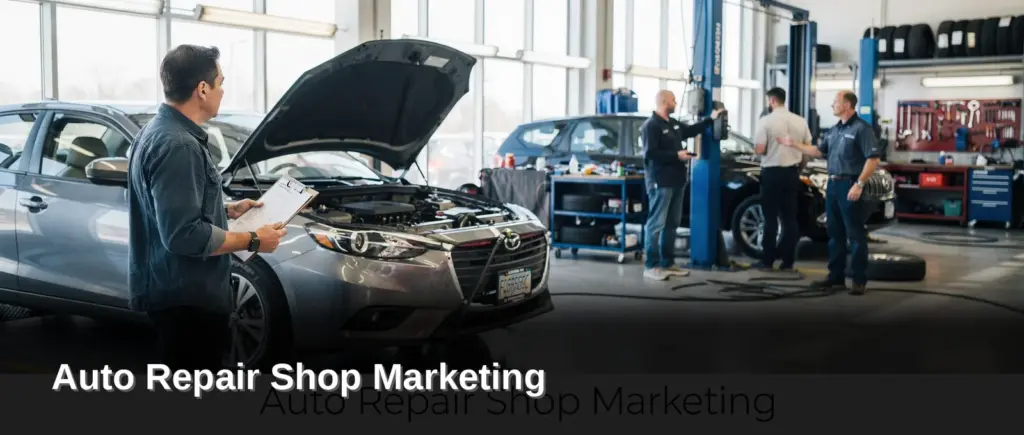
Consistent Google Business Profile management, targeted local SEO, and a steady flow of positive reviews fill auto repair bays. A documented strategy, not scattered tactics, builds predictable pipeline and enterprise value, and that strategy should include auto repair shop marketing ideas.
Key Takeaways
- A documented strategy, not scattered tactics, builds predictable pipeline and enterprise value.
- Drivers decide quickly, scanning star ratings and distance before calling one shop.
- A nearby shop with strong, recent reviews usually wins over a farther shop with weaker ones.
- A single review mentioning an upsell attempt can send a driver to the next shop on the list.
How drivers choose a repair shop
Drivers no longer call around for recommendations when a warning light appears. A Google search or a local Facebook group query now launches the process. The whole decision often happens in a few minutes, on a phone, usually in a parking lot. This compressed timeline means shop owners lose every job where their business never appears on that short list of results.
What happens in those few minutes? Someone searches, scans a handful of shops with star ratings and distance, reads two or three reviews, and calls one. That is the whole funnel. Trust acts as the deciding factor. Marketing for auto repair shops succeeds or fails based on whether the business shows up during those few minutes.
What do drivers look at first in search results?
Star ratings and proximity dominate the initial scan. A nearby shop with strong, recent reviews usually gets the call over a farther shop with weaker ones. The map pack shows only three listings before a user must click to expand. Missing the top three costs a shop many of the calls that come straight from the map.
Why do reviews matter more than price?
Drivers reading two or three reviews are not comparison-shopping labor rates. They want confirmation of honest diagnostics and clear communication. Ranking factors tied to relevance and prominence drive local visibility, and authoritative Google Business Profiles directly influence which shops populate that critical short list.
Google Business Profile: the most important listing you have
The Google Business Profile is the listing that appears in Google Maps and the map pack when a driver searches for a repair shop nearby. Google states that local results rest mainly on three factors: relevance, distance, and prominence. A shop that ignores this listing cedes the map pack to competitors who maintain theirs.
Completeness drives relevance. Owners should fill in every field accurately, select the right primary and secondary categories, and list every service the shop performs. Current hours, fresh photos, and accurate attributes reinforce the same signal. Reviews supply the prominence piece, and a steady flow of them outperforms a burst followed by silence.
What happens when a profile goes stale?
A profile set up once and left alone slowly loses ground to competitors who keep theirs active. Hours drift out of date, photos age, and review volume stalls. Each gap weakens the shop’s standing in local results.
Which fields matter most for an auto shop?
Start with the primary category, then add specific secondary categories that match the work performed. Inspections, hours, photos, and attributes round out the listing. A structured Google Business Profile checklist keeps every field current.
Reviews that build trust
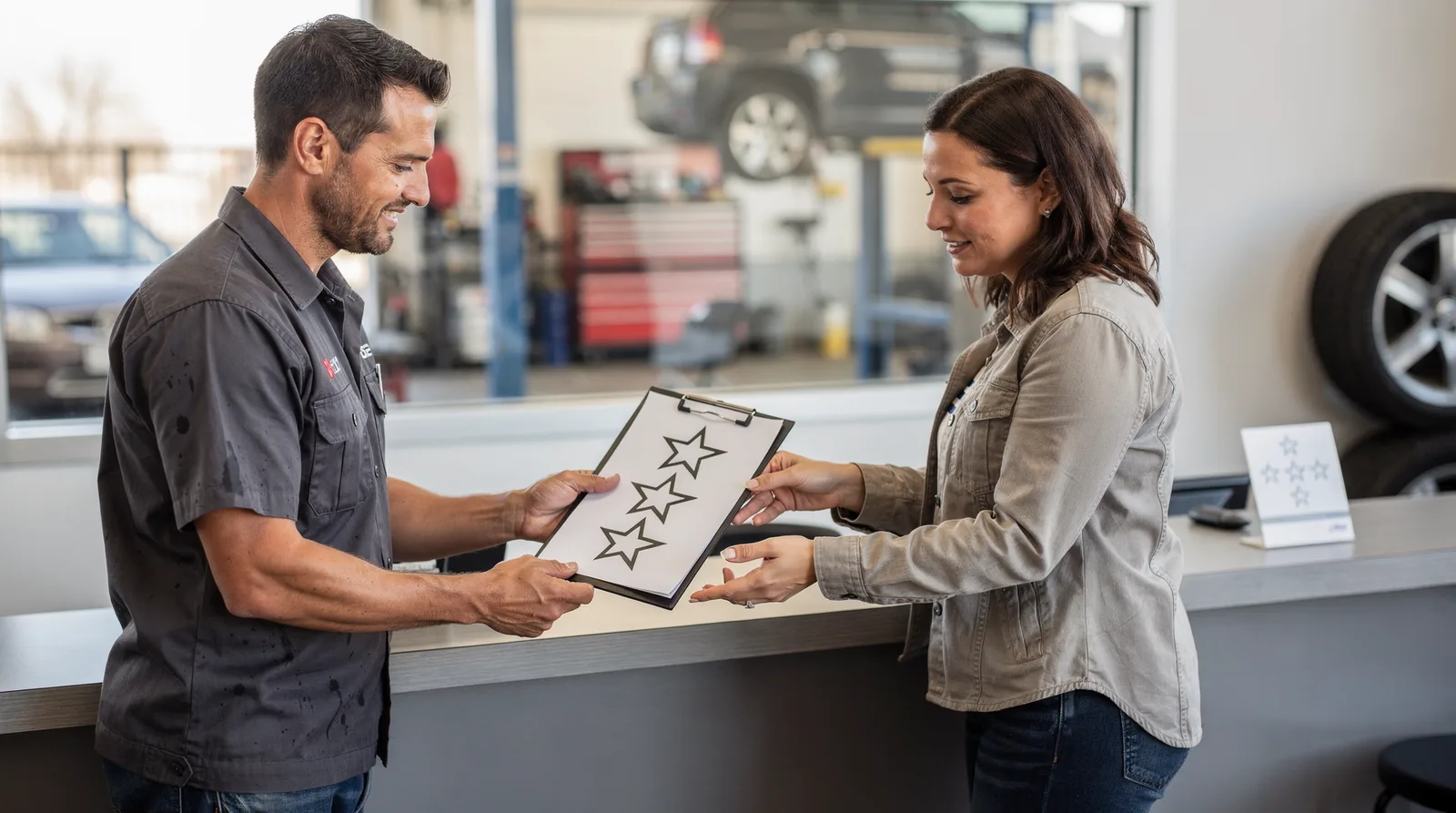
Every review builds or erodes trust with potential customers. Auto repair shop marketing hinges on that trust because drivers choose a shop in a few minutes, usually from a short list ranked by star ratings and distance. A shop with sparse or negative reviews never makes that list.
Google rewards active profiles. Marketing for auto repair shops must include a steady flow of reviews to keep a Google Business Profile competitive. Every recommendation and online mention shapes a shop’s reputation. A profile that collects reviews consistently stays visible. One that sits idle loses ground to competitors who keep theirs active.
Why does review velocity matter for local rankings?
Google interprets fresh reviews as a signal that a business is active and relevant. A profile receiving new reviews weekly appears in the map pack more often than one with older, stagnant feedback. Shops that pause review collection see their visibility decline over time, even if nothing else about their profile changes.
Auto shop SEO treats reviews as a core component, not a separate service. Reviews and Google Business Profile optimization live inside the same local SEO strategy. A review generation system turns that work from a sporadic effort into a repeatable process that compounds month after month.
What makes a review strategy sustainable?
A sustainable approach ties review requests to specific service triggers. After a brake job or timing belt replacement, the shop sends a simple, low-friction request that takes the customer directly to the review form. This removes guesswork. Technicians and service writers know exactly when to ask, and customers face no unnecessary steps. Consistent execution builds the review velocity that search engines reward while reinforcing the trust that turns a first-time caller into a long-term customer.
A website built for booking
An auto repair shop’s website serves one primary function: converting a visitor into a booked appointment. The difference between a browser and a customer often comes down to how quickly and easily that booking happens. A site loaded with stock photos and vague service descriptions loses the prospect before the phone number is ever dialed.
Auto repair shop marketing starts with a site built around specific, bookable services. Every page must answer the questions a driver asks while standing in a parking lot with a grinding brake. Click-to-call buttons and online booking tools remove friction. Service pages listing makes, models, warranty details, and estimate processes build the trust needed to complete the booking. Generic content fails here. A page that names the exact vehicle and the exact repair converts.
What website elements directly increase booking rates?
Service pages structured by specific repair types, rather than broad categories, give drivers the precise information they seek. Online booking integrated directly into the header removes the need to hunt for contact information. Clear warranty language and estimate explanations address the two biggest unspoken objections a new customer brings.
How does a website affect a shop’s future sale value?
A buyer looking at a business needs to see documented marketing systems that hold up in due diligence. The website represents the most visible piece of that system. A marketing strategy document that covers the ideal customer, positioning, offer, channel plan, budget, tracked metrics, and sequenced roadmap a future buyer would see turns the site from a brochure into a documented asset. A written strategy fixes accountability, continuity, and value for a future buyer. Without it, the website is just one more opinion in a folder of unconnected tactics.
Keep customers coming back
Retention tools keep customers coming back, and they cost far less than acquiring new ones. Reminders, follow-ups, and loyalty programs form the core of that system for independent shops. Most successful marketing strategies come down to creating the right customer touchpoints, building trust, and making it easy for customers to choose a shop over the competition.
Relying on word-of-mouth alone eventually stalls growth. Regulars only have so many friends and coworkers to send your way. A shop of that size cannot scale on referrals alone, and the gap shows up as flat bays and idle technicians.
What retention tactics work for auto repair shops?
Service reminders, digital inspections with photos, follow-up, and seasonal checks anchor a retention program. Each touchpoint gives the customer a reason to return before a small issue becomes a costly repair. Documented follow-up also builds the kind of predictable revenue that supports recurring revenue architecture and a stronger valuation.
How should a shop sequence retention efforts?
Start with the touchpoints already in reach. Then layer loyalty incentives on top.
- Service reminders tied to mileage or time
- Digital inspections with photos sent to the customer
- Post-service follow-up
- Seasonal maintenance checks
Each item adds a reason to return. Together they turn a one-time repair into a relationship the shop controls.
Local search beyond your neighborhood
For an independent shop, local search is not one channel among many. It is the channel. A driver types “brake repair near me” and Google returns a map with three shops. Shops outside that map pack lose the job before the phone ever rings.
Auto repair shop marketing succeeds or fails in that short window. The shop must appear in the local pack, carry a strong star rating, and show recent reviews. I treat auto shop SEO as the foundation of a shop’s growth plan, not an afterthought. It also strengthens the profile a buyer examines during due diligence.
Why does the Google map pack matter more than the website?
The map pack sits above organic results on mobile. It occupies the entire screen. A shop with a complete Google Business Profile and steady review velocity claims one of those three spots. Shops without that presence become invisible to drivers searching with intent to book.
How does local SEO connect to enterprise value?
My approach starts by mapping what exists, then builds the foundation and grows through steady campaigns. A local SEO strategy that documents ranking factors, review cadence, and profile optimization creates an asset a buyer can audit. Multiplying worth means sharpening and automating those marketing systems so the shop runs without the owner’s daily presence.
Paid options
Paid advertising accelerates auto repair shop marketing when every dollar connects to a measurable outcome. Local Services Ads and search ads tracked by booked appointments deliver the strongest return for independent shops. Social ads build awareness, but awareness alone does not fill bays. These are the core paid options in auto repair marketing for shops competing in local search.
Which paid channels work best for auto repair shops?
Local Services Ads place a shop at the top of Google results with a booking-ready format. Search ads capture drivers actively looking for repairs. Social ads support awareness campaigns. Each channel serves a distinct role, but all three require appointment tracking to prove value.
How should a shop owner evaluate paid advertising spend?
Every dollar should tie back to a written plan. A documented strategy lets an owner tell what is working and hold vendors accountable. Without that framework, paid campaigns become an expense without evidence. I structure paid media management around booked customers, not ad spend, so performance stays visible.
The discipline is simple. Track booked appointments. Compare channel costs. Cut what does not produce work.
Measure car count, not clicks
Most auto repair shop marketing reports celebrate vanity metrics. Impressions rise. Clicks climb. Yet the bays stay empty. The disconnect comes from tracking what is easy instead of what matters. A shop owner needs to know how many vehicles roll through the door, not how many browsers landed on a homepage.
Marketing for auto repair shops succeeds when measurement shifts to outcomes a future buyer will underwrite. I build the work around the metrics a buyer actually underwrites: pipeline predictability, retention, customer concentration, and how transferable the marketing function is when due diligence starts. Clicks do not appear on that list.
What numbers belong in a marketing strategy document?
A written strategy document should include the numbers the shop tracks. A complete document has seven parts, and tracked metrics are one of them. Without defined numbers, the strategy becomes a collection of opinions rather than a framework a team or a future buyer can follow.
Why does enterprise value matter more than revenue?
Revenue growth alone does not increase what a shop is worth. That’s why I focus on enterprise value, not revenue alone.A shop with documented systems, predictable car count, and transferable marketing processes commands a higher multiple than one running on ad hoc campaigns and rising click counts.
FAQ
How quickly do auto repair shops see results from a fractional CMO?
Most clients see early results within 30 days. I build momentum through systematic improvements rather than one-off campaigns. Early wins typically come from fixing broken tracking, tightening local listings, and aligning offers with what drivers actually search for.
What does a typical engagement look like?
Engagements are ongoing, typically 1 to 2 years, not one-time projects or sprints. This timeline reflects the reality that auto repair shop marketing requires sustained effort. A shop cannot build a predictable pipeline in a month. I work alongside the owner, maps existing systems, builds foundational infrastructure, and then scales what works.
Who leads the strategy?
I do. I spent more than 20 years in federal strategic communications and hold an M.A. in Strategic Communications from American University. I bring the same discipline to marketing for auto repair shops.
What kind of shops do you work with?
I work with owner-led businesses doing $1 million to $10 million a year. That includes independent auto repair shops, along with roofing, HVAC, plumbing, law firms and accounting practices. Owners in that range get a marketing leader who understands running a business where the owner still signs every check.
Conclusion
The decision to fill bays comes down to choosing a system over a campaign. A shop that documents its marketing, tracks booked appointments, and builds a local presence a buyer can audit creates value beyond the work in the garage. That discipline turns marketing from an expense into an asset. The next step is mapping what exists and closing the gaps that keep the bays empty.
For the full approach, see auto repair marketing and how to get more Google reviews. To see where your shop shows up on the map, start with the free geo-grid audit.
About the author
Justin Smith is the founder of Ronin Communications, a fractional CMO practice for owner-led businesses. He spent more than 20 years writing and leading strategic communications for the federal government and holds an M.A. in Strategic Communications from American University.