
Maintenance agreements transform HVAC lead generation from one-off emergency calls into predictable recurring revenue. A maintenance walkthrough creates real service conversations, not repair requests. That documented pipeline increases enterprise value and survives buyer due diligence.
Key Takeaways
- Maintenance agreement members and past customers form the most predictable lead base without per-lead acquisition costs.
- Documenting each channel’s cost per lead and close rate shifts budget toward sources producing contract work.
- Technicians on every service call convert repair visits into maintenance conversations without additional marketing spend.
- A signed agreement schedules visits in February, replacing empty trucks with booked work.
Where HVAC leads come from
HVAC leads originate from seven distinct channels, each with different economics and conversion profiles. Owners who rely on a single source expose the business to seasonal volatility and pricing pressure.
What are the most reliable sources for recurring HVAC work?
Maintenance agreement members and past customers form the most predictable lead base. These owned sources generate recurring service calls without per-lead acquisition costs. Growing maintenance contracts remains a constant struggle for most HVAC teams, yet the payoff is a steady base of work that referrals and emergency repairs cannot match.
Which channels deliver new local demand?
A Google Business Profile is a primary source for local hvac leads, showing in maps and map packs for service area searches. Website and organic search capture buyers researching solutions. Local Services Ads and search ads buy visibility for competitive terms. Lead marketplaces sell shared leads to multiple contractors, which dilutes exclusivity and increases competition. Homeowner marketplaces flood contractors with one-off repair calls rather than contract work.
How do owners build a lead mix that survives slow seasons?
Hvac lead generation succeeds when owned sources outweigh purchased ones. Hvac service agreements convert one-time repairs into scheduled maintenance revenue. Owners who document each channel’s cost per lead and close rate can shift budget toward sources that produce contract work, not just emergency calls.

Why maintenance agreements matter so much
HVAC maintenance agreements convert unpredictable repair calls into booked, recurring work. The core shift: shops that fill schedules year-round change what they sell during slow months, moving from reactive service calls to proactive contracts. Without that shift, owners face the feast-or-famine cycle that drains cash flow every February.
Agreement members receive first call on repairs. That priority status creates a steady pipeline of service opportunities, not a scramble for one-off jobs. Growing maintenance contracts remains a constant struggle for most HVAC teams, but the payoff compounds.
What do maintenance agreements do for slow-season revenue?
They book work before the slow season arrives. A signed agreement means scheduled visits in February, not empty trucks. The pipeline stays warm when demand drops.
Why do buyers value maintenance agreements during a sale?
Buyers underwrite metrics like pipeline predictability, retention, and customer concentration. Recurring revenue from hvac service agreements signals exactly that. I build marketing around those same metrics, including how well the marketing function transfers to a new owner. A documented recurring revenue architecture strengthens the valuation case.
- Booked work in slow seasons
- First call on repairs
- Replacement opportunities from routine inspections
- Recurring revenue buyers value
Owners who ignore hvac lead generation built on agreements lose the valuation premium that predictable revenue commands.
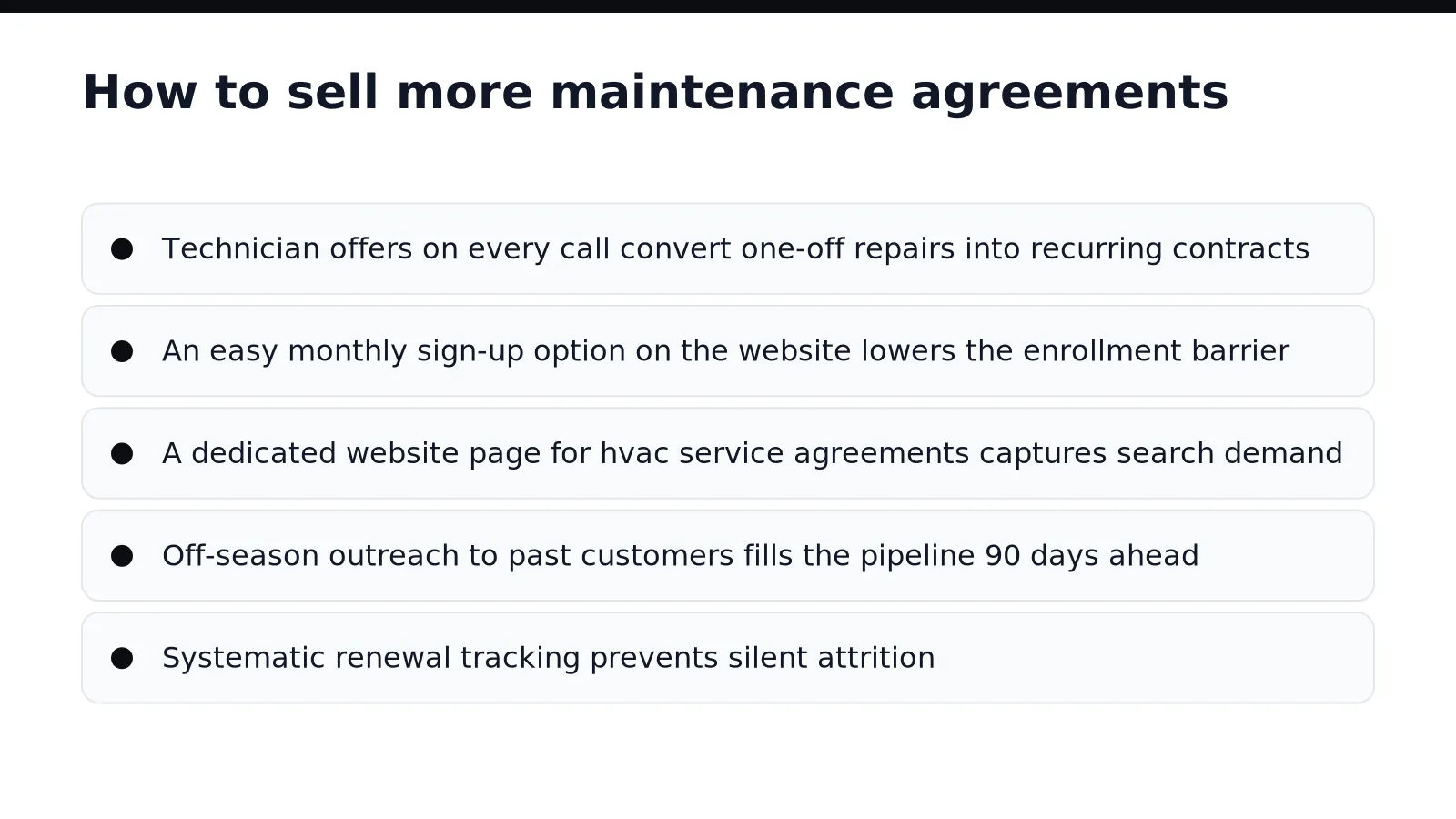
How to sell more maintenance agreements
Selling more hvac maintenance agreements turns irregular repair revenue into predictable, recurring income. Without a deliberate sales process, most shops leave contract growth to chance and stay trapped in one-off emergency work.
The most direct path starts with technicians on every service call. Technicians already stand inside the building, seeing the equipment, and speaking with the decision-maker. Converting that repair visit into a maintenance conversation builds the contract base without additional marketing spend.
Why do most HVAC companies struggle to grow maintenance contracts?
Most teams rely on referrals, emergency repairs, and one-off jobs to drive demand. That model does not work for building a steady base of maintenance work. It leaves revenue at the mercy of weather and equipment failures.
Five tactics shift the model toward maintenance volume:
- Technician offers on every call convert one-off repairs into recurring contracts
- An easy monthly sign-up option on the website lowers the enrollment barrier
- A dedicated website page for hvac service agreements captures search demand
- Off-season outreach to past customers fills the schedule ahead of the season
- Systematic renewal tracking prevents silent attrition
When should a contractor reach out to sell more agreements?
Off-season outreach turns slack periods into contract-signing windows. In my experience, shops that build an outreach system fill their schedule ahead of the season instead of reacting to whatever the phone brings in this week. Contacting past customers and unsold estimates before peak demand arrives locks in commitments when competitors are idle.

Capture urgent demand well
Urgent HVAC demand disappears when a business fails to respond. A well-optimized Google Business Profile captures local searches for emergency repairs and same-day installations. Without it, competitors appear in the map pack and claim those calls first.
How does a Google Business Profile capture urgent HVAC leads?
The profile surfaces in Google Maps when a property owner searches for immediate help nearby. Filling every field accurately, selecting the right categories, and listing all services positions the business for high-intent queries. Current photos and accurate hours signal reliability to both Google and the searcher.
What converts an urgent call into a booked job?
Answering the phone promptly during business hours converts urgent calls into booked jobs. Missed calls during a heatwave or equipment failure send revenue straight to the next listing. Staffing for immediate response protects the pipeline when demand spikes.
Local Services Ads prove effective during peak seasons for capturing time-sensitive, high-intent hvac leads. These ads appear above organic results and connect directly with buyers ready to schedule. Pairing them with dedicated service pages that detail emergency offerings and hvac service agreements creates multiple capture points for urgent demand. The combination prevents leads from leaking to faster-moving competitors.
Bought leads: when they make sense
Bought hvac leads fill pipeline gaps when owned channels run dry. Shared leads sold to several companies lack exclusivity, but they keep technicians scheduled during slow weeks. The tradeoff is straightforward: volume arrives fast, yet competitors receive the same contact information.
When do shared leads work best?
Shared leads suit emergency repair demand and short-term capacity gaps. A contractor with idle crews in February gains immediate call volume. The cost is competitive pressure, since multiple shops pursue the same prospect.
When do bought leads fail?
Bought leads fail when owners expect them to build hvac maintenance agreements. Homeowner marketplaces flood contractors with one-off repair calls. Winning maintenance agreements, install projects, and multi-site service work takes a different approach and a different kind of partner.
The strategic position is clear. Bought leads supplement owned lead sources; they never replace them. Growing maintenance contracts is a constant struggle that paid lead volume does not solve.
Lead generation companies for contract work fit specific goals, budgets, and support levels. Each option matches a particular sales model and closing process. Owners pursuing hvac service agreements need partners targeting higher-value jobs, not shared repair inquiries.
Don’t forget past customers
Past customers represent the most overlooked asset in hvac lead generation. These homeowners already trust the company’s work. They know the technicians. They have equipment that ages every season.
Reactivation usually costs far less than winning a stranger. A seasonal reminder postcard or email triggers immediate service calls. It also surfaces hvac maintenance agreements that lapsed quietly. Growing maintenance contracts is a constant struggle for most HVAC teams. The easiest renewal sits in the database, not on a billboard.
What reactivation tactics work best for hvac service agreements?
Three specific touchpoints move past customers back into the pipeline. Seasonal reminders prompt tune-up bookings before peak heating or cooling months. Post-install review requests generate referrals while the satisfaction is fresh. Replacement check-ins flag aging systems before a failure forces an emergency purchase.
How do past customers generate new hvac leads?
Satisfied homeowners become referral engines with minimal prompting. A post-install review request captures the testimonial. A direct referral ask follows while the relationship is warm. Each completed job creates a node in a network that produces hvac leads without additional ad spend. The company that ignores its install history leaves those connections dormant.
Measure what each lead is worth
A lead’s value is not the same as its cost. Tracking leads, booked jobs, and revenue per job by source reveals which channels deliver the best return. Without this data, marketing budgets leak into activities that generate noise instead of profit.
Most contractors track cost per lead. That number misleads. Cost per booked job is a more meaningful metric for evaluating hvac lead generation efforts. It measures what actually reaches the truck.
Which metrics matter most for lead value?
Three numbers separate profitable growth from busywork:
- Revenue per job by source identifies which channels attract high-value work
- Cost per booked job reveals true acquisition efficiency
- Agreement sign-ups by source show which marketing channels sell hvac service agreements effectively
How do agreement sign-ups change lead valuation?
A single hvac maintenance agreement sign-up generates recurring revenue over multiple years. That changes the math. Tracking agreement sign-ups by source helps identify which marketing channels are most effective for selling hvac service agreements. Companies that ignore this metric undervalue their best lead sources.
Growing maintenance contracts is a constant struggle for commercial contractors. The shops that win treat lead measurement as a financial exercise, not a marketing report. They connect every booked job to its source and calculate the long-term revenue each channel produces. This discipline transforms lead generation from a cost center into a predictable growth engine.
FAQ
How to get hvac leads from existing customers?
The most reliable path runs through hvac maintenance agreements. A maintenance walkthrough creates a real maintenance conversation, not a one-off repair request. That conversation gives a team the context needed to define service scope and convert a repair customer into a contract customer. Past customers already trust the company. They cost nothing to reach.
Are bought leads better than owned sources?
Bought leads flood a pipeline with one-off repair calls. Hvac service agreements built from walkthroughs and past customers produce recurring revenue instead. The cost question matters less than the quality question. A purchased lead costs money every time. An owned lead compounds. The honest answer: owned-source strategies take longer to build but deliver predictable, repeatable work.
Conclusion
The pipeline that produces maintenance agreements does not run on shared leads or emergency calls. It runs on past customers, seasonal reactivation, and measurement that tracks agreement sign-ups by source. Owners who build around these elements stop chasing one-off repairs and start compounding recurring revenue. The decision is not which lead source to buy. It is which infrastructure to build.
For how this fits into a full program, see HVAC marketing and HVAC SEO. To see where you rank across your service area, start with the free geo-grid audit.
About the author
Justin Smith is the founder of Ronin Communications, a fractional CMO practice for owner-led businesses. He spent more than 20 years writing and leading strategic communications for the federal government and holds an M.A. in Strategic Communications from American University.